




Carnassial teeth are modified for
A)Crushing
B)Grinding
C)Tearing
D)Cutting
Answer
 Verified
611.4k+ views
Hint: The paired upper and lower teeth - molars and premolars and molars are Carnassials. In several groups of carnivorous mammals, the modification in the Carnassials arose separately. Mostly carnivorous animals have these teeth and humans lack these types of teeth.
Complete answer:
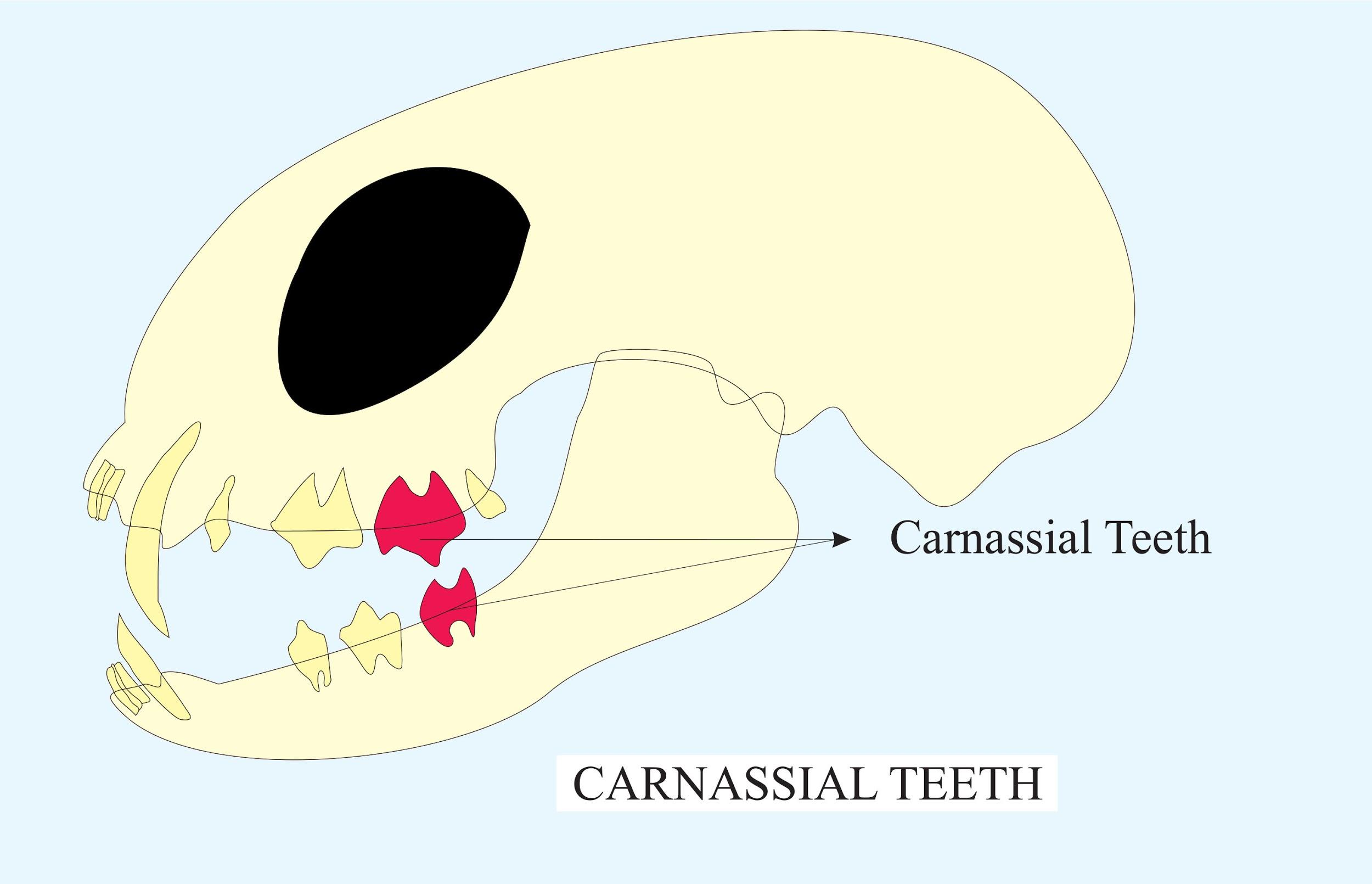
-The highly modified fourth upper premolars and the first lower molar teeth indicate the ancestral features that all the mammals evolved from the common lineage. These tips are adopted to tear flesh.
-These teeth (four teeth) are called; Carnassial teeth as their edges are knife-like so that they can slide past one another and when the jaw closes they act like scissors.
-The other features which are common to all the carnivorous are their restricted vertical movement of the jaw which helps the carnassial teeth to function.
-These modifications of the teeth can also be seen in a number of different mammals groups also.
Additional Information: -The dental formula of carnivorous animals is -
Incisors 3/3, Canine 1/1, Premolar 4/4, Molars 3/3, so there are a total of 44 teeth with well-developed canines.
-Many variations can be seen in the basic dental formula in some carnivorous animals due to the adaptation of animals to various diets. Many carnivorous animals have less than 44 teeth due to the reduced number of premolars, and molars.
-Many carnivorous animals like lions that eat meat from other vertebrates or invertebrates have well developed Carnassial teeth.
-The organisms that have a mixed diet of meat and vegetables, Carnassial teeth have been adapted from herbivorous to omnivorous animals. The premolars and molars are modified to grind vegetable matter.
-The few species which have adapted these teeth are Pandas to feed on bamboo, Walruses on mollusks, and crab-eating seals on krill.
So, the correct answer is,” tearing”.
Note: -The force generated by the mastication muscles allow Carnassial teeth for efficient tearing and cutting of flesh, tendon, and muscles.
-The carnival takes varies between species and the basis of length and size.
-Humans don't have Carnassial teeth.
Complete answer:
-The highly modified fourth upper premolars and the first lower molar teeth indicate the ancestral features that all the mammals evolved from the common lineage. These tips are adopted to tear flesh.
-These teeth (four teeth) are called; Carnassial teeth as their edges are knife-like so that they can slide past one another and when the jaw closes they act like scissors.
-The other features which are common to all the carnivorous are their restricted vertical movement of the jaw which helps the carnassial teeth to function.
-These modifications of the teeth can also be seen in a number of different mammals groups also.
Additional Information: -The dental formula of carnivorous animals is -
Incisors 3/3, Canine 1/1, Premolar 4/4, Molars 3/3, so there are a total of 44 teeth with well-developed canines.
-Many variations can be seen in the basic dental formula in some carnivorous animals due to the adaptation of animals to various diets. Many carnivorous animals have less than 44 teeth due to the reduced number of premolars, and molars.
-Many carnivorous animals like lions that eat meat from other vertebrates or invertebrates have well developed Carnassial teeth.
-The organisms that have a mixed diet of meat and vegetables, Carnassial teeth have been adapted from herbivorous to omnivorous animals. The premolars and molars are modified to grind vegetable matter.
-The few species which have adapted these teeth are Pandas to feed on bamboo, Walruses on mollusks, and crab-eating seals on krill.
So, the correct answer is,” tearing”.
Note: -The force generated by the mastication muscles allow Carnassial teeth for efficient tearing and cutting of flesh, tendon, and muscles.
-The carnival takes varies between species and the basis of length and size.
-Humans don't have Carnassial teeth.
Recently Updated Pages
Master Class 11 English: Engaging Questions & Answers for Success

Master Class 11 Social Science: Engaging Questions & Answers for Success
Master Class 11 Maths: Engaging Questions & Answers for Success
Master Class 11 Biology: Engaging Questions & Answers for Success
Master Class 11 Physics: Engaging Questions & Answers for Success
Master Class 11 Chemistry: Engaging Questions & Answers for Success
Trending doubts
One Metric ton is equal to kg A 10000 B 1000 C 100 class 11 physics CBSE
Difference Between Prokaryotic Cells and Eukaryotic Cells
Find the value of the expression given below sin 30circ class 11 maths CBSE
Two of the body parts which do not appear in MRI are class 11 biology CBSE
Draw a diagram of a plant cell and label at least eight class 11 biology CBSE
10 examples of friction in our daily life