



Why can’t you have zero to the power of zero?
Answer
 Verified
548.7k+ views
Hint: In the above given problem, we are given an expression zero to the power of zero that can be written as \[{0^0}\] . We have to explain the reason behind the fact that why can not someone have zero to the power of zero. The main reason behind this problem is that zero to the power of zero gives us two different values with two different considerations.
Complete answer:
Given that, an expression of the form of zero to the power of zero.
That can be written as,
\[ \Rightarrow {0^0}\]
We have to explain the reason that why can not we take zero to the power of zero.
According to the general rule of exponents and powers, if we have an expression of the form \[{0^p}\] where \[p > 0\] , then we have the value
\[ \Rightarrow {0^p} = 0\]
For all the values of \[p > 0\] .
Also if we have \[ - p < 0\] then we have
\[ \Rightarrow {0^{ - p}} = \dfrac{1}{{{0^p}}}\]
Since, we have \[{0^p} = 0\] , we get
\[ \Rightarrow {0^{ - p}} = \dfrac{1}{0}\]
That is an undefined value.
But since, this rules are only accountable for \[p \ne 0\] .
Therefore, \[{0^p}\] for \[p = 0\] , i.e. \[{0^0}\] is not defined.
That is one value for the expression \[{0^0}\] , but if we consider a function \[y = {x^x}\] , then we need to check the value of this function at \[x = 0\] .
To find that, first we draw the graph for the function \[y = {x^x}\] .
That can be shown as the graph drawn below:
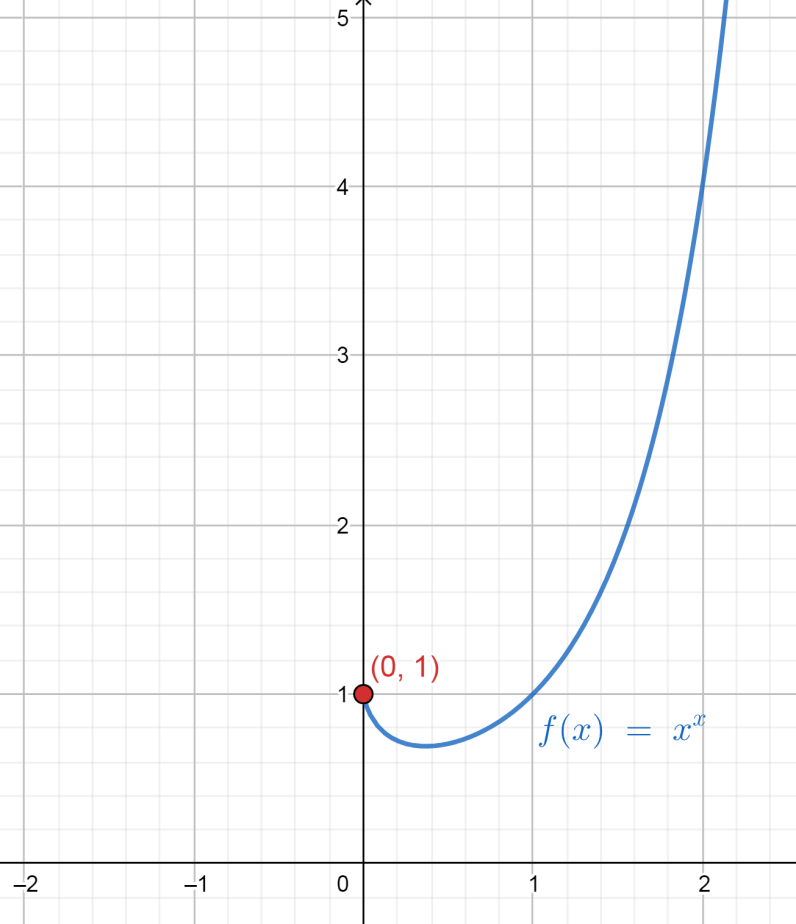
Here, since \[\left( {0,1} \right)\] lies on the graph of \[y = {x^x}\] ,
Therefore, we can see here that the graph shows the value for the function \[y = {x^x}\] at \[x = 0\] is equal to \[y = 1\] .
This is not because \[{0^0}\] is exactly equal to \[1\] every time, but because of the fact that in the neighbourhood of \[0\] the value of \[{x^x}\] is very close to \[1\] .
Therefore, there are two different values existing for the expression \[{0^0}\] , which are either \[1\] or not defined.
As a result, we can not find the exact value of \[{0^0}\] , hence we can not have zero to the power of zero.
Note: However, since now we know that we can not have zero to the power of zero as the value of the expression \[{0^0}\] is either \[1\] or not defined, but if we compare the two values precisely, then it is found that the value \[1\] is often more accurate and is taken at many places. For example, the limit of the function \[{n^n}\] when \[n\] is approaching \[0\] , is actually \[1\] i.e. \[\mathop {\lim }\limits_{n \to 0} {n^n} = 1\] .
Complete answer:
Given that, an expression of the form of zero to the power of zero.
That can be written as,
\[ \Rightarrow {0^0}\]
We have to explain the reason that why can not we take zero to the power of zero.
According to the general rule of exponents and powers, if we have an expression of the form \[{0^p}\] where \[p > 0\] , then we have the value
\[ \Rightarrow {0^p} = 0\]
For all the values of \[p > 0\] .
Also if we have \[ - p < 0\] then we have
\[ \Rightarrow {0^{ - p}} = \dfrac{1}{{{0^p}}}\]
Since, we have \[{0^p} = 0\] , we get
\[ \Rightarrow {0^{ - p}} = \dfrac{1}{0}\]
That is an undefined value.
But since, this rules are only accountable for \[p \ne 0\] .
Therefore, \[{0^p}\] for \[p = 0\] , i.e. \[{0^0}\] is not defined.
That is one value for the expression \[{0^0}\] , but if we consider a function \[y = {x^x}\] , then we need to check the value of this function at \[x = 0\] .
To find that, first we draw the graph for the function \[y = {x^x}\] .
That can be shown as the graph drawn below:
Here, since \[\left( {0,1} \right)\] lies on the graph of \[y = {x^x}\] ,
Therefore, we can see here that the graph shows the value for the function \[y = {x^x}\] at \[x = 0\] is equal to \[y = 1\] .
This is not because \[{0^0}\] is exactly equal to \[1\] every time, but because of the fact that in the neighbourhood of \[0\] the value of \[{x^x}\] is very close to \[1\] .
Therefore, there are two different values existing for the expression \[{0^0}\] , which are either \[1\] or not defined.
As a result, we can not find the exact value of \[{0^0}\] , hence we can not have zero to the power of zero.
Note: However, since now we know that we can not have zero to the power of zero as the value of the expression \[{0^0}\] is either \[1\] or not defined, but if we compare the two values precisely, then it is found that the value \[1\] is often more accurate and is taken at many places. For example, the limit of the function \[{n^n}\] when \[n\] is approaching \[0\] , is actually \[1\] i.e. \[\mathop {\lim }\limits_{n \to 0} {n^n} = 1\] .
Recently Updated Pages
What are the two major island groups in India class 9 social science CBSE

What is Jhum cultivation class 9 biology CBSE
Write an Article on Save Earth Save Life
Silk is obtained from of the silk moth APupa BLarva class 9 chemistry CBSE
Write chemical formulas of the following compounds class 9 chemistry CBSE
The Indo Gangetic Plains of India are fertile due to class 9 social science CBSE
Trending doubts
Fill the blanks with the suitable prepositions 1 The class 9 english CBSE
Difference Between Plant Cell and Animal Cell
Name 10 Living and Non living things class 9 biology CBSE
What is the full form of pH?
On an outline map of India show its neighbouring c class 9 social science CBSE
What is pollution? How many types of pollution? Define it