




Cannizzaro’s reaction is not given by :
A.
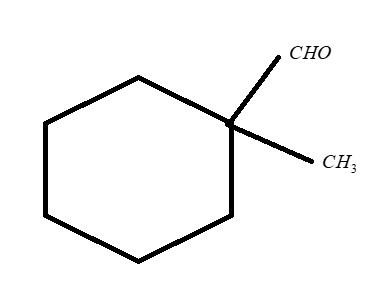
B.
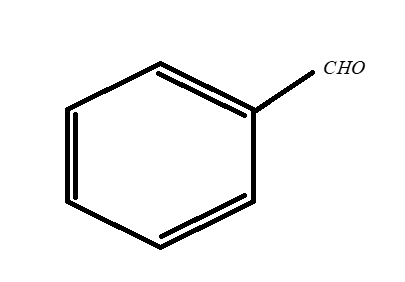
C.$HCHO$
D.$C{H_3}CHO$
Answer
 Verified
583.5k+ views
Hint:Firstly in the question we need to get the explanation of what is cannizzaro reaction and the reaction mechanism behind it. The reaction in which non-enolizable aldehyde given a molecule of primary alcohol and one carboxylic acid. Now we have to define the mechanism of the reaction. Then we can give the two conditions which don't allow the reaction ( existence of enol form and $3 - \alpha $ hydrogen attached to the carbonyl group). Then we can see which option doesn't follow it and get the answer.
Complete step by step answer:
Cannizzaro reaction is a characteristic reaction for the carboxylic acids which don’t have an enol form. It is a chemical reaction in which the given base-induced disproportionation of two molecules of a non-enolizable aldehyde takes place in order to give a primary alcohol and a carboxylic acid.
The given reaction mechanism of the Cannizzaro reaction is as follows:
The Cannizzaro reaction is a reaction that involves a nucleophilic acyl substitution, which is done on an aldehyde. In this process the leaving group concurrently attacks the other aldehyde in the second step of mechanism. In the first step the hydroxide attacks a carbonyl.
There are mainly two conditions when the Cannizzaro reaction does not takes place :
When the enol form exists and is attainable.
Secondly when the carboxyl group is directly attached to a carbon with $3 - \alpha $ hydrogen atoms.
In the given question among all the questions only the acetaldehyde doesn’t fulfill the conditions.
Therefore, the right answer is option D, $C{H_3}CHO$ .
Note:The Cannizzaro reaction, named after its discoverer Stanislao Cannizzaro who gave it in the year $1853$. He got it when he was reacting the benzaldehyde with the potash. He obtained benzyl alcohol and the potassium benzoate and thus named the reaction after him.
Complete step by step answer:
Cannizzaro reaction is a characteristic reaction for the carboxylic acids which don’t have an enol form. It is a chemical reaction in which the given base-induced disproportionation of two molecules of a non-enolizable aldehyde takes place in order to give a primary alcohol and a carboxylic acid.
The given reaction mechanism of the Cannizzaro reaction is as follows:
The Cannizzaro reaction is a reaction that involves a nucleophilic acyl substitution, which is done on an aldehyde. In this process the leaving group concurrently attacks the other aldehyde in the second step of mechanism. In the first step the hydroxide attacks a carbonyl.
There are mainly two conditions when the Cannizzaro reaction does not takes place :
When the enol form exists and is attainable.
Secondly when the carboxyl group is directly attached to a carbon with $3 - \alpha $ hydrogen atoms.
In the given question among all the questions only the acetaldehyde doesn’t fulfill the conditions.
Therefore, the right answer is option D, $C{H_3}CHO$ .
Note:The Cannizzaro reaction, named after its discoverer Stanislao Cannizzaro who gave it in the year $1853$. He got it when he was reacting the benzaldehyde with the potash. He obtained benzyl alcohol and the potassium benzoate and thus named the reaction after him.
Recently Updated Pages
Master Class 12 Economics: Engaging Questions & Answers for Success

Master Class 12 Physics: Engaging Questions & Answers for Success
Master Class 12 English: Engaging Questions & Answers for Success
Master Class 12 Social Science: Engaging Questions & Answers for Success
Master Class 12 Maths: Engaging Questions & Answers for Success
Master Class 12 Business Studies: Engaging Questions & Answers for Success
Trending doubts
Which are the Top 10 Largest Countries of the World?
What are the major means of transport Explain each class 12 social science CBSE
Draw a labelled sketch of the human eye class 12 physics CBSE
Differentiate between insitu conservation and exsitu class 12 biology CBSE
Draw a neat and well labeled diagram of TS of ovary class 12 biology CBSE
Give 10 examples of unisexual and bisexual flowers