




Can ribulose bisphosphate (RuBP) combine with both carbon dioxide and oxygen gas?
Answer
 Verified
537k+ views
Hint: The Calvin cycle is a process that plants and algae use to convert carbon dioxide from the air into sugar on which the autotrophs need to grow. It is a light-independent process. The Calvin cycle has four major steps: carbon fixation, reduction phase, carbohydrate formation, and regeneration phase.
Complete answer:
To solve this question, we must know about the process of the Calvin cycle. Calvin cycle is one of the most important processes on which all living beings depend. It is the main source of energy and food. The Calvin cycle has four steps.
A $CO_2$ molecule combines with a five-carbon acceptor molecule called ribulose-1,5-bisphosphate (RuBP). This step makes a six-carbon compound that splits into two molecules of a three-carbon compound i.e 3-phosphoglyceric acid (3-PGA). Enzyme RuBP carboxylase/oxygenase also known as rubisco acts as a catalyst.
In the second stage, ATP and NADPH are used to convert the 3-PGA molecules into molecules of a three-carbon sugar i.e glyceraldehyde-3-phosphate. Some G3P molecules go to make glucose, while others must be recycled to regenerate the initial RuBP acceptor.
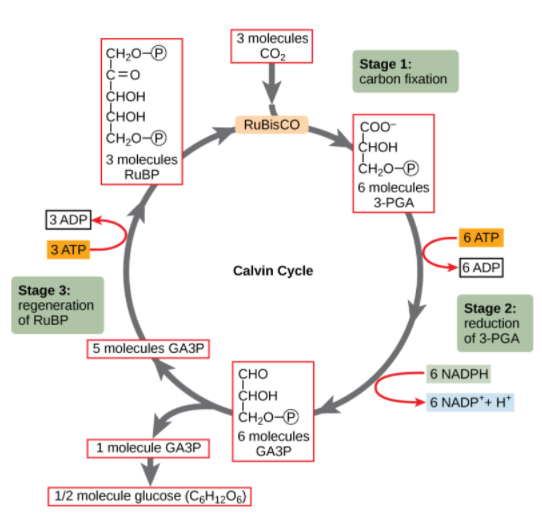
Thus, the enzyme Rubisco not only initiates carbon fixation in the Calvin cycle but it also combines with oxygen to initiate photo-respiration.
Additional Information: 3 ADP and 2 NADP+ are obtained during Calvin cycle. These are utilised in the light reaction.
Note: RuBP stands for ribulose bisphosphate and it's a 5-carbon compound involved in the Calvin cycle, which is part of the light-independent reactions of photosynthesis. Note that the active site of rubisco cannot distinguish the two similar substrates: O=C=O and O=O.
Complete answer:
To solve this question, we must know about the process of the Calvin cycle. Calvin cycle is one of the most important processes on which all living beings depend. It is the main source of energy and food. The Calvin cycle has four steps.
A $CO_2$ molecule combines with a five-carbon acceptor molecule called ribulose-1,5-bisphosphate (RuBP). This step makes a six-carbon compound that splits into two molecules of a three-carbon compound i.e 3-phosphoglyceric acid (3-PGA). Enzyme RuBP carboxylase/oxygenase also known as rubisco acts as a catalyst.
In the second stage, ATP and NADPH are used to convert the 3-PGA molecules into molecules of a three-carbon sugar i.e glyceraldehyde-3-phosphate. Some G3P molecules go to make glucose, while others must be recycled to regenerate the initial RuBP acceptor.
Thus, the enzyme Rubisco not only initiates carbon fixation in the Calvin cycle but it also combines with oxygen to initiate photo-respiration.
Additional Information: 3 ADP and 2 NADP+ are obtained during Calvin cycle. These are utilised in the light reaction.
Note: RuBP stands for ribulose bisphosphate and it's a 5-carbon compound involved in the Calvin cycle, which is part of the light-independent reactions of photosynthesis. Note that the active site of rubisco cannot distinguish the two similar substrates: O=C=O and O=O.
Recently Updated Pages
Master Class 12 Business Studies: Engaging Questions & Answers for Success

Master Class 12 Biology: Engaging Questions & Answers for Success
Master Class 12 Chemistry: Engaging Questions & Answers for Success
Class 12 Question and Answer - Your Ultimate Solutions Guide
Master Class 11 Social Science: Engaging Questions & Answers for Success
Master Class 11 English: Engaging Questions & Answers for Success
Trending doubts
Explain the Treaty of Vienna of 1815 class 10 social science CBSE
Which Indian city is known as the "City of Victory"?
Which instrument is used to measure the Blood Pressure?
Who Won 36 Oscar Awards? Record Holder Revealed
What is the median of the first 10 natural numbers class 10 maths CBSE
Why is it 530 pm in india when it is 1200 afternoon class 10 social science CBSE