




Why is it called a rectangular hyperbola?
Answer
 Verified
523.2k+ views
Hint: For a hyperbola to be called a rectangular hyperbola, we must check for the eccentricity of the hyperbola. If the eccentricity of the hyperbola is \[\sqrt{2}\], then the hyperbola is considered as a rectangular hyperbola. The equation of the rectangular hyperbola is \[{{a}^{2}}={{a}^{2}}\left( {{e}^{2}}-1 \right)\] where \[a=b\] for a rectangular hyperbola.
Complete step-by-step solution:
Now let us learn more about rectangular hyperbola. In a rectangular hyperbola, \[a=b\] i.e. the length of the transverse axis = length of the conjugate axis. The asymptotes of the rectangular hyperbola are \[y=\pm x\]. When \[xy={{c}^{2}}\], the asymptotes are the coordinate axes. The equation of a normal rectangular hyperbola is \[y-\dfrac{c}{t}={{t}^{2}}\left( x-ct \right)\]. A hyperbola for which the asymptotes are perpendicular, it is called an equilateral hyperbola or right hyperbola. The main difference between a regular hyperbola and rectangular hyperbola is that the asymptotes are perpendicular in the rectangular hyperbola. The equation of a rectangular hyperbola is \[{{x}^{2}}-{{y}^{2}}={{a}^{2}}\]. The AFC curve is represented by a rectangular hyperbola.
Now let us see why a hyperbola is called a rectangular hyperbola.
When a hyperbola has its asymptotes or the axes perpendicular to each other then it is called a rectangular hyperbola. Also, the eccentricity of a rectangular hyperbola is \[\sqrt{2}\].
Now, let us find the equation of the rectangular hyperbola whose asymptotes are \[3x-4y+9=0\] and \[4x+3y+1=0\] which passes through the origin.
We know that the join equation of the asymptotes and the equation of the hyperbola differs only by a constant \[r\].
So we get, \[\left( 3x-4y+9 \right)\left( 4x+3y+1 \right)+r=0\]
Since we are told that the hyperbola will be passing through the origin, we will be substituting \[x=y=0\].
Upon substituting we get,
\[\begin{align}
& 9+r=0 \\
& \Rightarrow r=-9 \\
\end{align}\]
Now, we obtain the equation of hyperbola as
\[\begin{align}
& \left( 3x-4y+9 \right)\left( 4x+3y+1 \right)-9=0 \\
& \Rightarrow 12{{x}^{2}}+9xy+3x-16xy-12{{y}^{2}}-4y+36x+27y+9-9=0 \\
& \Rightarrow 12{{x}^{2}}-12{{y}^{2}}+39x+23y-7xy=0 \\
\end{align}\]
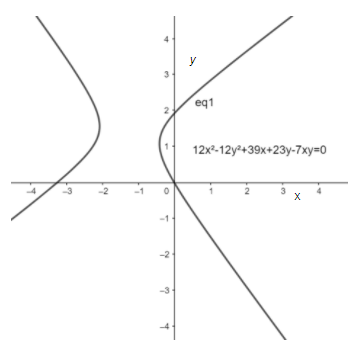
Note: e must always remember that the eccentricity of the rectangular hyperbola is \[\sqrt{2}\]. We must also note that the length of latus rectum can be calculated by the formula \[2\sqrt{2}c\] and when the vertices of a hyperbola are \[\left( c,c \right)\] and \[\left( -c,-c \right)\], then the focus of the hyperbola is \[\left( \sqrt{2}c,\sqrt{2}c \right)\] and \[\left( -\sqrt{2}c,-\sqrt{2}c \right)\].
Complete step-by-step solution:
Now let us learn more about rectangular hyperbola. In a rectangular hyperbola, \[a=b\] i.e. the length of the transverse axis = length of the conjugate axis. The asymptotes of the rectangular hyperbola are \[y=\pm x\]. When \[xy={{c}^{2}}\], the asymptotes are the coordinate axes. The equation of a normal rectangular hyperbola is \[y-\dfrac{c}{t}={{t}^{2}}\left( x-ct \right)\]. A hyperbola for which the asymptotes are perpendicular, it is called an equilateral hyperbola or right hyperbola. The main difference between a regular hyperbola and rectangular hyperbola is that the asymptotes are perpendicular in the rectangular hyperbola. The equation of a rectangular hyperbola is \[{{x}^{2}}-{{y}^{2}}={{a}^{2}}\]. The AFC curve is represented by a rectangular hyperbola.
Now let us see why a hyperbola is called a rectangular hyperbola.
When a hyperbola has its asymptotes or the axes perpendicular to each other then it is called a rectangular hyperbola. Also, the eccentricity of a rectangular hyperbola is \[\sqrt{2}\].
Now, let us find the equation of the rectangular hyperbola whose asymptotes are \[3x-4y+9=0\] and \[4x+3y+1=0\] which passes through the origin.
We know that the join equation of the asymptotes and the equation of the hyperbola differs only by a constant \[r\].
So we get, \[\left( 3x-4y+9 \right)\left( 4x+3y+1 \right)+r=0\]
Since we are told that the hyperbola will be passing through the origin, we will be substituting \[x=y=0\].
Upon substituting we get,
\[\begin{align}
& 9+r=0 \\
& \Rightarrow r=-9 \\
\end{align}\]
Now, we obtain the equation of hyperbola as
\[\begin{align}
& \left( 3x-4y+9 \right)\left( 4x+3y+1 \right)-9=0 \\
& \Rightarrow 12{{x}^{2}}+9xy+3x-16xy-12{{y}^{2}}-4y+36x+27y+9-9=0 \\
& \Rightarrow 12{{x}^{2}}-12{{y}^{2}}+39x+23y-7xy=0 \\
\end{align}\]
Note: e must always remember that the eccentricity of the rectangular hyperbola is \[\sqrt{2}\]. We must also note that the length of latus rectum can be calculated by the formula \[2\sqrt{2}c\] and when the vertices of a hyperbola are \[\left( c,c \right)\] and \[\left( -c,-c \right)\], then the focus of the hyperbola is \[\left( \sqrt{2}c,\sqrt{2}c \right)\] and \[\left( -\sqrt{2}c,-\sqrt{2}c \right)\].
Recently Updated Pages
Master Class 11 Social Science: Engaging Questions & Answers for Success

Master Class 11 Physics: Engaging Questions & Answers for Success
Master Class 11 Maths: Engaging Questions & Answers for Success
Master Class 11 Economics: Engaging Questions & Answers for Success
Master Class 11 Computer Science: Engaging Questions & Answers for Success
Master Class 11 Chemistry: Engaging Questions & Answers for Success
Trending doubts
One Metric ton is equal to kg A 10000 B 1000 C 100 class 11 physics CBSE
There are 720 permutations of the digits 1 2 3 4 5 class 11 maths CBSE
1 Quintal is equal to a 110 kg b 10 kg c 100kg d 1000 class 11 physics CBSE
State and prove Bernoullis theorem class 11 physics CBSE
Difference Between Prokaryotic Cells and Eukaryotic Cells
Discuss the various forms of bacteria class 11 biology CBSE