




How do you calculate voltage drop across a resistor?
Answer
 Verified
596.1k+ views
Hint: A voltage drop across resistance by simply using ohm’s law which states that the current through a conductor between the two points is directly proportional to the voltage across the two points.
Formula used:
$V=IR$
Complete answer:
In order to calculate the voltage drop of any circuit we need to simplify the circuit and then by using ohm's law we can measure voltage drop across the circuit.
Let’s consider below simple circuit for better understanding
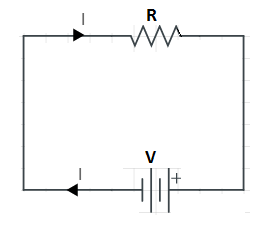
In above circuit the total current flows in the circuit are IA and the total resistance of the circuit is RΩ then voltage of the circuit is,
According to the ohm’s law
$V=IR$ ….. (1)
Where, V = voltage drop
I = current in the circuit
R = resistance
The unit of the voltage drop is volt and it is denoted by V.
And from equation 1 we can find the voltage drop of any circuit.
Additional information:
Voltage: voltage can be defined as the work needed per unit of charge to move a test charge between the points.
Current: current can be defined as the rate of the flow of the electrons in a conductor.
Resistance: A circuit electrical resistance is the ratio of the voltage applied to the current flowing through it.
Note:
As an approach to calculate the voltage drop of a circuit first we defined ohm’s law and by using the formula of the ohm’s law and with the example of the circuit we came to a formula which can find voltage drop.
V = IR
Formula used:
$V=IR$
Complete answer:
In order to calculate the voltage drop of any circuit we need to simplify the circuit and then by using ohm's law we can measure voltage drop across the circuit.
Let’s consider below simple circuit for better understanding
In above circuit the total current flows in the circuit are IA and the total resistance of the circuit is RΩ then voltage of the circuit is,
According to the ohm’s law
$V=IR$ ….. (1)
Where, V = voltage drop
I = current in the circuit
R = resistance
The unit of the voltage drop is volt and it is denoted by V.
And from equation 1 we can find the voltage drop of any circuit.
Additional information:
Voltage: voltage can be defined as the work needed per unit of charge to move a test charge between the points.
Current: current can be defined as the rate of the flow of the electrons in a conductor.
Resistance: A circuit electrical resistance is the ratio of the voltage applied to the current flowing through it.
Note:
As an approach to calculate the voltage drop of a circuit first we defined ohm’s law and by using the formula of the ohm’s law and with the example of the circuit we came to a formula which can find voltage drop.
V = IR
Recently Updated Pages
Master Class 11 English: Engaging Questions & Answers for Success

Master Class 11 Social Science: Engaging Questions & Answers for Success
Master Class 11 Maths: Engaging Questions & Answers for Success
Master Class 11 Biology: Engaging Questions & Answers for Success
Master Class 11 Physics: Engaging Questions & Answers for Success
Master Class 11 Chemistry: Engaging Questions & Answers for Success
Trending doubts
One Metric ton is equal to kg A 10000 B 1000 C 100 class 11 physics CBSE
Difference Between Prokaryotic Cells and Eukaryotic Cells
Find the value of the expression given below sin 30circ class 11 maths CBSE
Difference between physical and chemical change class 11 chemistry CBSE
Two of the body parts which do not appear in MRI are class 11 biology CBSE
Draw a diagram of a plant cell and label at least eight class 11 biology CBSE