



How do you calculate the perimeter of an isosceles triangle?
Answer
 Verified
575.4k+ views
Hint: An isosceles triangle is one of the triangles that has two of its sides of equal length. Generally, it is explained as having exactly two sides of equal length but sometimes it is explained as having at least two of its sides of equal length. In the latter case, the equilateral triangle becomes a special case as it has all of its three sides equal in length.
Moreover, the perimeter is the distance around a regular polygon or a 2d shape. We can find the perimeter of a regular polygon by just simply adding all of its side lengths.
Complete step by step solution:
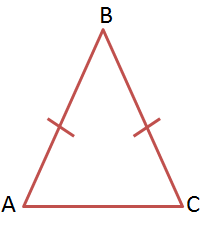 Let there be an isosceles triangle $\Delta ABC$ whose two sides $AB$ and $CB$ are equal. Hence $AB = CB$.
Also, let $AB = CB = a$(say) and $AC = b$(say).
So, the perimeter of $\Delta ABC$
$ = AB + CB + AC$ (Since perimeter is the sum of all the side lengths)
On substituting the values of $AB$, $CB$, and $AC$, we get
$ = a + a + b$
$ = 2a + b$
So, the perimeter of $\Delta ABC$ is $2a + b$.
Hence, the perimeter of an isosceles triangle is the sum of twice its one of the equal side and the unequal side.
Note:
The two equal sides of an isosceles triangle are defined as the legs of the triangle whereas the unequal side or the third side is defined as the base of the triangle. Also in an isosceles triangle, the angles opposite the equal sides are also equal in measurement.
Moreover, the perimeter is the distance around a regular polygon or a 2d shape. We can find the perimeter of a regular polygon by just simply adding all of its side lengths.
Complete step by step solution:
Also, let $AB = CB = a$(say) and $AC = b$(say).
So, the perimeter of $\Delta ABC$
$ = AB + CB + AC$ (Since perimeter is the sum of all the side lengths)
On substituting the values of $AB$, $CB$, and $AC$, we get
$ = a + a + b$
$ = 2a + b$
So, the perimeter of $\Delta ABC$ is $2a + b$.
Hence, the perimeter of an isosceles triangle is the sum of twice its one of the equal side and the unequal side.
Note:
The two equal sides of an isosceles triangle are defined as the legs of the triangle whereas the unequal side or the third side is defined as the base of the triangle. Also in an isosceles triangle, the angles opposite the equal sides are also equal in measurement.
Recently Updated Pages
Master Class 9 Social Science: Engaging Questions & Answers for Success

Master Class 9 Science: Engaging Questions & Answers for Success
Master Class 9 Maths: Engaging Questions & Answers for Success
Master Class 9 General Knowledge: Engaging Questions & Answers for Success
Class 9 Question and Answer - Your Ultimate Solutions Guide
Master Class 8 Social Science: Engaging Questions & Answers for Success
Trending doubts
Find the sum of series 1 + 2 + 3 + 4 + 5 + + 100 class 9 maths CBSE
What is the Full Form of ISI and RAW
Fill the blanks with the suitable prepositions 1 The class 9 english CBSE
Difference Between Plant Cell and Animal Cell
Who is eligible for RTE class 9 social science CBSE
What is pollution? How many types of pollution? Define it