




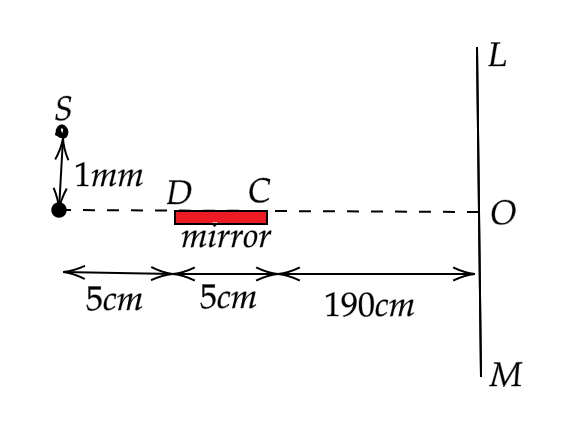
Calculate the number of fringes in
Answer
 Verified
615k+ views
Hint:The given question is an application of Young’s double-slit experiment. The fringes are seen due to the interference pattern caused as a result of overlapping light waves from the two slits.
Complete step-by-step solution:
From the given fig,
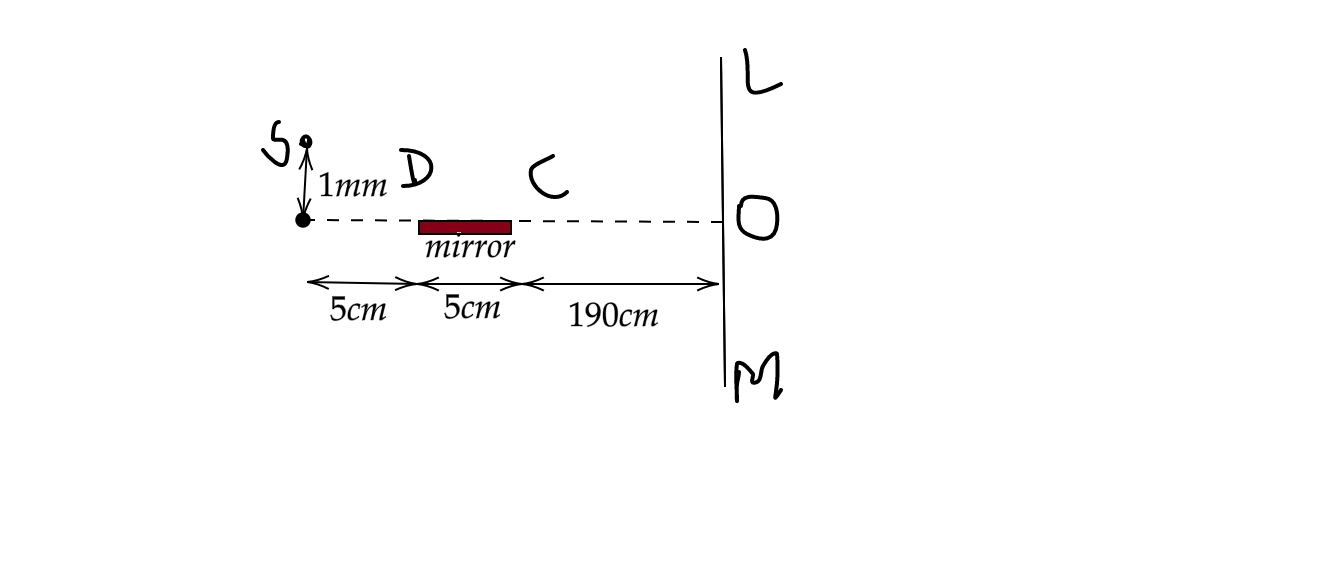
S is a point source of light
DC is the mirror
The rays from S get reflected on the mirror at points D and C and reach the screen at L and N
Thus, LN is the region in which fringes are visible.
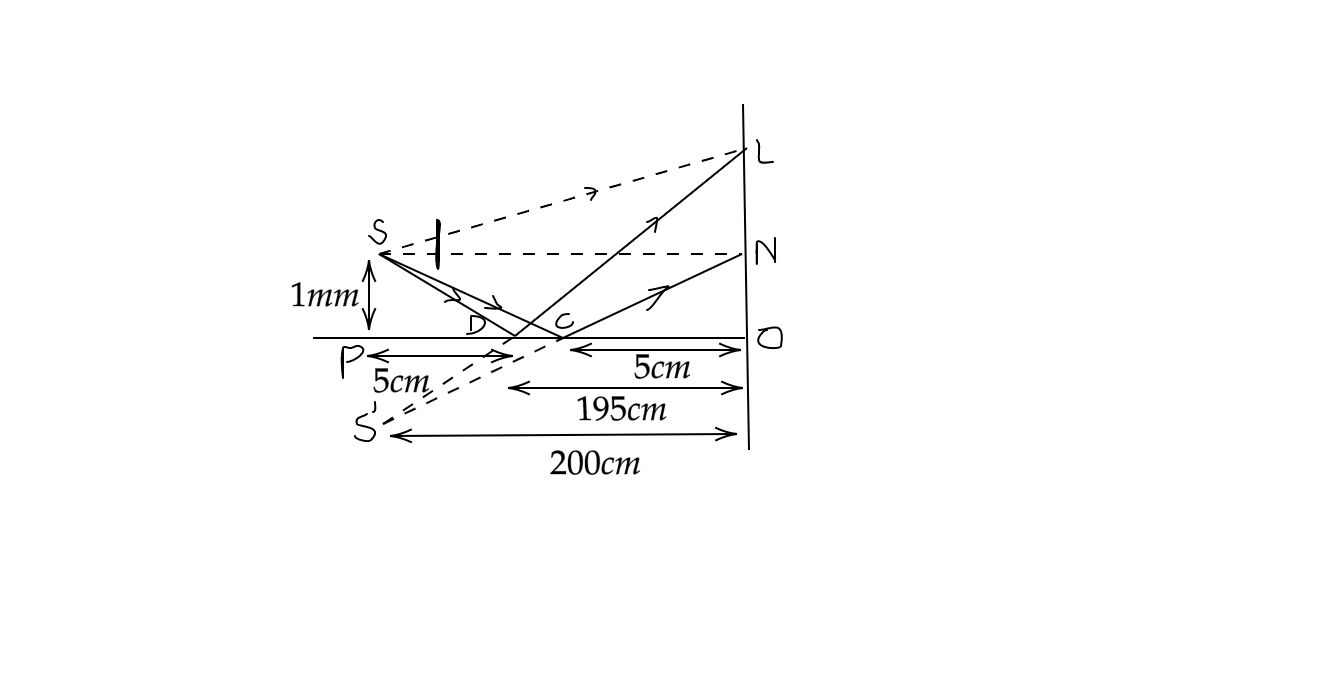
From the triangles SDP and LDO, using properties of similar triangles, we can state that
\[{{y}_{2}}=39mm\]
Now, from the triangles SCP and NCO, using properties of similar triangles, we can say that
\[{{y}_{1}}=19mm\]
Thus, the width of fringe visibility is LN, as stated above,
LN \[={{y}_{2}}-{{y}_{1}}=20mm=2cm\]
The width of the fringe \[\beta =0.05cm\]
Hence, we can also conclude that in interference, fringe width is constant for all fringes.
Now, the number of fringes can be seen by us is given as the ratio of the width of fringe visibility (which is nothing but the effective screen width) to the width of a single fringe, that is,
\[\begin{align}
& N=\dfrac{{{y}_{2}}-{{y}_{1}}}{\beta } \\
& \Rightarrow N=\dfrac{2}{0.05} \\
& \Rightarrow N=40 \\
\end{align}\]
Hence, the number of fringes observed in the given setup will be \[40\].
Note:- Interference is a phenomenon that supports the wave nature of light since only waves can overlap to produce a wave of greater, lower or the same amplitude. One other phenomenon that supports the wave nature of light is diffraction which is the bending of a light wave around the corners of an aperture.
Complete step-by-step solution:
From the given fig,
S is a point source of light
DC is the mirror
The rays from S get reflected on the mirror at points D and C and reach the screen at L and N
Thus, LN is the region in which fringes are visible.
From the triangles SDP and LDO, using properties of similar triangles, we can state that
\[{{y}_{2}}=39mm\]
Now, from the triangles SCP and NCO, using properties of similar triangles, we can say that
\[{{y}_{1}}=19mm\]
Thus, the width of fringe visibility is LN, as stated above,
LN \[={{y}_{2}}-{{y}_{1}}=20mm=2cm\]
The width of the fringe \[\beta =0.05cm\]
Hence, we can also conclude that in interference, fringe width is constant for all fringes.
Now, the number of fringes can be seen by us is given as the ratio of the width of fringe visibility (which is nothing but the effective screen width) to the width of a single fringe, that is,
\[\begin{align}
& N=\dfrac{{{y}_{2}}-{{y}_{1}}}{\beta } \\
& \Rightarrow N=\dfrac{2}{0.05} \\
& \Rightarrow N=40 \\
\end{align}\]
Hence, the number of fringes observed in the given setup will be \[40\].
Note:- Interference is a phenomenon that supports the wave nature of light since only waves can overlap to produce a wave of greater, lower or the same amplitude. One other phenomenon that supports the wave nature of light is diffraction which is the bending of a light wave around the corners of an aperture.
Recently Updated Pages
Master Class 12 Business Studies: Engaging Questions & Answers for Success

Master Class 12 Chemistry: Engaging Questions & Answers for Success
Master Class 12 Biology: Engaging Questions & Answers for Success
Class 12 Question and Answer - Your Ultimate Solutions Guide
Master Class 9 General Knowledge: Engaging Questions & Answers for Success
Master Class 9 Maths: Engaging Questions & Answers for Success
Trending doubts
Which are the Top 10 Largest Countries of the World?
Draw a labelled sketch of the human eye class 12 physics CBSE
Name the crygenes that control cotton bollworm and class 12 biology CBSE
Differentiate between homogeneous and heterogeneous class 12 chemistry CBSE
In a transcription unit the promoter is said to be class 12 biology CBSE
Sulphuric acid is known as the king of acids State class 12 chemistry CBSE