




Calculate the moment of inertia of a thin ring of mass $m$ and radius $R$ about an axis passing through its center and perpendicular to the ring.
Answer
 Verified
604.2k+ views
Hint: We can solve this problem by considering an infinitesimal part of the wire of infinitesimal mass and finding out the moment of inertia about the axis of this infinitesimal mass. We will then find out a relation of the infinitesimal mass with some other variable of the ring such as its radius to integrate and find out the moment of inertia of the whole ring.
Formula used:
The moment of inertia $I$ of a point mass $m$ about an axis at a perpendicular distance $r$ from it is given by
$I=m{{r}^{2}}$
Complete step by step answer:
We will find out the moment of inertia of the thin uniform ring by first finding out the moment of inertia of an infinitesimal part of the ring of infinitesimal mass about the required axis. Then, we will proceed to find out a relation between this mass and some other variable of the ring such as its radius or circumference to integrate the moment of inertia with respect to this variable and find out the moment of inertia of the whole ring.
So let us proceed in this way.
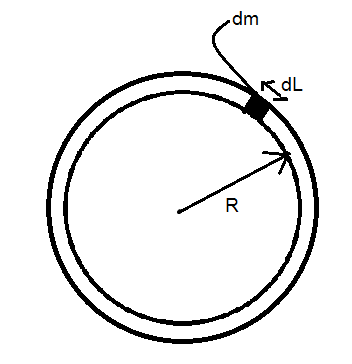
We have a thin ring of mass $m$ and radius $R$.
Therefore the total length $\left( L \right)$ of the ring is nothing but its circumference.
$\therefore L=2\pi R$
Since, the ring is uniform, it must have a constant mass per unit length $\lambda $.
$\therefore \lambda =\dfrac{\text{Total mass of ring}}{\text{Total length of ring}}=\dfrac{m}{2\pi R}$ --(1)
We take an infinitesimal strip of length $dL$ and mass $dm$. Hence,
$dm=\lambda dL$
$\therefore dm=\dfrac{m}{2\pi R}dL$ [Using (1)] --(2)
The moment of inertia $I$ of a point mass $m$ about an axis at a perpendicular distance $r$ from it is given by
$I=m{{r}^{2}}$ --(3)
Therefore, the moment of inertia of the infinitesimal mass about the axis passing through the center of the ring and perpendicular to its plane will be, using (3),
$dI=dm{{R}^{2}}$
$\therefore dI=\dfrac{m}{2\pi R}dL\times {{R}^{2}}=\dfrac{mR}{2\pi }dL$ [Using(2)]
Now, integrating both sides with the respective variable to cover the whole ring, we get,
$\int\limits_{0}^{I}{dI}=\dfrac{mR}{2\pi }\int\limits_{0}^{2\pi R}{dL}$
$\therefore \left[ I \right]_{0}^{I}=\dfrac{mR}{2\pi }\left[ L \right]_{0}^{2\pi R}$
$\therefore \left[ I-0 \right]=\dfrac{mR}{2\pi }\left[ 2\pi R-0 \right]$
$\therefore I=\dfrac{mR}{2\pi }\times 2\pi R=m{{R}^{2}}$
$\therefore I=m{{R}^{2}}$
Hence, the required moment of inertia of a ring about an axis passing through its center and perpendicular to its pane is $m{{R}^{2}}$.
Note: This is the most general and best approach to finding out the moment of inertia of different uniform bodies. However, students should have some important moment of inertia of some bodies like a sphere, disc, etc. memorized as without these most rotational mechanics problems cannot be solved. However, this approach is only applicable for uniform bodies. For non-uniform bodies it is not so easy to integrate the moment of inertia for the whole body using just one relation.
Many moments of inertia can be found out using the parallel and perpendicular axis theorems and students should understand those two very well as they are very helpful especially in competitive exams.
Formula used:
The moment of inertia $I$ of a point mass $m$ about an axis at a perpendicular distance $r$ from it is given by
$I=m{{r}^{2}}$
Complete step by step answer:
We will find out the moment of inertia of the thin uniform ring by first finding out the moment of inertia of an infinitesimal part of the ring of infinitesimal mass about the required axis. Then, we will proceed to find out a relation between this mass and some other variable of the ring such as its radius or circumference to integrate the moment of inertia with respect to this variable and find out the moment of inertia of the whole ring.
So let us proceed in this way.
We have a thin ring of mass $m$ and radius $R$.
Therefore the total length $\left( L \right)$ of the ring is nothing but its circumference.
$\therefore L=2\pi R$
Since, the ring is uniform, it must have a constant mass per unit length $\lambda $.
$\therefore \lambda =\dfrac{\text{Total mass of ring}}{\text{Total length of ring}}=\dfrac{m}{2\pi R}$ --(1)
We take an infinitesimal strip of length $dL$ and mass $dm$. Hence,
$dm=\lambda dL$
$\therefore dm=\dfrac{m}{2\pi R}dL$ [Using (1)] --(2)
The moment of inertia $I$ of a point mass $m$ about an axis at a perpendicular distance $r$ from it is given by
$I=m{{r}^{2}}$ --(3)
Therefore, the moment of inertia of the infinitesimal mass about the axis passing through the center of the ring and perpendicular to its plane will be, using (3),
$dI=dm{{R}^{2}}$
$\therefore dI=\dfrac{m}{2\pi R}dL\times {{R}^{2}}=\dfrac{mR}{2\pi }dL$ [Using(2)]
Now, integrating both sides with the respective variable to cover the whole ring, we get,
$\int\limits_{0}^{I}{dI}=\dfrac{mR}{2\pi }\int\limits_{0}^{2\pi R}{dL}$
$\therefore \left[ I \right]_{0}^{I}=\dfrac{mR}{2\pi }\left[ L \right]_{0}^{2\pi R}$
$\therefore \left[ I-0 \right]=\dfrac{mR}{2\pi }\left[ 2\pi R-0 \right]$
$\therefore I=\dfrac{mR}{2\pi }\times 2\pi R=m{{R}^{2}}$
$\therefore I=m{{R}^{2}}$
Hence, the required moment of inertia of a ring about an axis passing through its center and perpendicular to its pane is $m{{R}^{2}}$.
Note: This is the most general and best approach to finding out the moment of inertia of different uniform bodies. However, students should have some important moment of inertia of some bodies like a sphere, disc, etc. memorized as without these most rotational mechanics problems cannot be solved. However, this approach is only applicable for uniform bodies. For non-uniform bodies it is not so easy to integrate the moment of inertia for the whole body using just one relation.
Many moments of inertia can be found out using the parallel and perpendicular axis theorems and students should understand those two very well as they are very helpful especially in competitive exams.
Recently Updated Pages
Master Class 11 Computer Science: Engaging Questions & Answers for Success

Master Class 11 Business Studies: Engaging Questions & Answers for Success
Master Class 11 Economics: Engaging Questions & Answers for Success
Master Class 11 English: Engaging Questions & Answers for Success
Master Class 11 Maths: Engaging Questions & Answers for Success
Master Class 11 Biology: Engaging Questions & Answers for Success
Trending doubts
One Metric ton is equal to kg A 10000 B 1000 C 100 class 11 physics CBSE
There are 720 permutations of the digits 1 2 3 4 5 class 11 maths CBSE
Discuss the various forms of bacteria class 11 biology CBSE
Draw a diagram of a plant cell and label at least eight class 11 biology CBSE
State the laws of reflection of light
Explain zero factorial class 11 maths CBSE