




How do you calculate the length of an arc and area of a sector?
Answer
 Verified
577.2k+ views
Hint: The length of an arc of any circle depends on the radius of that circle and the central angle \[\theta \] (in radians). We know that for the angle equal to 360 degrees \[\left( 2\pi \right)\] , the arc length is equal to circumference. Similarly the area of sector can be found using the area of the whole circle.
Complete step by step solution:
Length of an arc of a circle
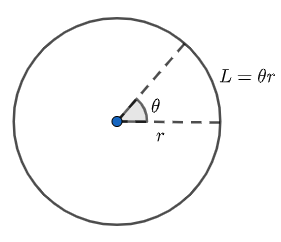
The proportion between angle and arc length is constant, we can say that:
\[\dfrac{L}{\theta }\] = \[\dfrac{C}{2\pi }\]
As circumference C = \[2\pi r\],
\[\Rightarrow \]\[\dfrac{L}{\theta }\] = \[\dfrac{2\pi r}{2\pi }\]
\[\Rightarrow \]\[\dfrac{L}{\theta }\] = \[r\text{ }\]
We find out the arc length formula when multiplying this equation by θ on both the sides:
\[L=r\times \theta \]
Hence, the arc length is equal to radius multiplied by the central angle (in radians).
Area of a sector of a circle,
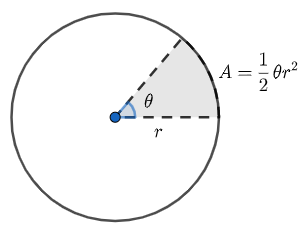
We can find the area of a sector of a circle in a similar way as we found the length of an arc. We know that the area of the whole circle is equal to \[\pi r{}^\text{2}\]. From the proportions,
\[\dfrac{A}{\theta }\] = \[\dfrac{\pi r{}^\text{2}}{2\pi }\]
\[\Rightarrow \] \[\dfrac{A}{\theta }\] = \[\dfrac{r{}^\text{2}}{2}\]
We find out the Area of a sector of a circle formula when multiplying this equation by θ on both the sides.
The formula for the area of a sector is:
\[\Rightarrow \] A = \[\dfrac{r{}^\text{2}}{2}\times \theta \]
Note: These are the standard formulas, so we have to know how we obtained these formulas. The important point here is that the values \[\theta \] is in radians, so if we have the \[\theta \] value in degrees then we should multiply the obtained formulas with \[\dfrac{360}{2\pi }\] .
Complete step by step solution:
Length of an arc of a circle
The proportion between angle and arc length is constant, we can say that:
\[\dfrac{L}{\theta }\] = \[\dfrac{C}{2\pi }\]
As circumference C = \[2\pi r\],
\[\Rightarrow \]\[\dfrac{L}{\theta }\] = \[\dfrac{2\pi r}{2\pi }\]
\[\Rightarrow \]\[\dfrac{L}{\theta }\] = \[r\text{ }\]
We find out the arc length formula when multiplying this equation by θ on both the sides:
\[L=r\times \theta \]
Hence, the arc length is equal to radius multiplied by the central angle (in radians).
Area of a sector of a circle,
We can find the area of a sector of a circle in a similar way as we found the length of an arc. We know that the area of the whole circle is equal to \[\pi r{}^\text{2}\]. From the proportions,
\[\dfrac{A}{\theta }\] = \[\dfrac{\pi r{}^\text{2}}{2\pi }\]
\[\Rightarrow \] \[\dfrac{A}{\theta }\] = \[\dfrac{r{}^\text{2}}{2}\]
We find out the Area of a sector of a circle formula when multiplying this equation by θ on both the sides.
The formula for the area of a sector is:
\[\Rightarrow \] A = \[\dfrac{r{}^\text{2}}{2}\times \theta \]
Note: These are the standard formulas, so we have to know how we obtained these formulas. The important point here is that the values \[\theta \] is in radians, so if we have the \[\theta \] value in degrees then we should multiply the obtained formulas with \[\dfrac{360}{2\pi }\] .
Recently Updated Pages
Master Class 11 English: Engaging Questions & Answers for Success

Master Class 11 Social Science: Engaging Questions & Answers for Success
Master Class 11 Maths: Engaging Questions & Answers for Success
Master Class 11 Biology: Engaging Questions & Answers for Success
Master Class 11 Physics: Engaging Questions & Answers for Success
Master Class 11 Chemistry: Engaging Questions & Answers for Success
Trending doubts
Explain the Treaty of Vienna of 1815 class 10 social science CBSE
What is the full form of POSCO class 10 social science CBSE
Define Potential, Developed, Stock and Reserved resources
The diagonals of a rhombus are 10cm and 24cm Find the class 10 maths CBSE
Fill the blanks with proper collective nouns 1 A of class 10 english CBSE
What planets have no moons Which one has only one moon class 10 physics CBSE