




Calculate the lattice energy of a salt \[MX(s)\] from the date given below:
Heat of formation of \[MX\left( {\Delta H} \right)\; = - 550\;kJ/mol\]
Heat of sublimation of \[M\left( S \right) = 80\;kJ/mol\]
Heat of dissociation of \[{X_2}\left( D \right) = 155\;kJ/mol\]
Ionization energy of \[M\left( {IE} \right) = 347\;kJ/mol\]
Electron affinity of \[X\left( {EA} \right) = - 343\;kJ/mol\]
A. \[ - 835KJ/mol\]
B. \[ - 938.5{\text{ }}kJ/mol\]
C. \[ - 711.5{\text{ }}kJ/mol\]
D. \[ - 638.5{\text{ }}kJ/mol\]
Answer
 Verified
608.4k+ views
Hint:Born Haber cycle is mainly used to calculate the lattice energy. It also involves steps such as sublimation energy \[\left( {\Delta {H_{sub}}\;} \right),\] dissociation energy \[\left( D \right),\] ionisation energy\[\left( I \right),\] electron affinity\[\left( E \right)\] and heat of formation of crystal \[\left( H \right).\] Represented in the form of
\[\Delta {\text{ }}H{\;_{f{\;^0}}}\; = {\text{ }}\Delta H\;sub\; + {\text{ }}\dfrac{D}{2} + {\text{ }}IE{\text{ }} + {\text{ }}EA\; + U\]
Complete step by step answer:
Born Haber cycle is a cycle of enthalpy change of process and The energy terms involved in building a crystal lattice\[\left( {{\text{ }}MX} \right)\] such as -
Step\[\;1\] - convert solid \[\left( {{\text{ }}M} \right)\] to gaseous \[\left( {{\text{ }}M} \right)\]is called enthalpy of sublimation \[\left( {\Delta H\;sub} \right).\]
Step \[2\] - convert gaseous\[\left( X \right)\] molecule to atoms is called enthalpy of dissociation\[\left( D \right).\]
Step \[3\] - Conversion of gaseous \[\left( {{\text{ }}M} \right)\] atom into \[\left( {M{\text{ }}ion} \right)\] in gaseous state is called ionisation energy .
Step \[4\] - Conversion of gaseous \[\left( X \right)\] atom into gaseous \[X{\text{ }}\;ion\] is known as electron gain enthalpy and represented by \[{E_A}\;.\]
Step \[5\] - The amount of energy released when one mole of solid crystalline compound is obtained from gaseous ions is called lattice energy\[\left( U \right)\]
\[M\left( s \right) + {\text{ }}\dfrac{1}{2}X\;\left( g \right) \to MX\left( s \right)\]
The Born-Haber Cycle can be reduced to a single equation:
Heat of formation= Heat of atomization + Dissociation energy+ (sum of Ionization energies) + (sum of Electron affinities)+ Lattice energy
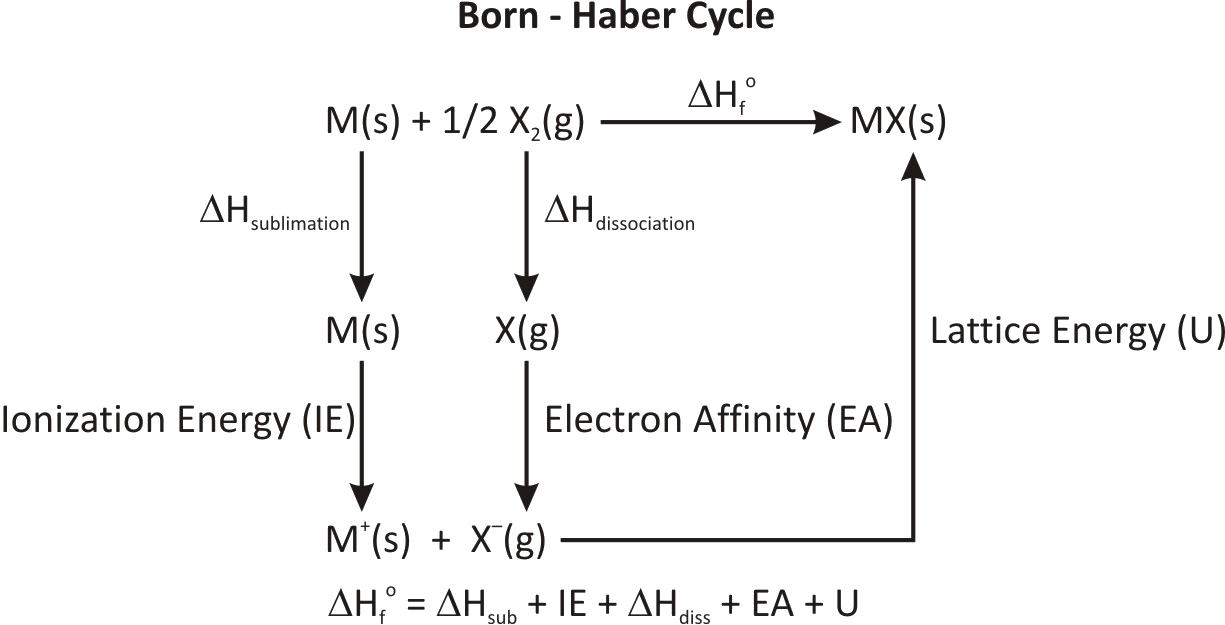
The enthalpies are represented in figure.
These steps are represented as -
\[\Delta {\text{ }}H{\;_f}^0\; = {\text{ }}\Delta H{\;_{sub}}\; + {\text{ }}D/2{\text{ }} + {\text{ }}IE{\text{ }} + {\text{ }}{E_A}\; + U\]
Now, Putting values as -
\[\Delta {H_f}\; = \;\;\;S{\text{ }} + {\text{ }}0.5D{\text{ }} + {\text{ }}IE{\text{ }} + {\text{ }}EA{\text{ }} + {\text{ }}U\]
\[ - 550{\text{ }} = \;\;80 + \dfrac{{155}}{2} + 347 - 343 + U\]
\[\;\;U = - 711.5kJ/mol\]
lattice energy of salt \[ = \; - 711.5\;kJ/mol.\]
Option (c ) is correct.
Note:Born Haber process is a method that allows us to observe and analyze energies in a reaction. It mainly helps in describing the formation of ionic compounds from different elements. Born Haber cycle is a process that leads to the formation of a solid crystalline ionic compound from the elemental atoms in their standard state and of the enthalpy of formation of the solid compound such that the net enthalpy becomes zero.
\[\Delta {\text{ }}H{\;_{f{\;^0}}}\; = {\text{ }}\Delta H\;sub\; + {\text{ }}\dfrac{D}{2} + {\text{ }}IE{\text{ }} + {\text{ }}EA\; + U\]
Complete step by step answer:
Born Haber cycle is a cycle of enthalpy change of process and The energy terms involved in building a crystal lattice\[\left( {{\text{ }}MX} \right)\] such as -
Step\[\;1\] - convert solid \[\left( {{\text{ }}M} \right)\] to gaseous \[\left( {{\text{ }}M} \right)\]is called enthalpy of sublimation \[\left( {\Delta H\;sub} \right).\]
Step \[2\] - convert gaseous\[\left( X \right)\] molecule to atoms is called enthalpy of dissociation\[\left( D \right).\]
Step \[3\] - Conversion of gaseous \[\left( {{\text{ }}M} \right)\] atom into \[\left( {M{\text{ }}ion} \right)\] in gaseous state is called ionisation energy .
Step \[4\] - Conversion of gaseous \[\left( X \right)\] atom into gaseous \[X{\text{ }}\;ion\] is known as electron gain enthalpy and represented by \[{E_A}\;.\]
Step \[5\] - The amount of energy released when one mole of solid crystalline compound is obtained from gaseous ions is called lattice energy\[\left( U \right)\]
\[M\left( s \right) + {\text{ }}\dfrac{1}{2}X\;\left( g \right) \to MX\left( s \right)\]
The Born-Haber Cycle can be reduced to a single equation:
Heat of formation= Heat of atomization + Dissociation energy+ (sum of Ionization energies) + (sum of Electron affinities)+ Lattice energy
The enthalpies are represented in figure.
These steps are represented as -
\[\Delta {\text{ }}H{\;_f}^0\; = {\text{ }}\Delta H{\;_{sub}}\; + {\text{ }}D/2{\text{ }} + {\text{ }}IE{\text{ }} + {\text{ }}{E_A}\; + U\]
Now, Putting values as -
\[\Delta {H_f}\; = \;\;\;S{\text{ }} + {\text{ }}0.5D{\text{ }} + {\text{ }}IE{\text{ }} + {\text{ }}EA{\text{ }} + {\text{ }}U\]
\[ - 550{\text{ }} = \;\;80 + \dfrac{{155}}{2} + 347 - 343 + U\]
\[\;\;U = - 711.5kJ/mol\]
lattice energy of salt \[ = \; - 711.5\;kJ/mol.\]
Option (c ) is correct.
Note:Born Haber process is a method that allows us to observe and analyze energies in a reaction. It mainly helps in describing the formation of ionic compounds from different elements. Born Haber cycle is a process that leads to the formation of a solid crystalline ionic compound from the elemental atoms in their standard state and of the enthalpy of formation of the solid compound such that the net enthalpy becomes zero.
Recently Updated Pages
Master Class 11 English: Engaging Questions & Answers for Success

Master Class 11 Social Science: Engaging Questions & Answers for Success
Master Class 11 Maths: Engaging Questions & Answers for Success
Master Class 11 Biology: Engaging Questions & Answers for Success
Master Class 11 Physics: Engaging Questions & Answers for Success
Master Class 11 Chemistry: Engaging Questions & Answers for Success
Trending doubts
One Metric ton is equal to kg A 10000 B 1000 C 100 class 11 physics CBSE
What is cell theory Who formulated it class 11 biology CBSE
Phyllotaxy is the arrangement of ALeaflets BLeaves class 11 biology CBSE
Difference Between Prokaryotic Cells and Eukaryotic Cells
The symbiotic association of fungi and algae is called class 11 biology CBSE
Cell theory was formulated by A Schleiden and Schwann class 11 biology CBSE