




How do you calculate the formal charge of $NO_{3}^{-}$?
Answer
 Verified
595.5k+ views
Hint: The factor on which we can calculate the formal charge of the atom in the molecule are the total number of valence electrons in the free atom, the total number of electrons of lone pairs (non-bonding electrons), and the total number of shared electrons (bonding electrons).
Complete step by step answer:
- The factor on which we can calculate the formal charge of the atom in the molecule is the total number of valence electrons in the free atom, the total number of electrons of lone pairs (non-bonding electrons), and the total number of shared electrons (bonding electrons).
- The formula of formal charge is:
$Formal\text{ }ch\arg e = Total\operatorname{}\text{ }no.\text{ }of\text{ }valence\text{ }electrons-Total\operatorname{}\text{ }no.\text{ }of\text{ }electron\operatorname{s}\text{ }in\text{ }lone\text{ }pairs-\dfrac{1}{2}\text{ }Total\operatorname{}\text{ }no.\text{ }of\text{ }shared\text{ }electrons$
The structure of $NO_{3}^{-}$ is given below:
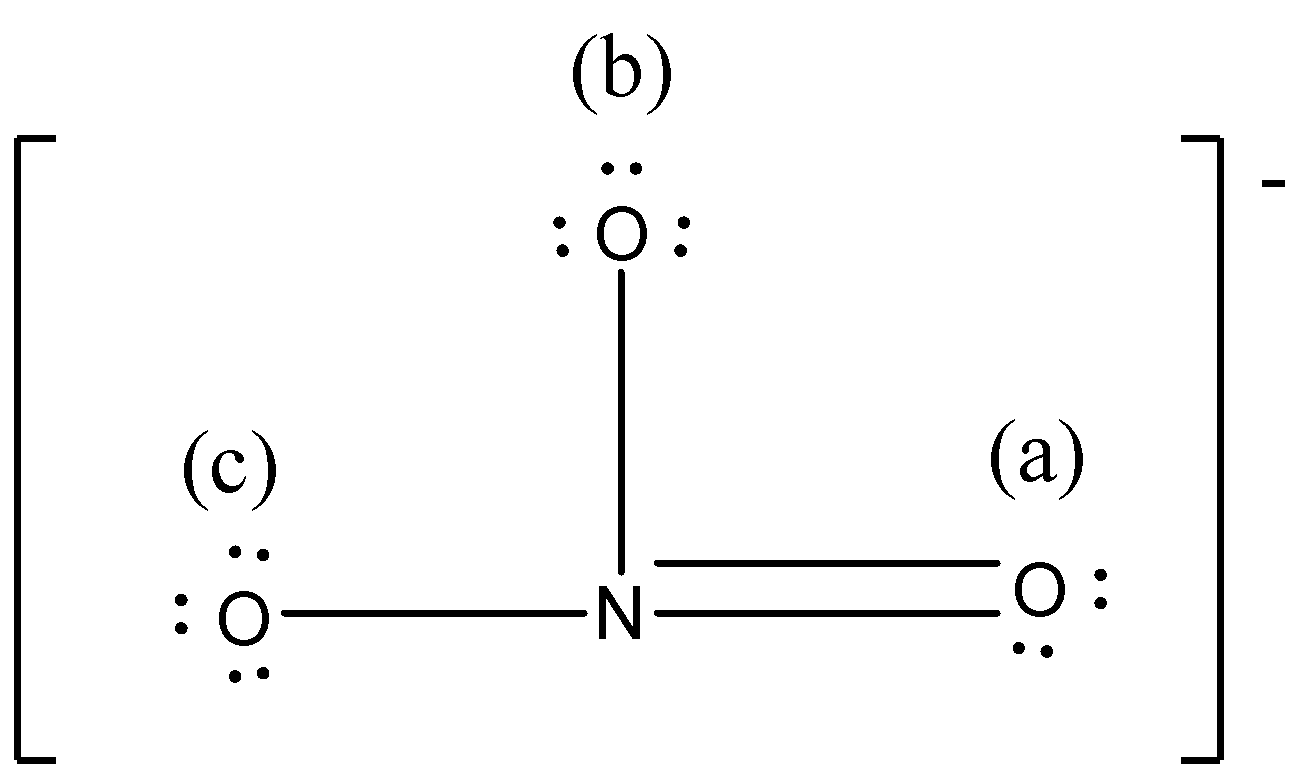
So, there are four atoms in this molecule,
The formal charge of nitrogen in this molecule will be, the total number of valence electrons in nitrogen is 5, the total number of electrons of lone pairs is 0, and the total number of shared electrons is 8. So, putting all these in the formula we get:
$\text{Formal charge of N = 5}-0-\dfrac{8}{2} = 5 - 4 = +1$
Now there are three oxygen atoms in the molecule designated as (a), (b), and (c).
- The formal charge of oxygen (a) in this molecule will be, the total number of valence electrons in Oxygen is 6, the total number of electrons of lone pairs is 4, and the total number of shared electrons is 4, So, putting all these in the formula we get:
$\text{Formal charge of O (a) = 6} - 4 - \dfrac{4}{2} = 6 - 4 - 2 = 0$
- The formal charge of oxygen (b) in this molecule will be, the total number of valence electrons in oxygen is 6, the total number of electrons of lone pairs is 6, and the total number of shared electrons is 2, So, putting all these in the formula we get:
$\text{Formal charge of O (b) = 6}-6-\dfrac{2}{2} = 6 - 6 - 1 = -1$
The formal charge of oxygen (c) in this molecule will be, the total number of valence electrons in oxygen is 6, the total number of electrons of lone pairs is 6, and the total number of shared electrons is 2. So, putting all these in the formula we get:
$\text{Formal charge of O (c) = 6} -6 - \dfrac{2}{2} = 6 - 6 - 1 = -1$
So, by combining all the charges of the atoms, we get:
$ + 1 + 0 - 1 - 1 = -1$
Therefore, the formal charge of $NO_{3}^{-}$ is -1.
Note: Don't get confused between the number of bonds and the number of bonded electrons. In the formula of formal charge, the number of electrons involved in the bond must be taken not the number of bonds.
Complete step by step answer:
- The factor on which we can calculate the formal charge of the atom in the molecule is the total number of valence electrons in the free atom, the total number of electrons of lone pairs (non-bonding electrons), and the total number of shared electrons (bonding electrons).
- The formula of formal charge is:
$Formal\text{ }ch\arg e = Total\operatorname{}\text{ }no.\text{ }of\text{ }valence\text{ }electrons-Total\operatorname{}\text{ }no.\text{ }of\text{ }electron\operatorname{s}\text{ }in\text{ }lone\text{ }pairs-\dfrac{1}{2}\text{ }Total\operatorname{}\text{ }no.\text{ }of\text{ }shared\text{ }electrons$
The structure of $NO_{3}^{-}$ is given below:
So, there are four atoms in this molecule,
The formal charge of nitrogen in this molecule will be, the total number of valence electrons in nitrogen is 5, the total number of electrons of lone pairs is 0, and the total number of shared electrons is 8. So, putting all these in the formula we get:
$\text{Formal charge of N = 5}-0-\dfrac{8}{2} = 5 - 4 = +1$
Now there are three oxygen atoms in the molecule designated as (a), (b), and (c).
- The formal charge of oxygen (a) in this molecule will be, the total number of valence electrons in Oxygen is 6, the total number of electrons of lone pairs is 4, and the total number of shared electrons is 4, So, putting all these in the formula we get:
$\text{Formal charge of O (a) = 6} - 4 - \dfrac{4}{2} = 6 - 4 - 2 = 0$
- The formal charge of oxygen (b) in this molecule will be, the total number of valence electrons in oxygen is 6, the total number of electrons of lone pairs is 6, and the total number of shared electrons is 2, So, putting all these in the formula we get:
$\text{Formal charge of O (b) = 6}-6-\dfrac{2}{2} = 6 - 6 - 1 = -1$
The formal charge of oxygen (c) in this molecule will be, the total number of valence electrons in oxygen is 6, the total number of electrons of lone pairs is 6, and the total number of shared electrons is 2. So, putting all these in the formula we get:
$\text{Formal charge of O (c) = 6} -6 - \dfrac{2}{2} = 6 - 6 - 1 = -1$
So, by combining all the charges of the atoms, we get:
$ + 1 + 0 - 1 - 1 = -1$
Therefore, the formal charge of $NO_{3}^{-}$ is -1.
Note: Don't get confused between the number of bonds and the number of bonded electrons. In the formula of formal charge, the number of electrons involved in the bond must be taken not the number of bonds.
Recently Updated Pages
Master Class 11 English: Engaging Questions & Answers for Success

Master Class 11 Social Science: Engaging Questions & Answers for Success
Master Class 11 Maths: Engaging Questions & Answers for Success
Master Class 11 Biology: Engaging Questions & Answers for Success
Master Class 11 Physics: Engaging Questions & Answers for Success
Master Class 11 Chemistry: Engaging Questions & Answers for Success
Trending doubts
One Metric ton is equal to kg A 10000 B 1000 C 100 class 11 physics CBSE
Difference Between Prokaryotic Cells and Eukaryotic Cells
Find the value of the expression given below sin 30circ class 11 maths CBSE
1 ton equals to A 100 kg B 1000 kg C 10 kg D 10000 class 11 physics CBSE
Two of the body parts which do not appear in MRI are class 11 biology CBSE
What are hard magnetic materials class 11 physics CBSE