




Calculate the following in a triangle ABC, D is the midpoint of AB and E is the midpoint of AC. \[\]
i)DE if BC=8cm\[\]
ii)$\angle ADE$ if $\angle DBC={{125}^{\circ }}$\[\]
b)If $\dfrac{{{9}^{n}}{{.3}^{2}}\cdot {{3}^{n}}{{27}^{n}}}{{{2}^{3m}}}=\dfrac{3}{8},$Find the value of $m-n$ where $m,n$ are integers. \[\]
Answer
 Verified
636.3k+ views
Hint: We prove the similarity of triangles ADE and ABC in part(a). We use the ratio of sides to get DE. We use the equality of corresponding angles to get $\angle ADE$. We prime factorize 9 and 27 in the second part(b) and use identities like ${{\left( {{a}^{m}} \right)}^{n}}={{a}^{mn}}$,${{\left( {{a}^{m}} \right)}^{n}}={{a}^{mn}}$ to get an expression. We check for which integral values of $x$ the equation satisfies.
Complete step-by-step solution:
(a) We have the triangle ABC , D is the midpoint o f AB and E is the midpoint of AC , $AD=DB,AE=EB$ So we have
\[\begin{align}
& AB=AD+DB=AD+AD=2AD \\
& AC=AE+EC=AE+AE=2AE \\
\end{align}\]
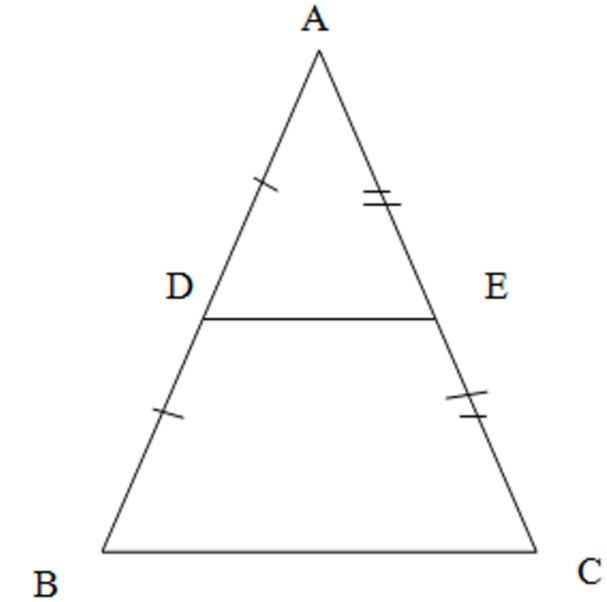
We have joined DE. . We know that lie joining the midpoints two sides will be parallel to the other side. So $DE||BC$. \[\]
We observe the triangles ADE and ABC. We have corresponding angles formed by the line AB cutting the parallel lines DE and BC . They will be equal. So we have $\angle ABC=\angle ADE$ . Similarly AC cuts the parallel lines DE and BC and makes equal corresponding angles$\angle AED=\angle ACB$. The angle $\angle BAC=\angle DAE$ is the common angle to both the triangles. So use angle-angle-angle similarity to conclude triangles $\Delta ADE\sim \Delta ABC$
So the sides will be in equal ratio which means
\[\begin{align}
& \dfrac{AD}{AB}=\dfrac{AE}{AC}=\dfrac{DE}{BC} \\
& \Rightarrow \dfrac{AD}{2AD}=\dfrac{AE}{2AE}=\dfrac{DE}{BC} \\
& \Rightarrow \dfrac{1}{2}=\dfrac{1}{2}=\dfrac{DE}{BC} \\
& \Rightarrow DE=\dfrac{1}{2}BC \\
\end{align}\]
(i)We are given that BC=8cm. So we find $DE=\dfrac{1}{2}BC=\dfrac{1}{2}\times 8=4$cm.
(ii) We are given $\angle DBC={{125}^{\circ }}$. So we have by corresponding angles $\angle ADE=\angle DBC={{125}^{\circ }}$ \[\]
(b) We are given
$\dfrac{{{9}^{n}}{{.3}^{2}}\cdot {{3}^{n}}-{{27}^{n}}}{{{2}^{3m}}}=\dfrac{1}{8},$
We proceed by replacing the composite numbers 9 and 27 by their prime factorization.
\[\begin{align}
& \dfrac{{{\left( 3\times 3 \right)}^{n}}{{.3}^{2}}{{.3}^{n}}-{{\left( 3\times 3\times 3 \right)}^{n}}}{{{2}^{3m}}}=\dfrac{1}{8} \\
& \Rightarrow \dfrac{{{\left( {{3}^{2}} \right)}^{n}}{{.3}^{2}}{{.3}^{n}}-{{\left( {{3}^{3}} \right)}^{n}}}{{{2}^{3m}}}=\dfrac{1}{8} \\
\end{align}\]
We use the formula ${{\left( {{a}^{m}} \right)}^{n}}={{a}^{mn}}$ where $a,m,n$ are real numbers and get
\[\Rightarrow \dfrac{{{3}^{2n}}{{.3}^{2}}{{.3}^{n}}-{{3}^{3n}}}{{{2}^{3m}}}=\dfrac{1}{8}\]
We use the formula ${{a}^{m}}\cdot {{a}^{n}}={{a}^{m+n}}$ and get
\[\begin{align}
& \Rightarrow \dfrac{{{3}^{3n+2}}-{{3}^{3n}}}{{{2}^{3m}}}=\dfrac{1}{8} \\
& \Rightarrow \dfrac{{{3}^{3n}}{{.3}^{2}}-{{3}^{3n}}}{{{2}^{3m}}}=\dfrac{1}{8} \\
& \Rightarrow \dfrac{{{3}^{3n}}\left( 9-1 \right)}{{{2}^{3m}}}=\dfrac{1}{8} \\
& \Rightarrow \dfrac{{{3}^{3n}}}{{{2}^{2m}}}=\dfrac{1}{8\times 8}=\dfrac{1}{64} \\
\end{align}\]
The above result is true when for integral values of $m,n$. The above is result true when ${{3}^{3n}}=1={{3}^{0}}$. Equating exponent we get $n=0$. Similarly we have ${{2}^{2m}}=64={{2}^{6}}$ and by equating exponents we get $m=3$. So the asked result is $m-n=3-0=3$\[\]
Note: We need to take care of confusion of similarity from congruence which is the equality of angles and sides of two different triangles. We can only find a non-integral solution when the base of the exponents $m,n$ are the same. We take care of the fact when we use the formula ${{\left( {{a}^{m}} \right)}^{n}}={{a}^{mn}}$ that both $a$ and $m$ are not zero at the same time.
Complete step-by-step solution:
(a) We have the triangle ABC , D is the midpoint o f AB and E is the midpoint of AC , $AD=DB,AE=EB$ So we have
\[\begin{align}
& AB=AD+DB=AD+AD=2AD \\
& AC=AE+EC=AE+AE=2AE \\
\end{align}\]
We have joined DE. . We know that lie joining the midpoints two sides will be parallel to the other side. So $DE||BC$. \[\]
We observe the triangles ADE and ABC. We have corresponding angles formed by the line AB cutting the parallel lines DE and BC . They will be equal. So we have $\angle ABC=\angle ADE$ . Similarly AC cuts the parallel lines DE and BC and makes equal corresponding angles$\angle AED=\angle ACB$. The angle $\angle BAC=\angle DAE$ is the common angle to both the triangles. So use angle-angle-angle similarity to conclude triangles $\Delta ADE\sim \Delta ABC$
So the sides will be in equal ratio which means
\[\begin{align}
& \dfrac{AD}{AB}=\dfrac{AE}{AC}=\dfrac{DE}{BC} \\
& \Rightarrow \dfrac{AD}{2AD}=\dfrac{AE}{2AE}=\dfrac{DE}{BC} \\
& \Rightarrow \dfrac{1}{2}=\dfrac{1}{2}=\dfrac{DE}{BC} \\
& \Rightarrow DE=\dfrac{1}{2}BC \\
\end{align}\]
(i)We are given that BC=8cm. So we find $DE=\dfrac{1}{2}BC=\dfrac{1}{2}\times 8=4$cm.
(ii) We are given $\angle DBC={{125}^{\circ }}$. So we have by corresponding angles $\angle ADE=\angle DBC={{125}^{\circ }}$ \[\]
(b) We are given
$\dfrac{{{9}^{n}}{{.3}^{2}}\cdot {{3}^{n}}-{{27}^{n}}}{{{2}^{3m}}}=\dfrac{1}{8},$
We proceed by replacing the composite numbers 9 and 27 by their prime factorization.
\[\begin{align}
& \dfrac{{{\left( 3\times 3 \right)}^{n}}{{.3}^{2}}{{.3}^{n}}-{{\left( 3\times 3\times 3 \right)}^{n}}}{{{2}^{3m}}}=\dfrac{1}{8} \\
& \Rightarrow \dfrac{{{\left( {{3}^{2}} \right)}^{n}}{{.3}^{2}}{{.3}^{n}}-{{\left( {{3}^{3}} \right)}^{n}}}{{{2}^{3m}}}=\dfrac{1}{8} \\
\end{align}\]
We use the formula ${{\left( {{a}^{m}} \right)}^{n}}={{a}^{mn}}$ where $a,m,n$ are real numbers and get
\[\Rightarrow \dfrac{{{3}^{2n}}{{.3}^{2}}{{.3}^{n}}-{{3}^{3n}}}{{{2}^{3m}}}=\dfrac{1}{8}\]
We use the formula ${{a}^{m}}\cdot {{a}^{n}}={{a}^{m+n}}$ and get
\[\begin{align}
& \Rightarrow \dfrac{{{3}^{3n+2}}-{{3}^{3n}}}{{{2}^{3m}}}=\dfrac{1}{8} \\
& \Rightarrow \dfrac{{{3}^{3n}}{{.3}^{2}}-{{3}^{3n}}}{{{2}^{3m}}}=\dfrac{1}{8} \\
& \Rightarrow \dfrac{{{3}^{3n}}\left( 9-1 \right)}{{{2}^{3m}}}=\dfrac{1}{8} \\
& \Rightarrow \dfrac{{{3}^{3n}}}{{{2}^{2m}}}=\dfrac{1}{8\times 8}=\dfrac{1}{64} \\
\end{align}\]
The above result is true when for integral values of $m,n$. The above is result true when ${{3}^{3n}}=1={{3}^{0}}$. Equating exponent we get $n=0$. Similarly we have ${{2}^{2m}}=64={{2}^{6}}$ and by equating exponents we get $m=3$. So the asked result is $m-n=3-0=3$\[\]
Note: We need to take care of confusion of similarity from congruence which is the equality of angles and sides of two different triangles. We can only find a non-integral solution when the base of the exponents $m,n$ are the same. We take care of the fact when we use the formula ${{\left( {{a}^{m}} \right)}^{n}}={{a}^{mn}}$ that both $a$ and $m$ are not zero at the same time.
Recently Updated Pages
Basicity of sulphurous acid and sulphuric acid are

Master Class 12 Economics: Engaging Questions & Answers for Success
Master Class 12 Biology: Engaging Questions & Answers for Success
Master Class 11 English: Engaging Questions & Answers for Success
Master Class 11 Physics: Engaging Questions & Answers for Success
Master Class 11 Computer Science: Engaging Questions & Answers for Success
Trending doubts
What is the Total Duration of Football Match?
Explain the Treaty of Vienna of 1815 class 10 social science CBSE
In football, which nation is called "La Roja"?
Why is there a time difference of about 5 hours between class 10 social science CBSE
10 examples of evaporation in daily life with explanations
What is the full form of POSCO class 10 social science CBSE