




Calculate the bond order of $ O_{2}^{+} $ and $ O_{2}^{-} $
Answer
 Verified
582k+ views
Hint :We know that first draw a molecular orbital diagram (MOT) where the atomic orbitals combine to form molecular orbitals. The total electrons associated with the molecules are filled in the MOT diagram. To solve this question, we need to write the molecular orbital configuration. To find out the bond order from the molecular orbital configuration is: $ Bond\text{ }order\text{ = }\dfrac{1}{2}\left[ Bonding\text{ }-\text{ }antibonding \right] $
Complete Step By Step Answer:
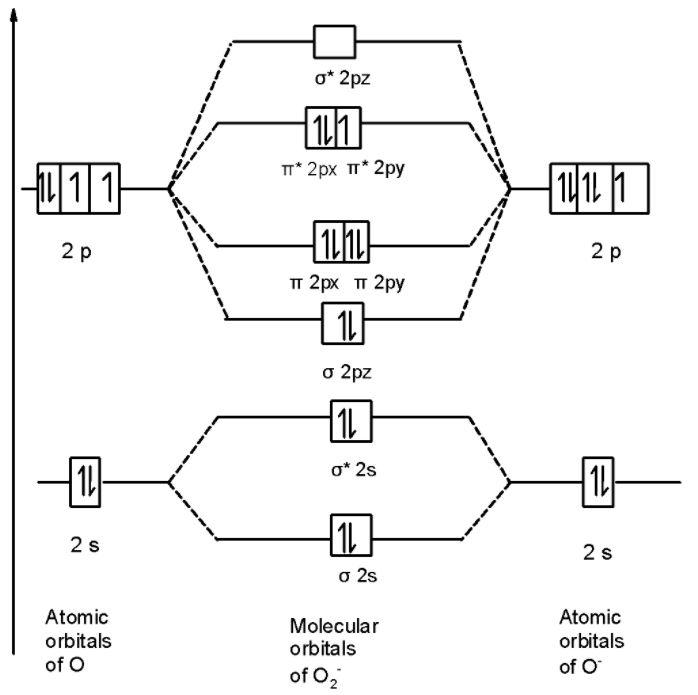
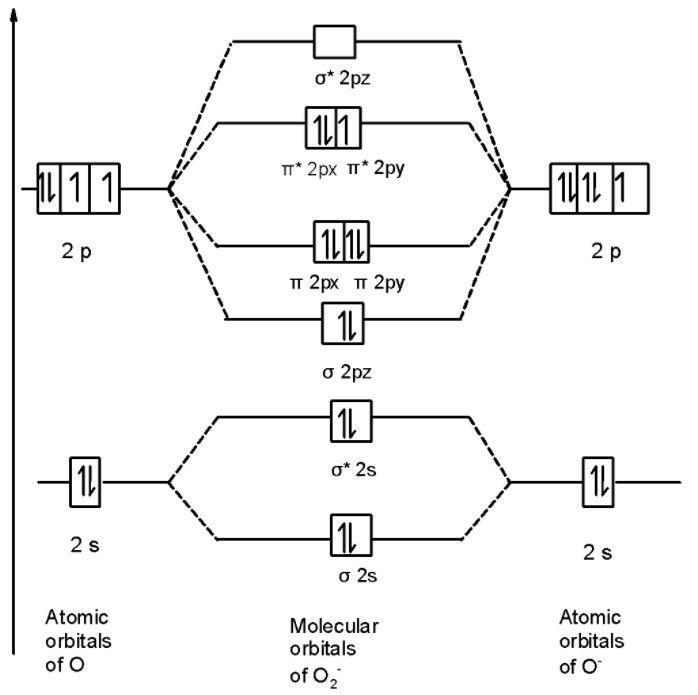
Let’s first draw the MOT of the oxygen molecule. The oxygen molecule contains the $ 16 $ electrons. The bond order may be defined as half the difference between the number of electrons in bonding molecular orbitals (Nonbonding) and the number of electrons in the antibonding molecular orbital.
And for $ O_{2}^{-} $
And for $ O_{2}^{+} $
Let us calculate the bond order
Bond order $ (B.O)\text{ }\dfrac{1}{2}\times $ [Number of an electron in antibonding molecular orbitals] – [Number of electrons in bonding molecular orbitals]
The higher the order of the bond the greater the pull between the two atoms and the shorter the length of the bond.
B.O for $ {{O}_{2~}}=\dfrac{1}{2}\times \left[ 106 \right]=2. $
B.O for $ O_{2}^{-}=\dfrac{1}{2}\times \left[ 10-7 \right]=1.5 $
B.O for $ O_{2}^{+}~=\dfrac{1}{2}\times \left[ 10-5 \right]=2.5 $
B.O for $ O_{2}^{2-}~=\dfrac{1}{2}\times \left[ 108 \right]=1 $
Therefore, the increasing order of bond length for these species is $ O_{2}^{+}~ < {{O}_{2}}~ < O_{2}^{-}~ < O_{2}^{2-} $
Note :
Remember that you should notice that bond order is indirectly proportional to the length of the bond. The higher the bond order, the shorter and stronger will be the bond. The addition of each electron in the antibonding molecular orbital will decrease the bond order.
Complete Step By Step Answer:
Let’s first draw the MOT of the oxygen molecule. The oxygen molecule contains the $ 16 $ electrons. The bond order may be defined as half the difference between the number of electrons in bonding molecular orbitals (Nonbonding) and the number of electrons in the antibonding molecular orbital.
And for $ O_{2}^{-} $
And for $ O_{2}^{+} $
Let us calculate the bond order
Bond order $ (B.O)\text{ }\dfrac{1}{2}\times $ [Number of an electron in antibonding molecular orbitals] – [Number of electrons in bonding molecular orbitals]
The higher the order of the bond the greater the pull between the two atoms and the shorter the length of the bond.
B.O for $ {{O}_{2~}}=\dfrac{1}{2}\times \left[ 106 \right]=2. $
B.O for $ O_{2}^{-}=\dfrac{1}{2}\times \left[ 10-7 \right]=1.5 $
B.O for $ O_{2}^{+}~=\dfrac{1}{2}\times \left[ 10-5 \right]=2.5 $
B.O for $ O_{2}^{2-}~=\dfrac{1}{2}\times \left[ 108 \right]=1 $
Therefore, the increasing order of bond length for these species is $ O_{2}^{+}~ < {{O}_{2}}~ < O_{2}^{-}~ < O_{2}^{2-} $
Note :
Remember that you should notice that bond order is indirectly proportional to the length of the bond. The higher the bond order, the shorter and stronger will be the bond. The addition of each electron in the antibonding molecular orbital will decrease the bond order.
Recently Updated Pages
Which will be the least stable resonating structure class 11 chemistry CBSE

How many 5 digit telephone numbers can be construc-class-11-maths-CBSE
How do you find the angle of the resultant vector class 11 physics CBSE
Draw labelled diagram of the following i Gram seed class 11 biology CBSE
1 Quintal is equal to a 110 kg b 10 kg c 100kg d 1000 class 11 physics CBSE
What is the need and importance of classification class 11 biology CBSE
Trending doubts
One Metric ton is equal to kg A 10000 B 1000 C 100 class 11 physics CBSE
Find the value of the expression given below sin 30circ class 11 maths CBSE
Draw a diagram of nephron and explain its structur class 11 biology CBSE
10 examples of friction in our daily life
Proton was discovered by A Thomson B Rutherford C Chadwick class 11 chemistry CBSE
The teeth used for biting and cutting food are called class 11 biology CBSE