




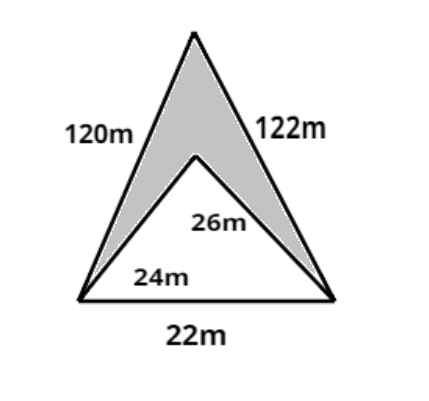
Calculate the area of the shaded region in the given figure.
$
(a){\text{ 1074}}{{\text{m}}^2} \\
(b){\text{ 1274}}{{\text{m}}^2} \\
(c){\text{ 1174}}{{\text{m}}^2} \\
(d){\text{ 1004}}{{\text{m}}^2} \\
$
Answer
 Verified
564k+ views
Hint – In this question use the length of the sides given to compute the perimeter of the triangle, then using this perimeter compute the area of the triangles via formula $A = \sqrt {s\left( {s - a} \right)\left( {s - b} \right)\left( {s - c} \right)} $, where s is the perimeter. The required shaded area will be the area of the larger triangle subtracted with that of the smaller triangle.
Complete Step-by-Step solution:
As we know area (A) of triangle is
$ \Rightarrow A = \sqrt {s\left( {s - a} \right)\left( {s - b} \right)\left( {s - c} \right)} $
Where (s) is half of the perimeter and a, b and c are the sides of the triangle.
So the area (A1) of the bigger triangle is where a = 120m, b= 122m, c = 22m.
$ \Rightarrow s = \dfrac{{a + b + c}}{2} = \dfrac{{120 + 122 + 22}}{2} = 132$meter.
$ \Rightarrow {A_1} = \sqrt {132\left( {132 - 120} \right)\left( {132 - 122} \right)\left( {132 - 22} \right)} = \sqrt {132\left( {12} \right)\left( {10} \right)\left( {110} \right)} = \sqrt {132 \times 132 \times 100} = 1320{\text{ }}{{\text{m}}^2}$Now the area (A2) of the smaller triangle is where a = 24m, b = 26m, c = 22m.
$ \Rightarrow s = \dfrac{{a + b + c}}{2} = \dfrac{{24 + 26 + 22}}{2} = 36$meter.
$ \Rightarrow {A_2} = \sqrt {36\left( {36 - 24} \right)\left( {36 - 26} \right)\left( {36 - 22} \right)} = \sqrt {36\left( {12} \right)\left( {10} \right)\left( {14} \right)} = 245.92{\text{ }}{{\text{m}}^2}$
So the area (A) of the shaded region is the difference of area of bigger triangle and area of smaller triangle.
$ \Rightarrow A = {A_1} - {A_2}$
$ \Rightarrow A = 1320 - 245.92 = 1074.08 \simeq 1074{\text{ }}{{\text{m}}^2}$
So this is the required answer.
Hence option (A) is correct.
Note – In this question the perimeter is calculated using the sides as the perimeter is the sum of all sides, thus we have added all the sides. It is always advised to have a good understanding of the diagrammatic representation in the area problems as it helps figuring out the correct portion to whose area is to be calculated.
Complete Step-by-Step solution:
As we know area (A) of triangle is
$ \Rightarrow A = \sqrt {s\left( {s - a} \right)\left( {s - b} \right)\left( {s - c} \right)} $
Where (s) is half of the perimeter and a, b and c are the sides of the triangle.
So the area (A1) of the bigger triangle is where a = 120m, b= 122m, c = 22m.
$ \Rightarrow s = \dfrac{{a + b + c}}{2} = \dfrac{{120 + 122 + 22}}{2} = 132$meter.
$ \Rightarrow {A_1} = \sqrt {132\left( {132 - 120} \right)\left( {132 - 122} \right)\left( {132 - 22} \right)} = \sqrt {132\left( {12} \right)\left( {10} \right)\left( {110} \right)} = \sqrt {132 \times 132 \times 100} = 1320{\text{ }}{{\text{m}}^2}$Now the area (A2) of the smaller triangle is where a = 24m, b = 26m, c = 22m.
$ \Rightarrow s = \dfrac{{a + b + c}}{2} = \dfrac{{24 + 26 + 22}}{2} = 36$meter.
$ \Rightarrow {A_2} = \sqrt {36\left( {36 - 24} \right)\left( {36 - 26} \right)\left( {36 - 22} \right)} = \sqrt {36\left( {12} \right)\left( {10} \right)\left( {14} \right)} = 245.92{\text{ }}{{\text{m}}^2}$
So the area (A) of the shaded region is the difference of area of bigger triangle and area of smaller triangle.
$ \Rightarrow A = {A_1} - {A_2}$
$ \Rightarrow A = 1320 - 245.92 = 1074.08 \simeq 1074{\text{ }}{{\text{m}}^2}$
So this is the required answer.
Hence option (A) is correct.
Note – In this question the perimeter is calculated using the sides as the perimeter is the sum of all sides, thus we have added all the sides. It is always advised to have a good understanding of the diagrammatic representation in the area problems as it helps figuring out the correct portion to whose area is to be calculated.
Recently Updated Pages
Master Class 11 English: Engaging Questions & Answers for Success

Master Class 11 Social Science: Engaging Questions & Answers for Success
Master Class 11 Maths: Engaging Questions & Answers for Success
Master Class 11 Biology: Engaging Questions & Answers for Success
Master Class 11 Physics: Engaging Questions & Answers for Success
Master Class 11 Chemistry: Engaging Questions & Answers for Success
Trending doubts
Explain the Treaty of Vienna of 1815 class 10 social science CBSE
What is the full form of POSCO class 10 social science CBSE
Define Potential, Developed, Stock and Reserved resources
The diagonals of a rhombus are 10cm and 24cm Find the class 10 maths CBSE
Fill the blanks with proper collective nouns 1 A of class 10 english CBSE
One number is chosen from numbers 1 to 200 Find the class 10 maths CBSE