




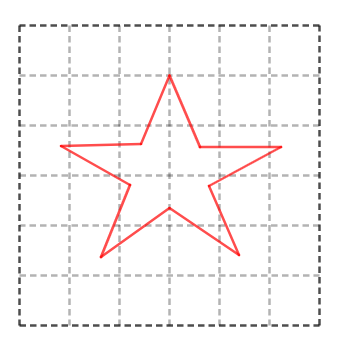
Calculate the area of irregular shape, if each square has side length of \[1cm\]. If the area is covering more than half of the square, then consider it as a full square.
(A) Area is approximately \[10sq.cm\]
(B) Area is approximately \[10sq.m\]
(C) Area is approximately \[6sq.cm\]
(D) Area is approximately \[6sq.m\]
Answer
 Verified
507k+ views
Hint:We are given an irregular shape and we are asked to find its area by counting the number of squares the given shape is spanned over. Each square has a side length of \[1cm\]. And we will count only those squares which are completely covered by the given shape and also those squares whose more than half area is covered by the given shape. Then, to find the area, we will multiply the number of squares with the area of one square block of side length \[1cm\]. Hence, we will have the required area of the given irregular shape.
Complete step-by-step solution:
According to the given question, we are given an irregular shape and we are asked to find its area by counting the number of squares the given shape is spanned over.
We will first count the number of squares covered by the given shape. Here, we will also consider those squares whose more than half area is covered by the given shape.
Number of squares completely covered (or almost completely covered) = \[4\] squares
Number of square which are covered more than half or almost more than half = \[2\] squares
So, the total number of squares satisfying the criteria (from the given figure) = \[6\] squares
Side of the square = \[1cm\]
Area of the square = \[{{\left( side \right)}^{2}}\]
\[\Rightarrow {{\left( 1 \right)}^{2}}=1c{{m}^{2}}\]
Total area of the given shape (approx.) = \[1\times 6\]
\[\Rightarrow 6c{{m}^{2}}\]
Therefore, the correct option is (C) Area is approximately \[6sq.cm\].
Note: The number of squares should be counted carefully as it is the deciding factor. Also a glance at the given options might help to narrow the answer. And after counting the number of squares covered by the shape, do not forget to calculate the area or else it will be incomplete.
Complete step-by-step solution:
According to the given question, we are given an irregular shape and we are asked to find its area by counting the number of squares the given shape is spanned over.
We will first count the number of squares covered by the given shape. Here, we will also consider those squares whose more than half area is covered by the given shape.
Number of squares completely covered (or almost completely covered) = \[4\] squares
Number of square which are covered more than half or almost more than half = \[2\] squares
So, the total number of squares satisfying the criteria (from the given figure) = \[6\] squares
Side of the square = \[1cm\]
Area of the square = \[{{\left( side \right)}^{2}}\]
\[\Rightarrow {{\left( 1 \right)}^{2}}=1c{{m}^{2}}\]
Total area of the given shape (approx.) = \[1\times 6\]
\[\Rightarrow 6c{{m}^{2}}\]
Therefore, the correct option is (C) Area is approximately \[6sq.cm\].
Note: The number of squares should be counted carefully as it is the deciding factor. Also a glance at the given options might help to narrow the answer. And after counting the number of squares covered by the shape, do not forget to calculate the area or else it will be incomplete.
Recently Updated Pages
Master Class 10 Computer Science: Engaging Questions & Answers for Success

Master Class 10 General Knowledge: Engaging Questions & Answers for Success
Master Class 10 English: Engaging Questions & Answers for Success
Master Class 10 Social Science: Engaging Questions & Answers for Success
Master Class 10 Maths: Engaging Questions & Answers for Success
Master Class 10 Science: Engaging Questions & Answers for Success
Trending doubts
What is the median of the first 10 natural numbers class 10 maths CBSE
Which women's tennis player has 24 Grand Slam singles titles?
Who is the Brand Ambassador of Incredible India?
Why is there a time difference of about 5 hours between class 10 social science CBSE
Write a letter to the principal requesting him to grant class 10 english CBSE
A moving boat is observed from the top of a 150 m high class 10 maths CBSE