




Calculate the area of a quadrilateral PQRS whose diagonal $PR = 20cm$and the lengths of perpendicular from Q and S on PR is $12cm\,\,and\,\,10cm$respectively.
Answer
 Verified
575.7k+ views
Hint:We will use the properties of triangles in a quadrilateral and areas of triangles to find the area of the quadrilateral ABCD.
Complete answer:
Here, it is given that PQRS is a quadrilateral in which diagonal $PR = 20cm$and length of perpendiculars from point Q and S are $12cm\,\,and\,\,10cm$respectively.
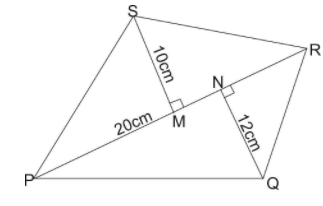
From the figure it is very much clear that diagonal PR divides quadrilateral PQRS in two triangles.
Therefore, its area can be calculated by calculating the area of two triangles PQR and PSR and then adding them.
Area of triangle PQR is given as: $\dfrac{1}{2} \times base \times altitude$
Substituting, value of base and altitude in above. We have,
$
\Rightarrow ar\left( {\Delta PQR} \right) = \dfrac{1}{2} \times 20 \times 12 \\
\Rightarrow ar\left( {\Delta PQR} \right) = 10 \times 12 \\
\Rightarrow ar\left( {\Delta PQR} \right) = 120 \\
$
Therefore, area of a triangle PQR is $120\,\,c{m^2}$………………..(i)
Area of triangle PSR is given as: $\dfrac{1}{2} \times base \times altitude$
Substituting, value of base and altitude in above. We have,
$
\Rightarrow ar\left( {\Delta PSR} \right) = \dfrac{1}{2} \times 20 \times 10 \\
\Rightarrow ar\left( {\Delta PSR} \right) = 10 \times 10 \\
\Rightarrow ar\left( {\Delta PSR} \right) = 100 \\
$
Therefore, area of a triangle PSR is $100\,\,c{m^2}$………………..(ii)
Adding (i) and (ii) we have
$
\Rightarrow ar\left( {\Delta PSR} \right) + ar\left( {\Delta PQR} \right) = 100 + 120 \\
\Rightarrow ar\left( {Qd.\,PQRS} \right) = 220 \\
$
Therefore, from above we see that area of a quadrilateral PQRS is $220\,c{m^2}$
Note: We can also find the area of a quadrilateral in another way. In this way instead of dividing a quadrilateral in two parts. We directly apply a mensuration formula to find the area of the quadrilateral. Which is$\dfrac{1}{2}\left( {{p_1} + {p_2}} \right) \times D$, where ${p_1}\,and\,\,{p_2}$are perpendiculars and ‘D’ is the longest diagonal of the quadrilateral.
Complete answer:
Here, it is given that PQRS is a quadrilateral in which diagonal $PR = 20cm$and length of perpendiculars from point Q and S are $12cm\,\,and\,\,10cm$respectively.
From the figure it is very much clear that diagonal PR divides quadrilateral PQRS in two triangles.
Therefore, its area can be calculated by calculating the area of two triangles PQR and PSR and then adding them.
Area of triangle PQR is given as: $\dfrac{1}{2} \times base \times altitude$
Substituting, value of base and altitude in above. We have,
$
\Rightarrow ar\left( {\Delta PQR} \right) = \dfrac{1}{2} \times 20 \times 12 \\
\Rightarrow ar\left( {\Delta PQR} \right) = 10 \times 12 \\
\Rightarrow ar\left( {\Delta PQR} \right) = 120 \\
$
Therefore, area of a triangle PQR is $120\,\,c{m^2}$………………..(i)
Area of triangle PSR is given as: $\dfrac{1}{2} \times base \times altitude$
Substituting, value of base and altitude in above. We have,
$
\Rightarrow ar\left( {\Delta PSR} \right) = \dfrac{1}{2} \times 20 \times 10 \\
\Rightarrow ar\left( {\Delta PSR} \right) = 10 \times 10 \\
\Rightarrow ar\left( {\Delta PSR} \right) = 100 \\
$
Therefore, area of a triangle PSR is $100\,\,c{m^2}$………………..(ii)
Adding (i) and (ii) we have
$
\Rightarrow ar\left( {\Delta PSR} \right) + ar\left( {\Delta PQR} \right) = 100 + 120 \\
\Rightarrow ar\left( {Qd.\,PQRS} \right) = 220 \\
$
Therefore, from above we see that area of a quadrilateral PQRS is $220\,c{m^2}$
Note: We can also find the area of a quadrilateral in another way. In this way instead of dividing a quadrilateral in two parts. We directly apply a mensuration formula to find the area of the quadrilateral. Which is$\dfrac{1}{2}\left( {{p_1} + {p_2}} \right) \times D$, where ${p_1}\,and\,\,{p_2}$are perpendiculars and ‘D’ is the longest diagonal of the quadrilateral.
Recently Updated Pages
Master Class 10 Computer Science: Engaging Questions & Answers for Success

Master Class 10 General Knowledge: Engaging Questions & Answers for Success
Master Class 10 English: Engaging Questions & Answers for Success
Master Class 10 Social Science: Engaging Questions & Answers for Success
Master Class 10 Maths: Engaging Questions & Answers for Success
Master Class 10 Science: Engaging Questions & Answers for Success
Trending doubts
What is the median of the first 10 natural numbers class 10 maths CBSE
Which women's tennis player has 24 Grand Slam singles titles?
Who is the Brand Ambassador of Incredible India?
Why is there a time difference of about 5 hours between class 10 social science CBSE
Write a letter to the principal requesting him to grant class 10 english CBSE
A moving boat is observed from the top of a 150 m high class 10 maths CBSE