




How do I calculate the area of a hexagon?
Answer
 Verified
573k+ views
Hint: At first, we join all the opposite vertices of the hexagon. This gives rise to six equilateral and congruent triangles. We need to find the area of one of the triangles and multiply it with $6$ .
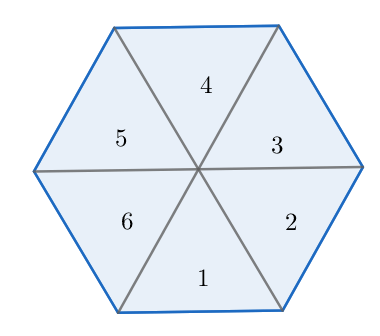
Complete step by step solution:
Hexagon can be of two types: regular and irregular. Regular hexagon is the one in which the lengths of all the sides are the same. We now join the opposite vertices of the hexagon. So, we get six diagonals and six internal triangles. Now, since the hexagon is regular, the six sides must subtend equal angles at the centre of the hexagon. The sum of the angles subtended is definitely ${{360}^{\circ }}$ and the six subtended angles being equal, each of them must be $\dfrac{{{360}^{\circ }}}{6}={{60}^{\circ }}$ . Also, all the diagonals are of equal lengths. This means that the sides of the internal triangles must also be same. This can only be possible if all the six triangles are equilateral.
Thus, the six triangles are equilateral and congruent. So, to find out the area of a regular hexagon, we need to only find out the area of one of the six equilateral triangles and multiply the area with $6$ . Now, let the side of the regular hexagon be of length $x$ (say). Then, the side of the equilateral triangle must also be $x$ . We know that if the length of the side of an equilateral triangle is $x$ , the formula for its area will be,
$area\left( \Delta \right)=\dfrac{\sqrt{3}}{4}{{x}^{2}}$
The area of the hexagon will then be,
$\Rightarrow area\left( hexagon \right)=6\times \dfrac{\sqrt{3}}{4}{{x}^{2}}=\dfrac{3\sqrt{3}}{2}{{x}^{2}}$
Therefore, we have seen how to find the area of a regular hexagon.
Note: These types of problems are very easy, there are less chances of mistakes. Nevertheless, we should be careful and should remember to multiply the area of the equilateral triangle with $6$ . Also, there is a predefined formula for the area of a regular hexagon, which is $\dfrac{3\sqrt{3}}{2}{{x}^{2}}$ where, $x$ is the length of the side of the hexagon.
Complete step by step solution:
Hexagon can be of two types: regular and irregular. Regular hexagon is the one in which the lengths of all the sides are the same. We now join the opposite vertices of the hexagon. So, we get six diagonals and six internal triangles. Now, since the hexagon is regular, the six sides must subtend equal angles at the centre of the hexagon. The sum of the angles subtended is definitely ${{360}^{\circ }}$ and the six subtended angles being equal, each of them must be $\dfrac{{{360}^{\circ }}}{6}={{60}^{\circ }}$ . Also, all the diagonals are of equal lengths. This means that the sides of the internal triangles must also be same. This can only be possible if all the six triangles are equilateral.
Thus, the six triangles are equilateral and congruent. So, to find out the area of a regular hexagon, we need to only find out the area of one of the six equilateral triangles and multiply the area with $6$ . Now, let the side of the regular hexagon be of length $x$ (say). Then, the side of the equilateral triangle must also be $x$ . We know that if the length of the side of an equilateral triangle is $x$ , the formula for its area will be,
$area\left( \Delta \right)=\dfrac{\sqrt{3}}{4}{{x}^{2}}$
The area of the hexagon will then be,
$\Rightarrow area\left( hexagon \right)=6\times \dfrac{\sqrt{3}}{4}{{x}^{2}}=\dfrac{3\sqrt{3}}{2}{{x}^{2}}$
Therefore, we have seen how to find the area of a regular hexagon.
Note: These types of problems are very easy, there are less chances of mistakes. Nevertheless, we should be careful and should remember to multiply the area of the equilateral triangle with $6$ . Also, there is a predefined formula for the area of a regular hexagon, which is $\dfrac{3\sqrt{3}}{2}{{x}^{2}}$ where, $x$ is the length of the side of the hexagon.

Recently Updated Pages
Master Class 12 Business Studies: Engaging Questions & Answers for Success

Master Class 12 Biology: Engaging Questions & Answers for Success
Master Class 12 Chemistry: Engaging Questions & Answers for Success
Class 12 Question and Answer - Your Ultimate Solutions Guide
Master Class 11 Social Science: Engaging Questions & Answers for Success
Master Class 11 English: Engaging Questions & Answers for Success
Trending doubts
What is BLO What is the full form of BLO class 8 social science CBSE
Citizens of India can vote at the age of A 18 years class 8 social science CBSE
Right to vote is a AFundamental Right BFundamental class 8 social science CBSE
Give me the opposite gender of Duck class 8 english CBSE
What are the 12 elements of nature class 8 chemistry CBSE
Full form of STD, ISD and PCO