




Calculate the angle of
( a ) ${{1}^{{}^\circ }}$ (degree)
( b ) $1'$ (minute of arc or arcmin)
( c ) $1''$ ( second of arc or arc second) in radian.
Use ${{360}^{{}^\circ }}=2\pi rad$ , ${{1}^{{}^\circ }}=60'$ and $1'=60''$ .
Answer
 Verified
552.4k+ views
Hint: For this question what we will do is we will take help of relation between degrees, minutes and seconds with radian measure and will evaluate the value of ${{1}^{{}^\circ }}$ , 1’ and 1” in radians as ${{1}^{\text{ }\!\!{}^\circ\!\!\text{ }}}=\dfrac{2\pi }{360}$ , ${{1}^{{}^\circ }}=60'$ and $1'=60''$.
Complete step-by-step answer:
Before solving let's see what are degree measures and radian measures.

If a rotation from the initial side to terminal side is ${{\left( \dfrac{1}{360} \right)}^{th}}$ revolution, the angle is said to have a measure of on degree written as ${{1}^{{}^\circ }}$and ${{1}^{{}^\circ }}$ is divided into 60 minute and 1 minute is divided into 60 seconds, thus ${{1}^{{}^\circ }}=60'$ and $1'=60''$
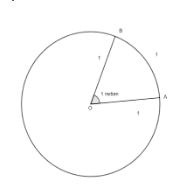
Angles subtended at the centre by an arc of length of 1 unit in a unit circle that is a circle with radius 1 unit is said to have a measure of 1 radian.
Now, relation between degree and radian is $\text{2 }\!\!\pi\!\!\text{ radian=36}{{\text{0}}^{\text{ }\!\!{}^\circ\!\!\text{ }}}$, where $\pi =\dfrac{22}{7}$ or $\pi =3.14$
Now in question we have to find values of ${{1}^{{}^\circ }}$ (degree), $1'$ (minute of arc or arcmin), $1''$ ( second of arc or arc second) in radian.
Now, we know that $\text{2 }\!\!\pi\!\!\text{ radian=36}{{\text{0}}^{\text{ }\!\!{}^\circ\!\!\text{ }}}$
So, taking $\text{36}{{\text{0}}^{\text{ }\!\!{}^\circ\!\!\text{ }}}$ from numerator of right hand side to denominator of left hand side, we get
${{1}^{\text{ }\!\!{}^\circ\!\!\text{ }}}=\dfrac{2\pi }{360}$
On solving we get
${{1}^{\text{ }\!\!{}^\circ\!\!\text{ }}}=\dfrac{\pi }{180}$radian or approximately 0.07146 radian.
Now, we know that ${{1}^{{}^\circ }}=60'$
So, we can write${{1}^{\text{ }\!\!{}^\circ\!\!\text{ }}}=\dfrac{\pi }{180}$ as $60'=\dfrac{\pi }{180}$
Taking 60 from numerator of left hand side to denominator of right hand side, we get
$1'=\dfrac{\pi }{60\times 180}$radians
On solving we get
$1'=0.000291$ radians
Now, we also know that $1'=60''$
So, we can write$60'=\dfrac{\pi }{180}$ as $(60\times 60)''=\dfrac{\pi }{180}$
Taking $60\times 60$ from numerator of left hand side to denominator of right hand side, we get
$1''=\dfrac{\pi }{3600\times 180}$radians
On solving we get
$1''=0.00000485$ radians
Note: For solving these types of questions one must know the relation of degrees, minutes and seconds with radian measure that is ${{1}^{\text{ }\!\!{}^\circ\!\!\text{ }}}=\dfrac{2\pi }{360}$, ${{1}^{{}^\circ }}=60'$ and $1'=60''$. Now, in the calculation part it is not necessary to solve the value of radian by putting the value of $\pi $ but if you solve it be careful of complex calculation.
Complete step-by-step answer:
Before solving let's see what are degree measures and radian measures.
If a rotation from the initial side to terminal side is ${{\left( \dfrac{1}{360} \right)}^{th}}$ revolution, the angle is said to have a measure of on degree written as ${{1}^{{}^\circ }}$and ${{1}^{{}^\circ }}$ is divided into 60 minute and 1 minute is divided into 60 seconds, thus ${{1}^{{}^\circ }}=60'$ and $1'=60''$
Angles subtended at the centre by an arc of length of 1 unit in a unit circle that is a circle with radius 1 unit is said to have a measure of 1 radian.
Now, relation between degree and radian is $\text{2 }\!\!\pi\!\!\text{ radian=36}{{\text{0}}^{\text{ }\!\!{}^\circ\!\!\text{ }}}$, where $\pi =\dfrac{22}{7}$ or $\pi =3.14$
Now in question we have to find values of ${{1}^{{}^\circ }}$ (degree), $1'$ (minute of arc or arcmin), $1''$ ( second of arc or arc second) in radian.
Now, we know that $\text{2 }\!\!\pi\!\!\text{ radian=36}{{\text{0}}^{\text{ }\!\!{}^\circ\!\!\text{ }}}$
So, taking $\text{36}{{\text{0}}^{\text{ }\!\!{}^\circ\!\!\text{ }}}$ from numerator of right hand side to denominator of left hand side, we get
${{1}^{\text{ }\!\!{}^\circ\!\!\text{ }}}=\dfrac{2\pi }{360}$
On solving we get
${{1}^{\text{ }\!\!{}^\circ\!\!\text{ }}}=\dfrac{\pi }{180}$radian or approximately 0.07146 radian.
Now, we know that ${{1}^{{}^\circ }}=60'$
So, we can write${{1}^{\text{ }\!\!{}^\circ\!\!\text{ }}}=\dfrac{\pi }{180}$ as $60'=\dfrac{\pi }{180}$
Taking 60 from numerator of left hand side to denominator of right hand side, we get
$1'=\dfrac{\pi }{60\times 180}$radians
On solving we get
$1'=0.000291$ radians
Now, we also know that $1'=60''$
So, we can write$60'=\dfrac{\pi }{180}$ as $(60\times 60)''=\dfrac{\pi }{180}$
Taking $60\times 60$ from numerator of left hand side to denominator of right hand side, we get
$1''=\dfrac{\pi }{3600\times 180}$radians
On solving we get
$1''=0.00000485$ radians
Note: For solving these types of questions one must know the relation of degrees, minutes and seconds with radian measure that is ${{1}^{\text{ }\!\!{}^\circ\!\!\text{ }}}=\dfrac{2\pi }{360}$, ${{1}^{{}^\circ }}=60'$ and $1'=60''$. Now, in the calculation part it is not necessary to solve the value of radian by putting the value of $\pi $ but if you solve it be careful of complex calculation.
Recently Updated Pages
Master Class 11 English: Engaging Questions & Answers for Success

Master Class 11 Maths: Engaging Questions & Answers for Success
Class 11 Question and Answer - Your Ultimate Solutions Guide
Master Class 11 Biology: Engaging Questions & Answers for Success
Master Class 11 Physics: Engaging Questions & Answers for Success
Master Class 11 Accountancy: Engaging Questions & Answers for Success
Trending doubts
Differentiate between an exothermic and an endothermic class 11 chemistry CBSE
One Metric ton is equal to kg A 10000 B 1000 C 100 class 11 physics CBSE
In what year Guru Nanak Dev ji was born A15 April 1469 class 11 social science CBSE
Difference Between Prokaryotic Cells and Eukaryotic Cells
There are 720 permutations of the digits 1 2 3 4 5 class 11 maths CBSE
Draw a diagram of a plant cell and label at least eight class 11 biology CBSE