




Calculate $ \sin (2\arctan 2) $
Answer
 Verified
558.9k+ views
Hint: Here the question is related to the trigonometry where it contains the sine and tan function. The question is exactly related to inverse trigonometry because we see “arctan” which means tan inverse. Hence by applying the inverse trigonometry we can find the result.
Complete step-by-step answer:
The question is given as $ \sin (2\arctan 2) $
Now let us consider the $ x = \arctan 2 $ --- (1)
We know that the inverse is also called an arc. Therefore the equation (1) can be written as
$ x = {\tan ^{ - 1}}(2) $ --------- (2)
The equation (2) can be written as
$ \tan x = 2 $ ---------- (3)
By the considering the triangle we can define the $ \tan x $
Let us consider the right angled triangle ABC
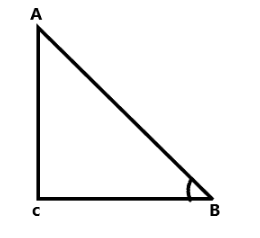
$ \tan x = \dfrac{{opposite}}{{adjacent}} = \dfrac{{AC}}{{BC}} $
$ \Rightarrow \dfrac{2}{1} = \dfrac{{AC}}{{BC}} $
Therefore the value of AC=2 and BC=1
By applying the Pythagoras theorem we have
$
A{B^2} = A{C^2} + B{C^2} \\
\Rightarrow A{B^2} = {(2)^2} + {(1)^2} \\
\Rightarrow A{B^2} = 4 + 1 \\
\Rightarrow A{B^2} = 5 \\
\Rightarrow AB = \sqrt 5 \;
$
Hence the length of the AB= $ \sqrt 5 $
Now we have to find the value of $ \sin 2x $
We know the trigonometry formula that is $ \sin 2x = 2.\sin x.cosx $ ----(4)
By considering the triangle we can find the value of sine and cosine.
So we have
$ \sin x = \dfrac{{opposite}}{{hypothesis}} = \dfrac{{AC}}{{AB}} $
As we know the value. Substituting we have
$ \Rightarrow \sin x = \dfrac{2}{{\sqrt 5 }} $ ---- (5)
$ \cos x = \dfrac{{adjacent}}{{hypothesis}} = \dfrac{{BC}}{{AB}} $
As we know the value. Substituting we have
$ \Rightarrow \cos x = \dfrac{1}{{\sqrt 5 }} $ ---- (6)
Substituting the equation (5) and equation (6) in equation (4) we have
$
\sin 2x = 2\sin x.\cos x \\
\Rightarrow \sin 2x = 2 \times \dfrac{2}{{\sqrt 5 }} \times \dfrac{1}{{\sqrt 5 }} \\
\Rightarrow \sin 2x = \dfrac{4}{5} \;
$
Hence we have obtained the required result.
Therefore, the value of $ \sin (2\arctan 2) = \dfrac{4}{5} $
So, the correct answer is “ $ \dfrac{4}{5} $ ”.
Note: The inverse is also called an arc. This word is used in question very rare. In most questions they will ask directly like find the inverse. The sine function, cosine function and tan function are defined by considering the right angled triangle. Hence we know about the Pythagoras theorem and to which type of triangle it is applicable.
Complete step-by-step answer:
The question is given as $ \sin (2\arctan 2) $
Now let us consider the $ x = \arctan 2 $ --- (1)
We know that the inverse is also called an arc. Therefore the equation (1) can be written as
$ x = {\tan ^{ - 1}}(2) $ --------- (2)
The equation (2) can be written as
$ \tan x = 2 $ ---------- (3)
By the considering the triangle we can define the $ \tan x $
Let us consider the right angled triangle ABC
$ \tan x = \dfrac{{opposite}}{{adjacent}} = \dfrac{{AC}}{{BC}} $
$ \Rightarrow \dfrac{2}{1} = \dfrac{{AC}}{{BC}} $
Therefore the value of AC=2 and BC=1
By applying the Pythagoras theorem we have
$
A{B^2} = A{C^2} + B{C^2} \\
\Rightarrow A{B^2} = {(2)^2} + {(1)^2} \\
\Rightarrow A{B^2} = 4 + 1 \\
\Rightarrow A{B^2} = 5 \\
\Rightarrow AB = \sqrt 5 \;
$
Hence the length of the AB= $ \sqrt 5 $
Now we have to find the value of $ \sin 2x $
We know the trigonometry formula that is $ \sin 2x = 2.\sin x.cosx $ ----(4)
By considering the triangle we can find the value of sine and cosine.
So we have
$ \sin x = \dfrac{{opposite}}{{hypothesis}} = \dfrac{{AC}}{{AB}} $
As we know the value. Substituting we have
$ \Rightarrow \sin x = \dfrac{2}{{\sqrt 5 }} $ ---- (5)
$ \cos x = \dfrac{{adjacent}}{{hypothesis}} = \dfrac{{BC}}{{AB}} $
As we know the value. Substituting we have
$ \Rightarrow \cos x = \dfrac{1}{{\sqrt 5 }} $ ---- (6)
Substituting the equation (5) and equation (6) in equation (4) we have
$
\sin 2x = 2\sin x.\cos x \\
\Rightarrow \sin 2x = 2 \times \dfrac{2}{{\sqrt 5 }} \times \dfrac{1}{{\sqrt 5 }} \\
\Rightarrow \sin 2x = \dfrac{4}{5} \;
$
Hence we have obtained the required result.
Therefore, the value of $ \sin (2\arctan 2) = \dfrac{4}{5} $
So, the correct answer is “ $ \dfrac{4}{5} $ ”.
Note: The inverse is also called an arc. This word is used in question very rare. In most questions they will ask directly like find the inverse. The sine function, cosine function and tan function are defined by considering the right angled triangle. Hence we know about the Pythagoras theorem and to which type of triangle it is applicable.
Recently Updated Pages
Master Class 11 Computer Science: Engaging Questions & Answers for Success

Master Class 11 Business Studies: Engaging Questions & Answers for Success
Master Class 11 Economics: Engaging Questions & Answers for Success
Master Class 11 English: Engaging Questions & Answers for Success
Master Class 11 Maths: Engaging Questions & Answers for Success
Master Class 11 Biology: Engaging Questions & Answers for Success
Trending doubts
One Metric ton is equal to kg A 10000 B 1000 C 100 class 11 physics CBSE
There are 720 permutations of the digits 1 2 3 4 5 class 11 maths CBSE
Discuss the various forms of bacteria class 11 biology CBSE
Draw a diagram of a plant cell and label at least eight class 11 biology CBSE
State the laws of reflection of light
Explain zero factorial class 11 maths CBSE