




By the electrolysis of aqueous sodium succinate, ethene is formed at ………..along with ………..
A. Anode, ${ H }_{ 2 }$
B. Cathode, ${ H }_{ 2 }$
C. Anode, ${ CO }_{ 2 }$
D. Cathode, ${ CO }_{ 2 }$
Answer
 Verified
628.2k+ views
Hint: Electrolysis: It is the process of separating a compound into its constituent particles by passing electricity through it when in the molten or aqueous state is known as electrolysis.
Complete step-by-step answer:
Kolbe’s electrolysis or Kolbe reaction is an organic reaction named after Adolph Wilhelm Hermann Kolbe. The Kolbe reaction is basically a decarboxylative dimerization and proceeds by a radical reaction mechanism.
In this reaction, an aqueous solution of sodium or potassium salt of a carboxylic acid is electrolyzed wherein dissociation of the salt into carboxylate ion and sodium or potassium ions take place.
At cathode, water gets converted to hydroxide ions and hydrogen gas.
${ 2H }_{ 2 }{ O }{ +2e^{ - } }{ \rightarrow 2OH^{ - } }{ +H }_{ 2 }$
At anode, the acetate ion donates an electron and gets converted to acetate radical. This acetate radical further releases carbon dioxide gas.
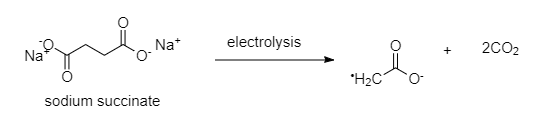
The complete reaction will take place as follows:
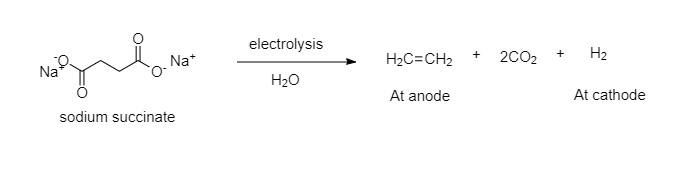
Hence, by the electrolysis of aqueous sodium succinate, ethene is formed at anode along with $H_2$.
The correct option is A.
Additional Information:
Methane cannot be prepared by this method as the alkane is formed by the combination of two alkyl free radicals. Therefore, the alkane should have a minimum of two carbon atoms.
Factors affecting electrolysis are:
1) Effect of concentration
2) Nature of electrolyte
3) Nature of electrodes
Note: The possibility to make a mistake is that you can choose option B. As we know that oxidation occurs at the anode and reduction occurs at the cathode. So, the ethene formed will be at anode, not cathode.
Complete step-by-step answer:
Kolbe’s electrolysis or Kolbe reaction is an organic reaction named after Adolph Wilhelm Hermann Kolbe. The Kolbe reaction is basically a decarboxylative dimerization and proceeds by a radical reaction mechanism.
In this reaction, an aqueous solution of sodium or potassium salt of a carboxylic acid is electrolyzed wherein dissociation of the salt into carboxylate ion and sodium or potassium ions take place.
At cathode, water gets converted to hydroxide ions and hydrogen gas.
${ 2H }_{ 2 }{ O }{ +2e^{ - } }{ \rightarrow 2OH^{ - } }{ +H }_{ 2 }$
At anode, the acetate ion donates an electron and gets converted to acetate radical. This acetate radical further releases carbon dioxide gas.
The complete reaction will take place as follows:
Hence, by the electrolysis of aqueous sodium succinate, ethene is formed at anode along with $H_2$.
The correct option is A.
Additional Information:
Methane cannot be prepared by this method as the alkane is formed by the combination of two alkyl free radicals. Therefore, the alkane should have a minimum of two carbon atoms.
Factors affecting electrolysis are:
1) Effect of concentration
2) Nature of electrolyte
3) Nature of electrodes
Note: The possibility to make a mistake is that you can choose option B. As we know that oxidation occurs at the anode and reduction occurs at the cathode. So, the ethene formed will be at anode, not cathode.
Recently Updated Pages
Master Class 12 Economics: Engaging Questions & Answers for Success

Master Class 12 English: Engaging Questions & Answers for Success
Master Class 12 Social Science: Engaging Questions & Answers for Success
Master Class 12 Maths: Engaging Questions & Answers for Success
Master Class 12 Physics: Engaging Questions & Answers for Success
Master Class 10 English: Engaging Questions & Answers for Success
Trending doubts
Who Won 36 Oscar Awards? Record Holder Revealed
Make a sketch of the human nerve cell What function class 10 biology CBSE
The speaker of the Lok Sabha is elected by the APresident class 10 social science CBSE
Explain the double helix structure of DNA with a labeled class 10 biology CBSE
What were the majoritarian measures taken in Sri Lanka class 10 social science CBSE
Mention the importance of the Himalayas class 10 social science CBSE