




By considering the roots of ${{z}^{5}}=1$, how do you show that $\cos \left( \dfrac{2\pi }{5} \right)+\cos \left( \dfrac{4\pi }{5} \right)+\cos \left( \dfrac{6\pi }{5} \right)+\cos \left( \dfrac{8\pi }{5} \right)=-1$?
Answer
 Verified
614.7k+ views
Hint: In this problem we need to prove the given equation by using the given value ${{z}^{5}}=1$. First, we will write the value $1$ as a complex number i.e., $\cos 0{}^\circ +i\sin 0{}^\circ $. Now we will calculate the value of ${{z}^{5}}$ and we will use the De moivre’s theorem. After applying De moivre’s theorem we will calculate the roots of the given equation by substituting the various values for $n$. Now we will plot the roots on a graph paper and from graph paper we can write the sum of the roots as $0$. So, we will sum the obtained roots and equate it to zero and simplify the obtained equation to get the required result.
Complete step by step answer:
Given that, ${{z}^{5}}=1$.
We can write the above value as
$\Rightarrow {{z}^{5}}=1=\cos 0{}^\circ +i\sin 0{}^\circ $
According to the de moivre’s theorem we can write the value of $z$ as
$\begin{align}
& \Rightarrow z={{\left( {{z}^{5}} \right)}^{\dfrac{1}{5}}} \\
& \Rightarrow z=\cos \left( \dfrac{2n\pi }{5} \right)+i\sin \left( \dfrac{2n\pi }{5} \right) \\
\end{align}$
For the above equation we can have five roots, which are obtained by substituting $n=0,1,2,3,4$, then we will get
If $n=0$, then the root is
$\begin{align}
& z=\cos \left( \dfrac{2\pi \times 0}{5} \right)+i\sin \left( \dfrac{2\pi \times 0}{5} \right) \\
& \Rightarrow z=\cos 0+i\sin 0 \\
\end{align}$
Similarly, for $n=1,2,3,4$ we will get the roots as $\cos \left( \dfrac{2\pi }{5} \right)+i\sin \left( \dfrac{2\pi }{5} \right)$, $\cos \left( \dfrac{4\pi }{5} \right)+i\sin \left( \dfrac{4\pi }{5} \right)$, $\cos \left( \dfrac{6\pi }{5} \right)+i\sin \left( \dfrac{6\pi }{5} \right)$, $\cos \left( \dfrac{8\pi }{5} \right)+i\sin \left( \dfrac{8\pi }{5} \right)$.
Now plotting the all the roots, we have in a graph paper, then we will get
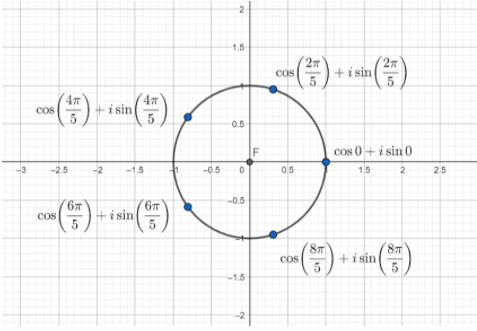
We can observe that all the points are forming a circle with unit radius with origin as centre. So, the sum of the roots is equal to zero. Considering the real part of the roots and equating their sum to zero, then we will get
$1+\cos \left( \dfrac{2\pi }{5} \right)+\cos \left( \dfrac{4\pi }{5} \right)+\cos \left( \dfrac{6\pi }{5} \right)+\cos \left( \dfrac{8\pi }{5} \right)=0$
Simplifying the above equation, then we will have
$\Rightarrow \cos \left( \dfrac{2\pi }{5} \right)+\cos \left( \dfrac{4\pi }{5} \right)+\cos \left( \dfrac{6\pi }{5} \right)+\cos \left( \dfrac{8\pi }{5} \right)=-1$
Hence proved.
Note: In this problem they have only asked to show that $\cos \left( \dfrac{2\pi }{5} \right)+\cos \left( \dfrac{4\pi }{5} \right)+\cos \left( \dfrac{6\pi }{5} \right)+\cos \left( \dfrac{8\pi }{5} \right)=-1$. But we can also have another equation when we consider the imaginary part after drawing the graph. If we equated the sum of imaginary part to zero, then we will get
$\begin{align}
& 0+\sin \left( \dfrac{2\pi }{5} \right)+\sin \left( \dfrac{4\pi }{5} \right)+\sin \left( \dfrac{6\pi }{5} \right)+\sin \left( \dfrac{8\pi }{5} \right)=0 \\
& \Rightarrow \sin \left( \dfrac{2\pi }{5} \right)+\sin \left( \dfrac{4\pi }{5} \right)+\sin \left( \dfrac{6\pi }{5} \right)+\sin \left( \dfrac{8\pi }{5} \right)=0 \\
\end{align}$
Complete step by step answer:
Given that, ${{z}^{5}}=1$.
We can write the above value as
$\Rightarrow {{z}^{5}}=1=\cos 0{}^\circ +i\sin 0{}^\circ $
According to the de moivre’s theorem we can write the value of $z$ as
$\begin{align}
& \Rightarrow z={{\left( {{z}^{5}} \right)}^{\dfrac{1}{5}}} \\
& \Rightarrow z=\cos \left( \dfrac{2n\pi }{5} \right)+i\sin \left( \dfrac{2n\pi }{5} \right) \\
\end{align}$
For the above equation we can have five roots, which are obtained by substituting $n=0,1,2,3,4$, then we will get
If $n=0$, then the root is
$\begin{align}
& z=\cos \left( \dfrac{2\pi \times 0}{5} \right)+i\sin \left( \dfrac{2\pi \times 0}{5} \right) \\
& \Rightarrow z=\cos 0+i\sin 0 \\
\end{align}$
Similarly, for $n=1,2,3,4$ we will get the roots as $\cos \left( \dfrac{2\pi }{5} \right)+i\sin \left( \dfrac{2\pi }{5} \right)$, $\cos \left( \dfrac{4\pi }{5} \right)+i\sin \left( \dfrac{4\pi }{5} \right)$, $\cos \left( \dfrac{6\pi }{5} \right)+i\sin \left( \dfrac{6\pi }{5} \right)$, $\cos \left( \dfrac{8\pi }{5} \right)+i\sin \left( \dfrac{8\pi }{5} \right)$.
Now plotting the all the roots, we have in a graph paper, then we will get
We can observe that all the points are forming a circle with unit radius with origin as centre. So, the sum of the roots is equal to zero. Considering the real part of the roots and equating their sum to zero, then we will get
$1+\cos \left( \dfrac{2\pi }{5} \right)+\cos \left( \dfrac{4\pi }{5} \right)+\cos \left( \dfrac{6\pi }{5} \right)+\cos \left( \dfrac{8\pi }{5} \right)=0$
Simplifying the above equation, then we will have
$\Rightarrow \cos \left( \dfrac{2\pi }{5} \right)+\cos \left( \dfrac{4\pi }{5} \right)+\cos \left( \dfrac{6\pi }{5} \right)+\cos \left( \dfrac{8\pi }{5} \right)=-1$
Hence proved.
Note: In this problem they have only asked to show that $\cos \left( \dfrac{2\pi }{5} \right)+\cos \left( \dfrac{4\pi }{5} \right)+\cos \left( \dfrac{6\pi }{5} \right)+\cos \left( \dfrac{8\pi }{5} \right)=-1$. But we can also have another equation when we consider the imaginary part after drawing the graph. If we equated the sum of imaginary part to zero, then we will get
$\begin{align}
& 0+\sin \left( \dfrac{2\pi }{5} \right)+\sin \left( \dfrac{4\pi }{5} \right)+\sin \left( \dfrac{6\pi }{5} \right)+\sin \left( \dfrac{8\pi }{5} \right)=0 \\
& \Rightarrow \sin \left( \dfrac{2\pi }{5} \right)+\sin \left( \dfrac{4\pi }{5} \right)+\sin \left( \dfrac{6\pi }{5} \right)+\sin \left( \dfrac{8\pi }{5} \right)=0 \\
\end{align}$
Recently Updated Pages
Master Class 11 Social Science: Engaging Questions & Answers for Success

Master Class 11 English: Engaging Questions & Answers for Success
Master Class 11 Accountancy: Engaging Questions & Answers for Success
Master Class 11 Physics: Engaging Questions & Answers for Success
Master Class 11 Computer Science: Engaging Questions & Answers for Success
Master Class 11 Business Studies: Engaging Questions & Answers for Success
Trending doubts
Find the value of the expression given below sin 30circ class 11 maths CBSE
One Metric ton is equal to kg A 10000 B 1000 C 100 class 11 physics CBSE
10 examples of friction in our daily life
Draw a diagram of nephron and explain its structur class 11 biology CBSE
The teeth used for biting and cutting food are called class 11 biology CBSE
Proton was discovered by A Thomson B Rutherford C Chadwick class 11 chemistry CBSE