




‘Bundle of His’ is a group of
(a)Nerve fibres
(b)Ganglia
(c)Connective tissue
(d)Muscle fibres
Answer
 Verified
605.4k+ views
Hint: An important part of the electrical conduction system of the heart, as it transmits impulses from the heart. Bundle of His is a network of cardiac muscle fibres found only in the ventricle wall. It will conduct the electrical impulses that can regulate the heartbeat.
Complete answer:
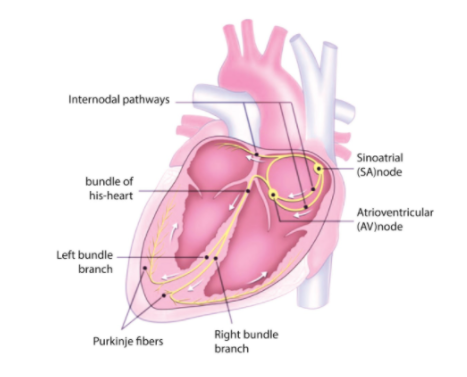
Bundle of His is a group of muscle fibres present between the two ventricles that are capable of conducting the electrical impulse from the atrioventricular node to the Purkinje fibres.
Additional Information:
Physiology of heart:
-Bundle of His passes impulses to right and left bundle branches.
-Bundle branches: -Right and left bundle branches
-Branch into Purkinje fibres.
-Muscles in heart:
Cardiac muscle (also called cardiac muscle or myocardium) is one among three sorts of vertebrate muscles, with the opposite two being skeletal and smooth muscles. it's an involuntary, skeletal muscle that constitutes the most tissue of the walls of the guts.
-Functions of Bundle of His:
The bundle of His is a crucial part of the conduction system of the guts because it transmits impulses from the cardiac muscle, located at the anterior-inferior end of the interatrial septum, to the ventricles of the guts. The bundle of His branches into the left and therefore the right bundle branches, which line the interventricular septum. The left bundle branch further divides into the left anterior and therefore the left posterior fascicles. These bundles and fascicles produce thin filaments referred to as Purkinje fibres. The ventricular conduction system comprises the bundle branches and therefore the Purkinje networks.
So, the correct answer is, “Muscle fibres”.
Note:
The AV node's normal intrinsic firing rate without stimulation from the SA node is 40–60 beats per minute. The intrinsic rate of the bundle of His is 20 or fewer beats per minute.
-Disorders affecting the cardiomyocytes that structure the conduction system of the guts are called heart blocks. Heart blocks are separated into different categories supporting the situation of cellular damage.
Complete answer:
Bundle of His is a group of muscle fibres present between the two ventricles that are capable of conducting the electrical impulse from the atrioventricular node to the Purkinje fibres.
Additional Information:
Physiology of heart:
-Bundle of His passes impulses to right and left bundle branches.
-Bundle branches: -Right and left bundle branches
-Branch into Purkinje fibres.
-Muscles in heart:
Cardiac muscle (also called cardiac muscle or myocardium) is one among three sorts of vertebrate muscles, with the opposite two being skeletal and smooth muscles. it's an involuntary, skeletal muscle that constitutes the most tissue of the walls of the guts.
-Functions of Bundle of His:
The bundle of His is a crucial part of the conduction system of the guts because it transmits impulses from the cardiac muscle, located at the anterior-inferior end of the interatrial septum, to the ventricles of the guts. The bundle of His branches into the left and therefore the right bundle branches, which line the interventricular septum. The left bundle branch further divides into the left anterior and therefore the left posterior fascicles. These bundles and fascicles produce thin filaments referred to as Purkinje fibres. The ventricular conduction system comprises the bundle branches and therefore the Purkinje networks.
So, the correct answer is, “Muscle fibres”.
Note:
The AV node's normal intrinsic firing rate without stimulation from the SA node is 40–60 beats per minute. The intrinsic rate of the bundle of His is 20 or fewer beats per minute.
-Disorders affecting the cardiomyocytes that structure the conduction system of the guts are called heart blocks. Heart blocks are separated into different categories supporting the situation of cellular damage.
Recently Updated Pages
Master Class 11 Social Science: Engaging Questions & Answers for Success

Master Class 11 English: Engaging Questions & Answers for Success
Master Class 11 Maths: Engaging Questions & Answers for Success
Master Class 11 Chemistry: Engaging Questions & Answers for Success
Master Class 11 Biology: Engaging Questions & Answers for Success
Master Class 11 Physics: Engaging Questions & Answers for Success
Trending doubts
One Metric ton is equal to kg A 10000 B 1000 C 100 class 11 physics CBSE
Difference Between Prokaryotic Cells and Eukaryotic Cells
How many of the following diseases can be studied with class 11 biology CBSE
Draw a diagram of a plant cell and label at least eight class 11 biology CBSE
Two of the body parts which do not appear in MRI are class 11 biology CBSE
10 examples of friction in our daily life