




Briefly describe the technique employed in DNA fingerprinting.
Answer
 Verified
576.9k+ views
Hint: Fingerprinting is a technique by which we can know everything about the person whose fingerprints we are analyzing.
Complete answer:
DNA Fingerprinting:The technique of DNA fingerprinting was introduced by British scientist, Sir Alec Jeffreys in 1984. DNA fingerprinting is also called as DNA profiling, DNA testing or genetic fingerprinting. It is a technique employed for determining an individual’s DNA characteristics.
The DNA of every individual is unique in its own way.
DNA fingerprinting is the same for every tissue and organ of a person.
Advantage of DNA fingerprinting:
The advantage is that the DNA can be isolated from any part of the body, skin cells, blood or semen.
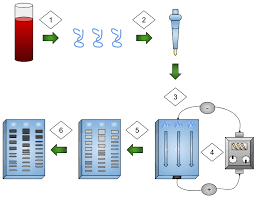
Steps involved in DNA fingerprinting:
1.First of all extract the DNA from the source.
2.Cutting up the DNA using restriction enzymes.
3.Separate the DNA fragments on gel with the help of process agarose gel electrophoresis.
4.Transfer the DNA onto a nylon sheet with the help of Southern Blotting.
5.Add the radioactive probe.
6.Visualize the results with the help of a technique called autoradiography.
Applications of DNA fingerprinting:
1.This technique is used in paternity disputes. 2. To diagnose inherited disorders in both prenatal and newborn babies like cystic fibrosis, sickle cell anaemia, etc.
3. To identify criminals with the help of blood or semen strains, hairs or items of clothing found at the place of crime.It is also used in the identification of dead bodies of soldiers killed in war.
Note: DNA of every individual is different so it is best to use DNA fingerprinting techniques in case of any disputes. Remember to keep in mind that radioactive probes should be complementary to the targeted DNA.
Complete answer:
DNA Fingerprinting:The technique of DNA fingerprinting was introduced by British scientist, Sir Alec Jeffreys in 1984. DNA fingerprinting is also called as DNA profiling, DNA testing or genetic fingerprinting. It is a technique employed for determining an individual’s DNA characteristics.
The DNA of every individual is unique in its own way.
DNA fingerprinting is the same for every tissue and organ of a person.
Advantage of DNA fingerprinting:
The advantage is that the DNA can be isolated from any part of the body, skin cells, blood or semen.
Steps involved in DNA fingerprinting:
1.First of all extract the DNA from the source.
2.Cutting up the DNA using restriction enzymes.
3.Separate the DNA fragments on gel with the help of process agarose gel electrophoresis.
4.Transfer the DNA onto a nylon sheet with the help of Southern Blotting.
5.Add the radioactive probe.
6.Visualize the results with the help of a technique called autoradiography.
Applications of DNA fingerprinting:
1.This technique is used in paternity disputes. 2. To diagnose inherited disorders in both prenatal and newborn babies like cystic fibrosis, sickle cell anaemia, etc.
3. To identify criminals with the help of blood or semen strains, hairs or items of clothing found at the place of crime.It is also used in the identification of dead bodies of soldiers killed in war.
Note: DNA of every individual is different so it is best to use DNA fingerprinting techniques in case of any disputes. Remember to keep in mind that radioactive probes should be complementary to the targeted DNA.
Recently Updated Pages
Master Class 12 Business Studies: Engaging Questions & Answers for Success

Master Class 12 Chemistry: Engaging Questions & Answers for Success
Master Class 12 Biology: Engaging Questions & Answers for Success
Class 12 Question and Answer - Your Ultimate Solutions Guide
Complete reduction of benzene diazonium chloride with class 12 chemistry CBSE
How can you identify optical isomers class 12 chemistry CBSE
Trending doubts
Which are the Top 10 Largest Countries of the World?
What are the major means of transport Explain each class 12 social science CBSE
Draw a labelled sketch of the human eye class 12 physics CBSE
Differentiate between insitu conservation and exsitu class 12 biology CBSE
Draw a neat and well labeled diagram of TS of ovary class 12 biology CBSE
Differentiate between homogeneous and heterogeneous class 12 chemistry CBSE