




Briefly describe the structure of the Pancreas.
Answer
 Verified
535.8k+ views
Hint: The pancreas is an extended, tapering organ positioned behind the stomach, across the back of the belly. The head, or right side of the organ, is the widest section of the organ and located in the curve of the duodenum, the small intestine's first division. The pancreas has two main functions: an exocrine function that helps in digestion and an endocrine function that regulates blood sugar.
Complete answer:
The pancreas is a gland that functions as both an endocrine and an exocrine organ. Between the spleen and the duodenum, it is placed transversely behind and below the stomach. It's a compact and lobulated structure.
The pancreas is around half a pound and looks like an elongated cone lying on its side. The pancreas' head, or broad end, is close to a duodenal curve, the section of the small intestine immediately beyond the stomach. It narrows to the left as it approaches the spleen and left kidney, ending in a ‘tail.'
The pancreas is found in the upper left abdomen, behind the stomach. Other organs such as the small intestine, liver, and spleen surround it. It's spongy, roughly six to ten inches long, and shaped like a flat pear or a fish with a horizontally stretched tail.
The head of the pancreas, which is the wide section, is positioned toward the centre of the abdomen as shown below.
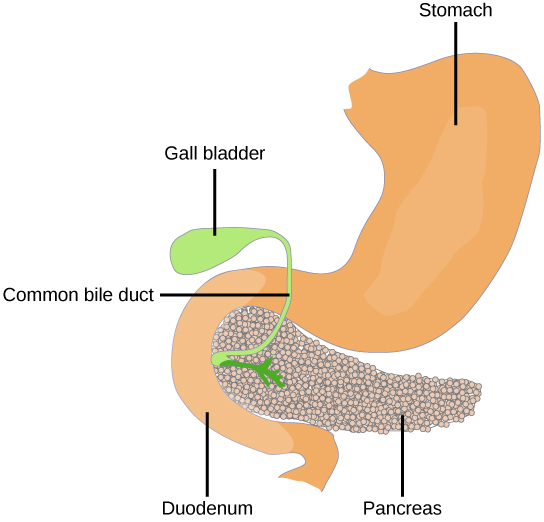
At the point where the stomach meets the first part of the small intestine, the pancreas' head is found. The pancreas releases digestive enzymes into these contents after the stomach empties partially digested food into the intestine.
The central section of the pancreas is called the neck or body. The thin end is called the tail and extends to the left side.
The pancreas is surrounded by several main blood arteries that feed blood to the pancreatic and other abdominal organs, including the superior mesenteric artery, superior mesenteric vein, portal vein, and intestinal axis.
Note:
Exocrine tissue makes up nearly all of the pancreas (95%) and produces pancreatic enzymes for digesting. The remaining tissue is made up of islets of Langerhans, which are endocrine cells. These clusters of cells, which resemble grape clusters, release hormones that control blood sugar and pancreatic secretions.
Complete answer:
The pancreas is a gland that functions as both an endocrine and an exocrine organ. Between the spleen and the duodenum, it is placed transversely behind and below the stomach. It's a compact and lobulated structure.
The pancreas is around half a pound and looks like an elongated cone lying on its side. The pancreas' head, or broad end, is close to a duodenal curve, the section of the small intestine immediately beyond the stomach. It narrows to the left as it approaches the spleen and left kidney, ending in a ‘tail.'
The pancreas is found in the upper left abdomen, behind the stomach. Other organs such as the small intestine, liver, and spleen surround it. It's spongy, roughly six to ten inches long, and shaped like a flat pear or a fish with a horizontally stretched tail.
The head of the pancreas, which is the wide section, is positioned toward the centre of the abdomen as shown below.
At the point where the stomach meets the first part of the small intestine, the pancreas' head is found. The pancreas releases digestive enzymes into these contents after the stomach empties partially digested food into the intestine.
The central section of the pancreas is called the neck or body. The thin end is called the tail and extends to the left side.
The pancreas is surrounded by several main blood arteries that feed blood to the pancreatic and other abdominal organs, including the superior mesenteric artery, superior mesenteric vein, portal vein, and intestinal axis.
Note:
Exocrine tissue makes up nearly all of the pancreas (95%) and produces pancreatic enzymes for digesting. The remaining tissue is made up of islets of Langerhans, which are endocrine cells. These clusters of cells, which resemble grape clusters, release hormones that control blood sugar and pancreatic secretions.
Recently Updated Pages
Master Class 11 English: Engaging Questions & Answers for Success

Master Class 11 Social Science: Engaging Questions & Answers for Success
Master Class 11 Maths: Engaging Questions & Answers for Success
Master Class 11 Biology: Engaging Questions & Answers for Success
Master Class 11 Physics: Engaging Questions & Answers for Success
Master Class 11 Chemistry: Engaging Questions & Answers for Success
Trending doubts
One Metric ton is equal to kg A 10000 B 1000 C 100 class 11 physics CBSE
Difference Between Prokaryotic Cells and Eukaryotic Cells
Find the value of the expression given below sin 30circ class 11 maths CBSE
Difference between physical and chemical change class 11 chemistry CBSE
Two of the body parts which do not appear in MRI are class 11 biology CBSE
Draw a diagram of a plant cell and label at least eight class 11 biology CBSE