




Briefly describe the anatomy of primary dicot root.
Answer
 Verified
629.7k+ views
Hint: Study of internal organs and internal structure is known as anatomy. Root are the organs of plants that are primarily involved in the absorption of water, minerals and nutrients from the soil for the growth of the overall plant. Dicot is a class of angiosperms in which the presence of two cotyledons can be observed easily.
Complete answer:
The most common example of dicot root is sunflower root:
- The outermost layer is epidermis. Many of the epidermal cells protrude in the form of unicellular root hairs.
- The cortex consists of several layers of thin layers of thin walled parenchyma cells with intercellular spaces.
- The innermost layer of the cortex is called endodermis. It comprises a single layer of barrel shaped cells without any intercellular spaces.
- The tangential as well as radial walls of the endodermal cells have a deposition of water- impermeable, waxy material-suberin in the form of casparian strips.
- Next to endodermis between the xylem and phloem lies a few layers of thick-walled parenchymatous cells referred to as pericycle.
- Initiation of lateral roots and vascular cambium during the secondary growth takes place in these cells.
- The pitch is small or inconspicuous. The parenchymatous cells which lie between the xylem and the phloem are called conjunctive tissue. There are usually two to four xylem and phloem patches. Later, a cambium ring develops to constitute the stele.
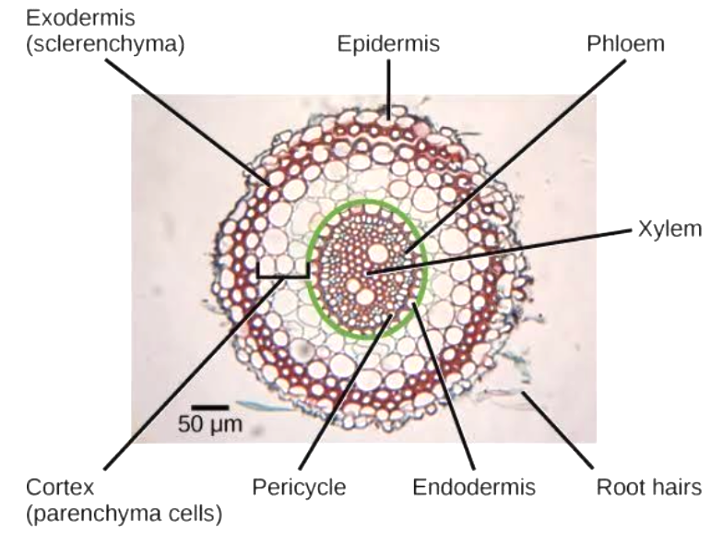
Note: So a primary dicotyledonous root has less xylem bundles than monocotyledonous root. There are four xylems in a dicot root but six in monocots. Dicot root undergoes secondary growth but monocots root does not. Root hairs in dicot roots play a role of protection in these.
Complete answer:
The most common example of dicot root is sunflower root:
- The outermost layer is epidermis. Many of the epidermal cells protrude in the form of unicellular root hairs.
- The cortex consists of several layers of thin layers of thin walled parenchyma cells with intercellular spaces.
- The innermost layer of the cortex is called endodermis. It comprises a single layer of barrel shaped cells without any intercellular spaces.
- The tangential as well as radial walls of the endodermal cells have a deposition of water- impermeable, waxy material-suberin in the form of casparian strips.
- Next to endodermis between the xylem and phloem lies a few layers of thick-walled parenchymatous cells referred to as pericycle.
- Initiation of lateral roots and vascular cambium during the secondary growth takes place in these cells.
- The pitch is small or inconspicuous. The parenchymatous cells which lie between the xylem and the phloem are called conjunctive tissue. There are usually two to four xylem and phloem patches. Later, a cambium ring develops to constitute the stele.
Note: So a primary dicotyledonous root has less xylem bundles than monocotyledonous root. There are four xylems in a dicot root but six in monocots. Dicot root undergoes secondary growth but monocots root does not. Root hairs in dicot roots play a role of protection in these.
Recently Updated Pages
Master Class 11 English: Engaging Questions & Answers for Success

Master Class 11 Social Science: Engaging Questions & Answers for Success
Master Class 11 Maths: Engaging Questions & Answers for Success
Master Class 11 Biology: Engaging Questions & Answers for Success
Master Class 11 Physics: Engaging Questions & Answers for Success
Master Class 11 Chemistry: Engaging Questions & Answers for Success
Trending doubts
One Metric ton is equal to kg A 10000 B 1000 C 100 class 11 physics CBSE
Difference Between Prokaryotic Cells and Eukaryotic Cells
Find the value of the expression given below sin 30circ class 11 maths CBSE
Difference between physical and chemical change class 11 chemistry CBSE
Two of the body parts which do not appear in MRI are class 11 biology CBSE
Draw a diagram of a plant cell and label at least eight class 11 biology CBSE