



How many bricks of size $25cm\times 15cm\times 6cm$ are required to make a wall 5 m long, 2 m high and 50cm thick, if 10% of the place is occupied by cement?
Answer
 Verified
602.7k+ views
Hint: It is given that the wall is of the dimensions $5m\times 2m\times 50cm$ which is equivalent to $500cm\times 200cm\times 50cm$ . Now find the volume of the wall and subtract the 10% of its volume from it to get the volume occupied by the bricks. Now divide the volume of the wall occupied by the bricks by the volume of each brick to get the number of bricks. Remember that the volume of a cuboid is given by $\text{length}\times \text{breadth}\times \text{height}$ .
Complete step-by-step solution -
Let us start the solution to the above question by drawing a representative diagram for better visualisation. First, let us draw the brick
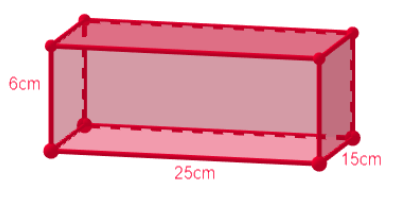
Now let us move to the diagram of the wall.
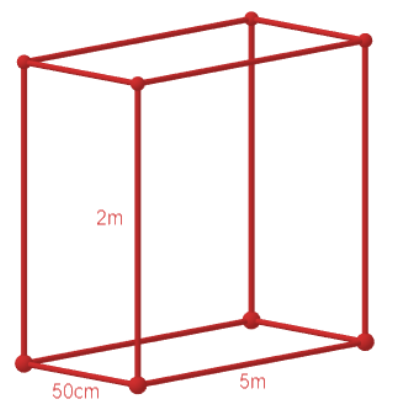
It is given that the dimensions of the wall are 5m, 2m and 50 cm which when converted to cm is 500cm, 200cm and 50cm. We also know that the volume of a cuboid is given by $\text{length}\times \text{breadth}\times \text{height}$ and the wall is in the shape of the cuboid. Therefore, the volume of the wall is:
$\text{Volume of wall=500}\times \text{200}\times \text{50=5000000 c}{{\text{m}}^{3}}$
Now out of these volumes, the 10% of the volume is occupied by cement. Therefore, the volume occupied by the brick is:
$\text{Volume of wall occupied by brick=5000000-}\dfrac{10}{100}\times \text{5000000}=4500000c{{m}^{3}}$
Now, the volume of one brick is equal to the product of its dimension.
$\text{Volume of brick=}25cm\times 15cm\times 6cm=2250c{{m}^{3}}$
Now divide the volume of the wall occupied by the bricks by the volume of each brick to get the number of bricks.
$\text{Number of bricks=}\dfrac{4500000}{2250}=2000\text{ bricks}$ .
Therefore, the number of bricks required for making the wall is 2000bricks.
Note: Don’t get confused and try to find the number of bricks by dividing the dimensions of the walls by the dimensions of the bricks, as we don’t know about the orientations of the bricks. Also, don’t forget to remove the space occupied by the cement. If you want, you can also convert all the dimensions to meters and solve accordingly, but it is prescribed to use the smaller unit among the units given in the question in order to avoid decimals in the calculations.
Complete step-by-step solution -
Let us start the solution to the above question by drawing a representative diagram for better visualisation. First, let us draw the brick
Now let us move to the diagram of the wall.
It is given that the dimensions of the wall are 5m, 2m and 50 cm which when converted to cm is 500cm, 200cm and 50cm. We also know that the volume of a cuboid is given by $\text{length}\times \text{breadth}\times \text{height}$ and the wall is in the shape of the cuboid. Therefore, the volume of the wall is:
$\text{Volume of wall=500}\times \text{200}\times \text{50=5000000 c}{{\text{m}}^{3}}$
Now out of these volumes, the 10% of the volume is occupied by cement. Therefore, the volume occupied by the brick is:
$\text{Volume of wall occupied by brick=5000000-}\dfrac{10}{100}\times \text{5000000}=4500000c{{m}^{3}}$
Now, the volume of one brick is equal to the product of its dimension.
$\text{Volume of brick=}25cm\times 15cm\times 6cm=2250c{{m}^{3}}$
Now divide the volume of the wall occupied by the bricks by the volume of each brick to get the number of bricks.
$\text{Number of bricks=}\dfrac{4500000}{2250}=2000\text{ bricks}$ .
Therefore, the number of bricks required for making the wall is 2000bricks.
Note: Don’t get confused and try to find the number of bricks by dividing the dimensions of the walls by the dimensions of the bricks, as we don’t know about the orientations of the bricks. Also, don’t forget to remove the space occupied by the cement. If you want, you can also convert all the dimensions to meters and solve accordingly, but it is prescribed to use the smaller unit among the units given in the question in order to avoid decimals in the calculations.

Recently Updated Pages
Master Class 9 General Knowledge: Engaging Questions & Answers for Success

Master Class 9 Social Science: Engaging Questions & Answers for Success
Master Class 9 English: Engaging Questions & Answers for Success
Master Class 9 Maths: Engaging Questions & Answers for Success
Master Class 9 Science: Engaging Questions & Answers for Success
Class 9 Question and Answer - Your Ultimate Solutions Guide
Trending doubts
Difference Between Plant Cell and Animal Cell
Fill the blanks with the suitable prepositions 1 The class 9 english CBSE
Who is eligible for RTE class 9 social science CBSE
Which places in India experience sunrise first and class 9 social science CBSE
What is pollution? How many types of pollution? Define it
Name 10 Living and Non living things class 9 biology CBSE