




What is the breakdown of dead organisms and wastes?
Answer
 Verified
580.5k+ views
Hint: Every organism while carrying out metabolic processes releases some unused or by-products that are referred to as waste products. This waste product is released out of the body into the environment in various forms.
Complete answer:
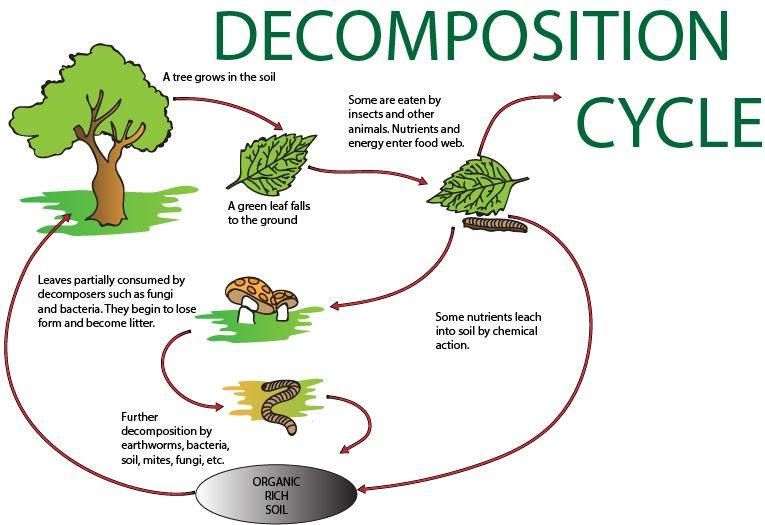
The waste products secreted by the body of a living organism and their dead remains are two distinct yet overlapping phenomena. They have the same destiny, that is to break down into simpler states and eventually dissolve into the environment. Let's study about breakdown of both dead remains and waste products in detail:
1. Breakdown of dead remains of organisms-
Breakdown of dead remains of organisms is concerned with decomposition of the dead bodies of organisms. It is a long process that involves decaying and rotting of the dead body. These bacterias and fungi rely on the dead bodies as a source of nutrition therefore while undergoing their metabolic reactions break the organic compounds into simpler states (Carbon dioxide,water, Nitrogen, Oxygen, etc.)
2. Breakdown of waste products-
This is another process that involves breakdown of excretory products that are the unused products or by-products of metabolic processes of the body. They are rich in nitrogen. It's breakdown is similar to that of dead bodies as it also involves action of bacterias and fungi to dissolve in the environment. However, excretion is a process that takes place at regular intervals of time.
Note:
Breakdown in technical terms is referred to as decomposition. This process involves breaking off complex organic substances into simpler form or their natural form so that they can easily get dissolved back into the environment (the ultimate source of their origin). This mission is accomplished with the help of microorganisms such as bacterias present in the atmosphere.
Complete answer:
The waste products secreted by the body of a living organism and their dead remains are two distinct yet overlapping phenomena. They have the same destiny, that is to break down into simpler states and eventually dissolve into the environment. Let's study about breakdown of both dead remains and waste products in detail:
1. Breakdown of dead remains of organisms-
Breakdown of dead remains of organisms is concerned with decomposition of the dead bodies of organisms. It is a long process that involves decaying and rotting of the dead body. These bacterias and fungi rely on the dead bodies as a source of nutrition therefore while undergoing their metabolic reactions break the organic compounds into simpler states (Carbon dioxide,water, Nitrogen, Oxygen, etc.)
2. Breakdown of waste products-
This is another process that involves breakdown of excretory products that are the unused products or by-products of metabolic processes of the body. They are rich in nitrogen. It's breakdown is similar to that of dead bodies as it also involves action of bacterias and fungi to dissolve in the environment. However, excretion is a process that takes place at regular intervals of time.
Note:
Breakdown in technical terms is referred to as decomposition. This process involves breaking off complex organic substances into simpler form or their natural form so that they can easily get dissolved back into the environment (the ultimate source of their origin). This mission is accomplished with the help of microorganisms such as bacterias present in the atmosphere.
Recently Updated Pages
Class 10 Question and Answer - Your Ultimate Solutions Guide

Master Class 12 Economics: Engaging Questions & Answers for Success
Master Class 12 Social Science: Engaging Questions & Answers for Success
Master Class 12 English: Engaging Questions & Answers for Success
Master Class 12 Maths: Engaging Questions & Answers for Success
Master Class 12 Physics: Engaging Questions & Answers for Success
Trending doubts
Explain the Treaty of Vienna of 1815 class 10 social science CBSE
The slogan Jai Hind was given by A Lal Bahadur Shastri class 10 social science CBSE
10 examples of evaporation in daily life with explanations
What is the full form of POSCO class 10 social science CBSE
Identify the feminine form of noun nephew a shenephew class 10 english CBSE
CSIR full form?