




Bowman’s glands are associated with
a) Seminiferous tubules
b) Pleural membrane
c) Olfactory membrane
d) Cardiac muscles
Answer
 Verified
624.6k+ views
Hint: These glands are associated with sensory organs. The main function is to secrete mucus.Mucus contains a protein MUC5AC. These glands show mixed appearance of tubules and alveolar like structures.
Complete Answer:
Sensory organs are specialised organs as they perceive external stimuli and convert them into impulses so that the brain can recognise those stimuli and react accordingly. These sensory organs are eye, nose, ear, skin and tongue.
Smell receptors
The smell receptors occur in olfactory epithelium. This is made up of pseudostratified epithelium. This epithelium is located in the roof of the nasal cavity.
The olfactory epithelium consists of three types of cells.
1) Olfactory receptor cells : These are specialised cells that receive the sense of smell. These are the main receptor cells. Each cell is thin spindle shaped and has a dendrite that bears apical hairs.
2)Supporting cells: These are in between the receptor cells and support them. These are brownish in color.
3)Basal cells : These give rise to the new receptor cells
Section of Olfactory Epithelium
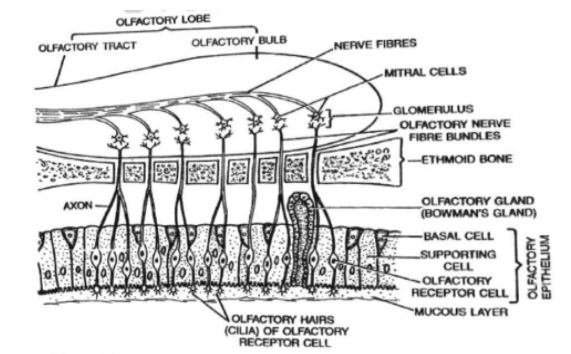
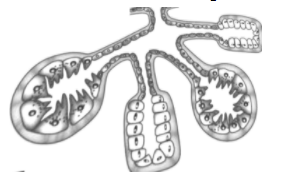
There are many olfactory glands present below the olfactory epithelium. These secrete mucus to keep the epithelium moist. These glands are known as Bowman’s gland. These glands also release fluids to get rid of the irritating substances and to dissolve odorous material. These are branched tubuloalveolar glands. (tube like and sac like).
The structure of tubuloalveolar glands
Thus the correct answer is Olfactory membrane that is option C.
Note: Women have a keener sense of smell than men especially during ovulation.
Smoking and ageing deteriorates the sense of smell.
Complete Answer:
Sensory organs are specialised organs as they perceive external stimuli and convert them into impulses so that the brain can recognise those stimuli and react accordingly. These sensory organs are eye, nose, ear, skin and tongue.
Smell receptors
The smell receptors occur in olfactory epithelium. This is made up of pseudostratified epithelium. This epithelium is located in the roof of the nasal cavity.
The olfactory epithelium consists of three types of cells.
1) Olfactory receptor cells : These are specialised cells that receive the sense of smell. These are the main receptor cells. Each cell is thin spindle shaped and has a dendrite that bears apical hairs.
2)Supporting cells: These are in between the receptor cells and support them. These are brownish in color.
3)Basal cells : These give rise to the new receptor cells
Section of Olfactory Epithelium
There are many olfactory glands present below the olfactory epithelium. These secrete mucus to keep the epithelium moist. These glands are known as Bowman’s gland. These glands also release fluids to get rid of the irritating substances and to dissolve odorous material. These are branched tubuloalveolar glands. (tube like and sac like).
The structure of tubuloalveolar glands
Thus the correct answer is Olfactory membrane that is option C.
Note: Women have a keener sense of smell than men especially during ovulation.
Smoking and ageing deteriorates the sense of smell.
Recently Updated Pages
Master Class 12 Economics: Engaging Questions & Answers for Success

Master Class 12 English: Engaging Questions & Answers for Success
Master Class 12 Social Science: Engaging Questions & Answers for Success
Master Class 12 Maths: Engaging Questions & Answers for Success
Master Class 12 Physics: Engaging Questions & Answers for Success
Master Class 9 General Knowledge: Engaging Questions & Answers for Success
Trending doubts
One Metric ton is equal to kg A 10000 B 1000 C 100 class 11 physics CBSE
Difference Between Prokaryotic Cells and Eukaryotic Cells
Two of the body parts which do not appear in MRI are class 11 biology CBSE
1 ton equals to A 100 kg B 1000 kg C 10 kg D 10000 class 11 physics CBSE
Draw a diagram of nephron and explain its structur class 11 biology CBSE
10 examples of friction in our daily life