




Bond angle of \[{{H}_{2}}O\] (104.5) is higher than the bond angle of \[{{H}_{2}}S\] (92.1). The difference is due to
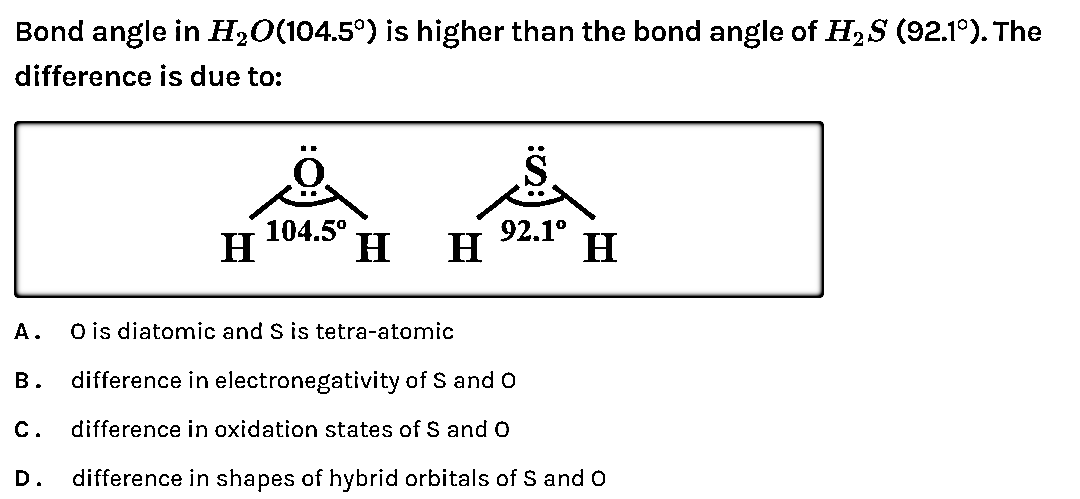
A. O is diatomic and S is tetra atomic
B. Difference in electronegativity of S and O
C. Difference in oxidation state of S and O
D. Difference in shapes of hybrid orbitals of S and O
Answer
 Verified
644.7k+ views
Hint: We can use the concept of electronegativity and the atomic size and the type of hybridisation.
Complete step-by-step answer:
We should explain this by difference in electronegativity. As we know that if we move down the group from O to Te, the size of the central atom goes on increasing and its electronegativity goes on decreasing.
As a result, we can observe that the position of the two bond pairs shifts away and away from the central atom as we move from ${{H}_{2}}O$ to \[{{H}_{2}}Te\]. And the repulsion between the bond pairs decreases as we move from \[{{H}_{2}}O\] to \[{{H}_{2}}Te~\] and therefore, the bond angle decreases in the order.
Hence the correct option is B.
Additional information:
The difference in atomic size between oxygen and sulphur impacts the sizes and energy levels of the valence shell orbitals, which in turn affects how these orbitals are being used for bonding. $sp^3$ hybridized for oxygen in water, possibly un-hybridized for sulphur in hydrogen sulphide.
Note: As we know that the electronegativity of the group 16 decreases down the group, so does their tendency to acquire two electrons to form compounds in the −2 oxidation state. The lightest member, oxygen, has the greatest tendency to form multiple bonds with other elements. Because of its high electronegativity, the chemistry of oxygen is generally restricted to compounds in which it has a negative oxidation state, and its bonds to other elements tend to be highly polar. We should remember the trend of electronegativity that is followed in group 16. Lone pair repulsion also takes place, that’s why bond angle differs in oxygen.
Complete step-by-step answer:
We should explain this by difference in electronegativity. As we know that if we move down the group from O to Te, the size of the central atom goes on increasing and its electronegativity goes on decreasing.
As a result, we can observe that the position of the two bond pairs shifts away and away from the central atom as we move from ${{H}_{2}}O$ to \[{{H}_{2}}Te\]. And the repulsion between the bond pairs decreases as we move from \[{{H}_{2}}O\] to \[{{H}_{2}}Te~\] and therefore, the bond angle decreases in the order.
Hence the correct option is B.
Additional information:
The difference in atomic size between oxygen and sulphur impacts the sizes and energy levels of the valence shell orbitals, which in turn affects how these orbitals are being used for bonding. $sp^3$ hybridized for oxygen in water, possibly un-hybridized for sulphur in hydrogen sulphide.
Note: As we know that the electronegativity of the group 16 decreases down the group, so does their tendency to acquire two electrons to form compounds in the −2 oxidation state. The lightest member, oxygen, has the greatest tendency to form multiple bonds with other elements. Because of its high electronegativity, the chemistry of oxygen is generally restricted to compounds in which it has a negative oxidation state, and its bonds to other elements tend to be highly polar. We should remember the trend of electronegativity that is followed in group 16. Lone pair repulsion also takes place, that’s why bond angle differs in oxygen.
Recently Updated Pages
Master Class 11 English: Engaging Questions & Answers for Success

Master Class 11 Social Science: Engaging Questions & Answers for Success
Master Class 11 Maths: Engaging Questions & Answers for Success
Master Class 11 Biology: Engaging Questions & Answers for Success
Master Class 11 Physics: Engaging Questions & Answers for Success
Master Class 11 Chemistry: Engaging Questions & Answers for Success
Trending doubts
One Metric ton is equal to kg A 10000 B 1000 C 100 class 11 physics CBSE
Difference Between Prokaryotic Cells and Eukaryotic Cells
1 ton equals to A 100 kg B 1000 kg C 10 kg D 10000 class 11 physics CBSE
Find the value of the expression given below sin 30circ class 11 maths CBSE
Two of the body parts which do not appear in MRI are class 11 biology CBSE
Draw a diagram of a plant cell and label at least eight class 11 biology CBSE