




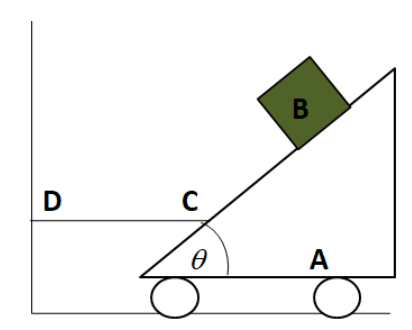
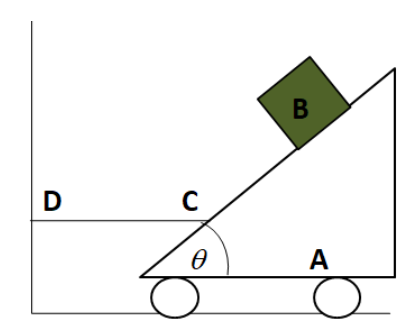
Block B has a mass $m$ and is released from rest when it is on top of wedge A, which has a mass\[3{\text{ }}m\] . Determine the tension in cord CD needed to hold the wedge from moving while B is sliding down A. Neglect friction –
Answer
 Verified
492.9k+ views
Hint: When two or more physical objects come into touch with each other, they exert forces on each other. These contact forces are given different names depending on the objects in touch. The force is called tension if one of the items in contact is a string, rope, cable, or spring.
Complete step by step answer:
The gravitational force acts in the opposite direction of tension. If an object is suspended, tension must be used to keep it balanced; otherwise, gravity will cause it to fall.
Because the rope works as a force transfer agent, there should never be a situation when two items connected by one rope are subjected to tension forces of different magnitudes.
Forces acting on the block are as below -
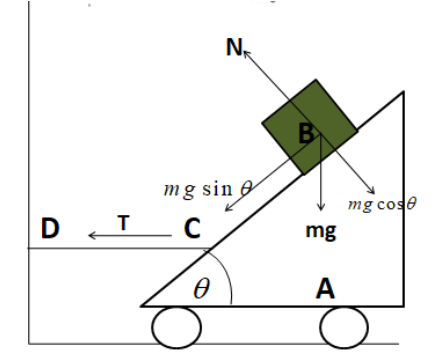
On equating vertical forces acting on block B,
\[N = mg\cos \theta \]
For the wedge to be in the equilibrium net force acting along horizontal must be zero,
\[ \Rightarrow T = N\sin \theta \]
\[ \Rightarrow T = (mg\cos \theta )\sin \theta \]
\[ \Rightarrow T = \dfrac{{mg}}{2}\sin 2\theta \]
where,
\[T = \] Tension in the string, $N$ or \[kg - m/{s^2}\]
$N = $ Force, $N$ or \[kg - m/{s^2}\]
\[m = \] mass, kg and $g = $ gravitational force
Thus, the answer is \[T = \dfrac{{mg}}{2}\sin 2\theta \].
Note: Because ropes cannot effectively push, tension is a pulling force rather than a pushing force. Attempting to push the rope will lead it to become slack and lose its tension. This may seem self-evident, yet when depicting the forces acting on an item, individuals frequently depict the force of tension in the wrong direction. As a result, it's critical to keep in mind that tension can only pull on an object. A force is exerted on an object, which causes stress. Internal components of the thing impart internal forces to one another when the object is subjected to force. The thing is effectively deformed as a result of this. Pressure units are used to measure stress.
Complete step by step answer:
The gravitational force acts in the opposite direction of tension. If an object is suspended, tension must be used to keep it balanced; otherwise, gravity will cause it to fall.
Because the rope works as a force transfer agent, there should never be a situation when two items connected by one rope are subjected to tension forces of different magnitudes.
Forces acting on the block are as below -
On equating vertical forces acting on block B,
\[N = mg\cos \theta \]
For the wedge to be in the equilibrium net force acting along horizontal must be zero,
\[ \Rightarrow T = N\sin \theta \]
\[ \Rightarrow T = (mg\cos \theta )\sin \theta \]
\[ \Rightarrow T = \dfrac{{mg}}{2}\sin 2\theta \]
where,
\[T = \] Tension in the string, $N$ or \[kg - m/{s^2}\]
$N = $ Force, $N$ or \[kg - m/{s^2}\]
\[m = \] mass, kg and $g = $ gravitational force
Thus, the answer is \[T = \dfrac{{mg}}{2}\sin 2\theta \].
Note: Because ropes cannot effectively push, tension is a pulling force rather than a pushing force. Attempting to push the rope will lead it to become slack and lose its tension. This may seem self-evident, yet when depicting the forces acting on an item, individuals frequently depict the force of tension in the wrong direction. As a result, it's critical to keep in mind that tension can only pull on an object. A force is exerted on an object, which causes stress. Internal components of the thing impart internal forces to one another when the object is subjected to force. The thing is effectively deformed as a result of this. Pressure units are used to measure stress.
Recently Updated Pages
Master Class 11 Social Science: Engaging Questions & Answers for Success

Master Class 11 Physics: Engaging Questions & Answers for Success
Master Class 11 Maths: Engaging Questions & Answers for Success
Master Class 11 Economics: Engaging Questions & Answers for Success
Master Class 11 Computer Science: Engaging Questions & Answers for Success
Master Class 11 Chemistry: Engaging Questions & Answers for Success
Trending doubts
One Metric ton is equal to kg A 10000 B 1000 C 100 class 11 physics CBSE
There are 720 permutations of the digits 1 2 3 4 5 class 11 maths CBSE
1 Quintal is equal to a 110 kg b 10 kg c 100kg d 1000 class 11 physics CBSE
State and prove Bernoullis theorem class 11 physics CBSE
Difference Between Prokaryotic Cells and Eukaryotic Cells
Which among the following are examples of coming together class 11 social science CBSE