




Birds and mammals being homeothermic (capable of maintaining constant body temperature) have evolved a mechanism to regulate their metabolic rate. An inverse relationship is observed between metabolic rate and body weight from the plot of the rate of oxygen consumption versus body weight of different mammals. On the other hand, there is a direct proportional relationship between metabolic rate and surface area to volume ratio. From the given figure it is evident that more internal heat per gram of body weight is generated by shrew and more heat is lost to the environment than the horse. Thus maintenance of constant body temperature is more difficult for small animals in cold weather. Why do penguin chicks have to huddle together in a cold environment?
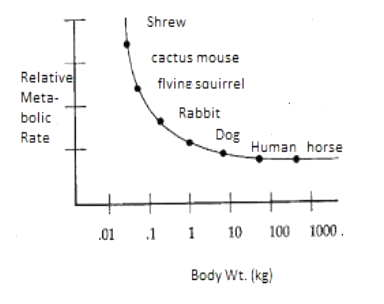
a. Hudding decreases the effective surface area to volume ratio and decreases the loss of body heat.
b. Hudding increases the effective surface area to volume ratio and increases the loss of body heat.
c. Hudding increases the metabolic rate.
d. Hudding is an instinct in penguin chicks.
e. Baby penguins huddle following imprinting.
Answer
 Verified
574.5k+ views
Hint: Homoiothermy is thermoregulation that, irrespective of external influence, maintains a steady internal body temperature. Sometimes but not always, this inner body temperature is higher than the immediate environment. One of the three mechanisms of thermoregulation in warm-blooded animal species is homeothermic.
Complete answer:
Enzymes have a relatively small range of temperatures at which their output is optimum. Temperatures beyond this range can significantly reduce or completely stop the rate of a reaction. Therefore a creature with a fairly constant body temperature may specialize in enzymes that at that particular temperature are effective. Most of the time, a poikilotherm must work far below optimum performance, migrate, hibernate or expend additional resources to provide a wider range of enzymes to cover the broader range of body temperatures.
Chicks have a comparatively high ratio of surface area to volume, which makes them very easily lose body heat. Chicks are also seen huddling together in colder temperatures as it decreases the effective surface-area-to-volume ratio, which consequently reduces the amount of heat lost from their bodies.
To keep them from freezing to death, in closely packed groups, penguins huddle together to conserve heat and protect themselves from the strong winds. The most noticeable action is that within the huddle, penguins on the edges constantly muscle their way.
Hence, the correct answer is option (B).
Note: Hypothermia easily leads to torpor and then death, since many homeothermic animals use enzymes that are adapted for a limited range of body temperatures. Also, endothermy obtained homeothermic is a high energy technique and many habitats can provide these species with lower carrying capacity. The expenditure of energy to maintain body temperature accelerates malnutrition in cold weather and can lead to death.
Complete answer:
Enzymes have a relatively small range of temperatures at which their output is optimum. Temperatures beyond this range can significantly reduce or completely stop the rate of a reaction. Therefore a creature with a fairly constant body temperature may specialize in enzymes that at that particular temperature are effective. Most of the time, a poikilotherm must work far below optimum performance, migrate, hibernate or expend additional resources to provide a wider range of enzymes to cover the broader range of body temperatures.
Chicks have a comparatively high ratio of surface area to volume, which makes them very easily lose body heat. Chicks are also seen huddling together in colder temperatures as it decreases the effective surface-area-to-volume ratio, which consequently reduces the amount of heat lost from their bodies.
To keep them from freezing to death, in closely packed groups, penguins huddle together to conserve heat and protect themselves from the strong winds. The most noticeable action is that within the huddle, penguins on the edges constantly muscle their way.
Hence, the correct answer is option (B).
Note: Hypothermia easily leads to torpor and then death, since many homeothermic animals use enzymes that are adapted for a limited range of body temperatures. Also, endothermy obtained homeothermic is a high energy technique and many habitats can provide these species with lower carrying capacity. The expenditure of energy to maintain body temperature accelerates malnutrition in cold weather and can lead to death.
Recently Updated Pages
Basicity of sulphurous acid and sulphuric acid are

Master Class 11 Business Studies: Engaging Questions & Answers for Success
Master Class 11 Computer Science: Engaging Questions & Answers for Success
Master Class 11 Economics: Engaging Questions & Answers for Success
Master Class 11 Social Science: Engaging Questions & Answers for Success
Master Class 11 English: Engaging Questions & Answers for Success
Trending doubts
One Metric ton is equal to kg A 10000 B 1000 C 100 class 11 physics CBSE
Explain zero factorial class 11 maths CBSE
State and prove Bernoullis theorem class 11 physics CBSE
What steps did the French revolutionaries take to create class 11 social science CBSE
The transition element that has lowest enthalpy of class 11 chemistry CBSE
Can anyone list 10 advantages and disadvantages of friction