




What is Bioreactor? Explain its functioning?
Answer
 Verified
603.6k+ views
Hint: Bioreactors are the artificial conditions set up for obtaining the foreign gene product on a large scale. With the help of recombinant DNA technology, a foreign gene gets expressed into target protein in a heterologous host called recombinant protein.
Complete Answer:
A bioreactor refers to a process(aerobic or anaerobic) where a system supports a biologically active environment. It is a chemical process where a system is created for growing organisms such as yeast, bacteria, or animal cells in a controlled way. These bioreactors are also used in industries for creating vaccines and antibodies.
In this chemical process, organisms are placed in vessels. They are cylindrical and are made of stainless steel. Bioreactors produce the same kind of environment and ensure the same temperature, oxygen level and pH level.
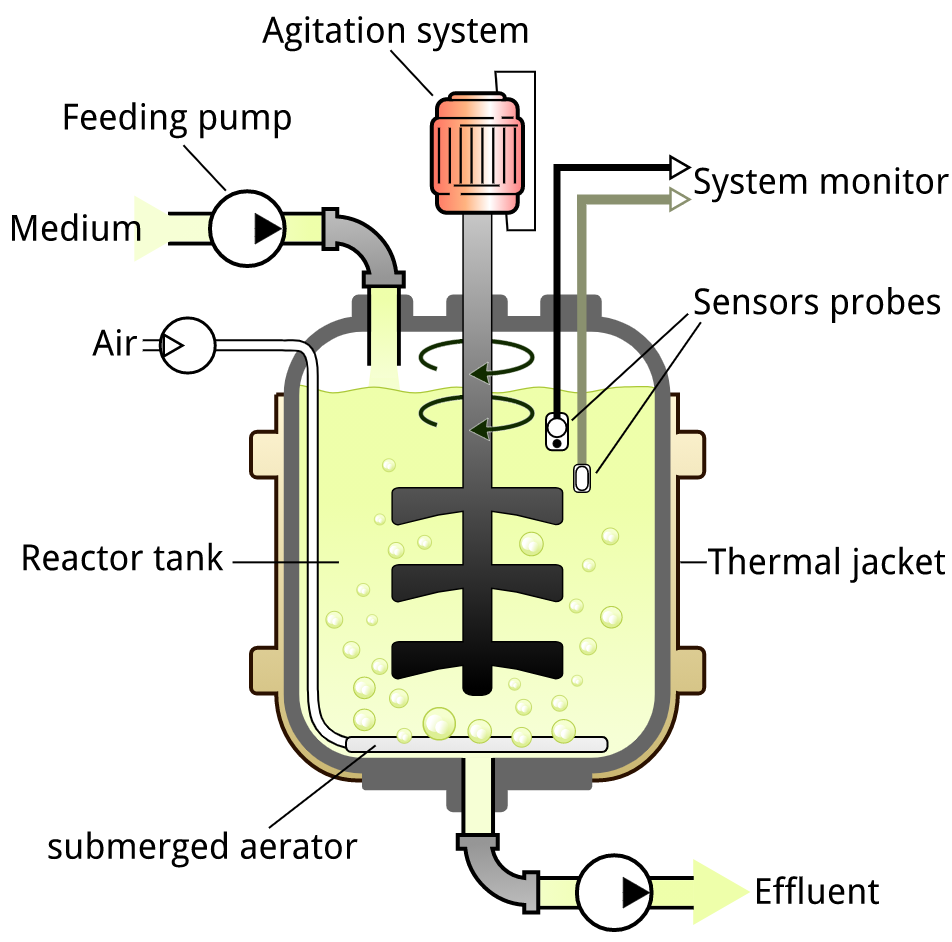
The process of obtaining foreign gene products from bioreactors includes 3 stages:
1. Upstream Processing where the raw material is an origin where it is converted into a suitable form.
2. Bioreaction where it is next transferred into another bioreaction stage.
3. Downstream Processing where the material is further processed into more
useful byproduct.
The ecological conditions inside the bioreactor, for example, temperature, supplement fixations, pH, and disintegrated gases influence the development and efficiency of the creatures grown in the bioreactor. The temperature of the ageing medium is kept up by a cooling coat, curls, or both.
Note: For maintaining the optimal conditions, bioreactors contain several systems. They are agitator system, oxygen delivery system, foam control system, temperature control system, Ph control system, sampling ports to withdraw a small volume of culture.
Complete Answer:
A bioreactor refers to a process(aerobic or anaerobic) where a system supports a biologically active environment. It is a chemical process where a system is created for growing organisms such as yeast, bacteria, or animal cells in a controlled way. These bioreactors are also used in industries for creating vaccines and antibodies.
In this chemical process, organisms are placed in vessels. They are cylindrical and are made of stainless steel. Bioreactors produce the same kind of environment and ensure the same temperature, oxygen level and pH level.
The process of obtaining foreign gene products from bioreactors includes 3 stages:
1. Upstream Processing where the raw material is an origin where it is converted into a suitable form.
2. Bioreaction where it is next transferred into another bioreaction stage.
3. Downstream Processing where the material is further processed into more
useful byproduct.
The ecological conditions inside the bioreactor, for example, temperature, supplement fixations, pH, and disintegrated gases influence the development and efficiency of the creatures grown in the bioreactor. The temperature of the ageing medium is kept up by a cooling coat, curls, or both.
Note: For maintaining the optimal conditions, bioreactors contain several systems. They are agitator system, oxygen delivery system, foam control system, temperature control system, Ph control system, sampling ports to withdraw a small volume of culture.
Recently Updated Pages
Master Class 12 Business Studies: Engaging Questions & Answers for Success

Master Class 12 Chemistry: Engaging Questions & Answers for Success
Master Class 12 Biology: Engaging Questions & Answers for Success
Class 12 Question and Answer - Your Ultimate Solutions Guide
Master Class 11 English: Engaging Questions & Answers for Success
Master Class 11 Social Science: Engaging Questions & Answers for Success
Trending doubts
Which are the Top 10 Largest Countries of the World?
Draw a labelled sketch of the human eye class 12 physics CBSE
The end of compass needle which points towards north class 12 physics CBSE
Differentiate between homogeneous and heterogeneous class 12 chemistry CBSE
Why is the cell called the structural and functional class 12 biology CBSE
When was the first election held in India a 194748 class 12 sst CBSE