




Why is binary fission so effective for bacteria?
Answer
 Verified
506.1k+ views
Hint: Bacterial binary fission is the process by which bacteria divide their cells. Binary fission is conceptually similar to mitosis that occurs in multicellular organisms (such as plants and animals), but it serves a different purpose.
Complete answer:
In the body of a multicellular organism, cells divide by mitosis, causing the organism to grow larger or replacing old, worn-out cells with new ones. Cell division in bacteria, on the other hand, isn't just about producing more cells for the body. Instead, it refers to the process by which bacteria reproduce or add to their population. Binary fission shares some characteristics with mitosis, but it also differs in some key ways.
Steps of binary fission:
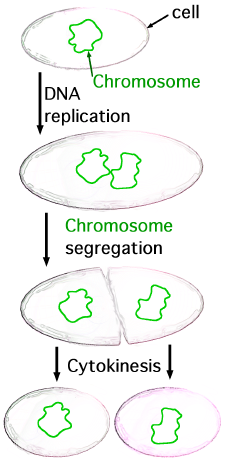
A dividing bacterium, like a human cell, needs to copy its DNA. Unlike human cells, which have multiple linear (rod-like) chromosomes enclosed in a membrane-bound nucleus, bacteria have only one circular chromosome and no nucleus. The bacterial chromosome, on the other hand, is found in the nucleoid, a specialized region of the cell.
Replication enzymes begin copying DNA at a location on the chromosome known as the origin of replication. The first part of the DNA to be copied is the origin. As replication progresses, the two origins pull the rest of the chromosome with them to opposite ends of the cell. The cell grows longer, which helps to separate the newly formed chromosomes.
The replication process continues until the entire chromosome has been copied and the replication enzymes have met on the opposite side. The cytoplasm can be divided once the new chromosomes have moved to opposite cell ends and cleared the call center.
The membrane pinches inward during this process, and a septum, or new dividing wall, forms down the middle of the cell. (Because bacteria have a cell wall, they must regenerate it during cell division).
Finally, the septum splits down the middle, releasing the two cells to live out their lives as separate bacteria.
Benefits of Binary Fission for Bacteria-
1. There's no need to waste time mate because binary fission only requires one parent.
2. In eukaryotes, the time between two consecutive binary fissions is shorter.
3. Daughter cells share all of their parents' characteristics.
4. Multiple fission (much binary fission) allows a single bacterium to produce a large number of new bacteria in a short amount of time.
Note:
Binary fission has the fatal flaw that because there is no genetic recombination, the species cannot survive environmental changes and the entire population is wiped out. This flaw in binary fission is beneficial to us because it prevents bacterial overpopulation.
Complete answer:
In the body of a multicellular organism, cells divide by mitosis, causing the organism to grow larger or replacing old, worn-out cells with new ones. Cell division in bacteria, on the other hand, isn't just about producing more cells for the body. Instead, it refers to the process by which bacteria reproduce or add to their population. Binary fission shares some characteristics with mitosis, but it also differs in some key ways.
Steps of binary fission:
A dividing bacterium, like a human cell, needs to copy its DNA. Unlike human cells, which have multiple linear (rod-like) chromosomes enclosed in a membrane-bound nucleus, bacteria have only one circular chromosome and no nucleus. The bacterial chromosome, on the other hand, is found in the nucleoid, a specialized region of the cell.
Replication enzymes begin copying DNA at a location on the chromosome known as the origin of replication. The first part of the DNA to be copied is the origin. As replication progresses, the two origins pull the rest of the chromosome with them to opposite ends of the cell. The cell grows longer, which helps to separate the newly formed chromosomes.
The replication process continues until the entire chromosome has been copied and the replication enzymes have met on the opposite side. The cytoplasm can be divided once the new chromosomes have moved to opposite cell ends and cleared the call center.
The membrane pinches inward during this process, and a septum, or new dividing wall, forms down the middle of the cell. (Because bacteria have a cell wall, they must regenerate it during cell division).
Finally, the septum splits down the middle, releasing the two cells to live out their lives as separate bacteria.
Benefits of Binary Fission for Bacteria-
1. There's no need to waste time mate because binary fission only requires one parent.
2. In eukaryotes, the time between two consecutive binary fissions is shorter.
3. Daughter cells share all of their parents' characteristics.
4. Multiple fission (much binary fission) allows a single bacterium to produce a large number of new bacteria in a short amount of time.
Note:
Binary fission has the fatal flaw that because there is no genetic recombination, the species cannot survive environmental changes and the entire population is wiped out. This flaw in binary fission is beneficial to us because it prevents bacterial overpopulation.
Recently Updated Pages
Master Class 11 Social Science: Engaging Questions & Answers for Success

Master Class 11 English: Engaging Questions & Answers for Success
Master Class 11 Maths: Engaging Questions & Answers for Success
Master Class 11 Chemistry: Engaging Questions & Answers for Success
Master Class 11 Biology: Engaging Questions & Answers for Success
Master Class 11 Physics: Engaging Questions & Answers for Success
Trending doubts
Differentiate between an exothermic and an endothermic class 11 chemistry CBSE
One Metric ton is equal to kg A 10000 B 1000 C 100 class 11 physics CBSE
Difference Between Prokaryotic Cells and Eukaryotic Cells
There are 720 permutations of the digits 1 2 3 4 5 class 11 maths CBSE
Two of the body parts which do not appear in MRI are class 11 biology CBSE
Which gas is abundant in air class 11 chemistry CBSE