




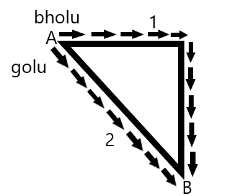
Bholu and Golu are playing on the ground. They start running from the same point A in the ground and reach point B at the same time by following the paths marked $1$ and $2$ respectively as shown in the figure. Which of the following is/are true for the given situation?As compared to Golu, Bholu covers a
A. Longer distance but with a lower speed
B. Longer distance with a higher speed
C. Shorter distance with a lower speed
D. Shorter distance with a higher speed
Answer
 Verified
599.1k+ views
Hint: We will use the formula of the speed to find the answer. Now, from this formula we can say that distance is directly proportional to speed. Here, Bholu covers a longer distance than that of Golu. They both arrive at B point at the same time.
Formula used:
The formula for finding the above relation is given below
$$v = \dfrac{d}{t}$$
Here, $v$ is the speed, $d$ is the distance covered and $t$ is the time taken to cover that distance.
Complete step by step answer:
Here, there are two boys Bholu and Golu. Bholu is travelling along the path $1$ to cover AB distance. On the other hand, Golu is travelling along the path $2$ to cover AB distance. Now, we will use the formula speed to find the answer which is given below.The formula for finding the above relation is given below
$v = \dfrac{d}{t}$
Now, we can see that speed is directly proportional to distance, therefore, we can say that with the increase in distance speed also increases. As the path $1$ is longer than the path $2$. Therefore, Bholu is travelling a longer distance than Golu. Now, according to the formula speed will be higher because it is directly proportional to distance.Therefore, we can say that Bholu covers a longer distance with a higher speed.
Hence, option B is the correct option.
Note:We can also find the answer by seeing the diagram only. As seen in the diagram, Bholu covers a longer distance than that of the Golu. They both arrive at point B at the same time. Therefore, speed of Bholu will cover a longer speed with higher speed.
Formula used:
The formula for finding the above relation is given below
$$v = \dfrac{d}{t}$$
Here, $v$ is the speed, $d$ is the distance covered and $t$ is the time taken to cover that distance.
Complete step by step answer:
Here, there are two boys Bholu and Golu. Bholu is travelling along the path $1$ to cover AB distance. On the other hand, Golu is travelling along the path $2$ to cover AB distance. Now, we will use the formula speed to find the answer which is given below.The formula for finding the above relation is given below
$v = \dfrac{d}{t}$
Now, we can see that speed is directly proportional to distance, therefore, we can say that with the increase in distance speed also increases. As the path $1$ is longer than the path $2$. Therefore, Bholu is travelling a longer distance than Golu. Now, according to the formula speed will be higher because it is directly proportional to distance.Therefore, we can say that Bholu covers a longer distance with a higher speed.
Hence, option B is the correct option.
Note:We can also find the answer by seeing the diagram only. As seen in the diagram, Bholu covers a longer distance than that of the Golu. They both arrive at point B at the same time. Therefore, speed of Bholu will cover a longer speed with higher speed.
Recently Updated Pages
Master Class 11 English: Engaging Questions & Answers for Success

Master Class 11 Physics: Engaging Questions & Answers for Success
Master Class 11 Computer Science: Engaging Questions & Answers for Success
Master Class 11 Chemistry: Engaging Questions & Answers for Success
Master Class 11 Social Science: Engaging Questions & Answers for Success
Master Class 11 Accountancy: Engaging Questions & Answers for Success
Trending doubts
Difference Between Prokaryotic Cells and Eukaryotic Cells
Two of the body parts which do not appear in MRI are class 11 biology CBSE
One Metric ton is equal to kg A 10000 B 1000 C 100 class 11 physics CBSE
10 examples of friction in our daily life
Draw a diagram of nephron and explain its structur class 11 biology CBSE
Draw a diagram of a plant cell and label at least eight class 11 biology CBSE