




Benzene with molecular formula ${C_6}{H_6}$ has:
Option:
A.$6$ Single bond and $6$ double bond
B.$12$ Single bond and $3$ double bond
C.$18$ Single bond only
D.$12$ double bond only
Answer
 Verified
516.9k+ views
Hint: Benzene is defined as an aromatic compound which is composed of only carbon and hydrogen atoms therefore it is also known as aromatic hydrocarbon. Structure of benzene was successfully described by Kekule.
Complete answer:
As we know, the molecular formula of benzene is ${C_6}{H_6}$. According to the basic concept of orbital theory, all the $6$ carbon atoms of benzene are $s{p^2}$ hybridized. When a carbon atom undergoes overlapping, out of three hybrid orbital of the carbon atom two undergoes axillary overlapping with the adjacent carbon atoms to form the bond. While the remaining last hybrid orbital of carbon undergoes overlapping with the hydrogen atom to form a bond with it.
From the above discussion we finally draw the structure of benzene:
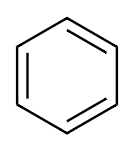
All the carbon atoms of benzene attached to one hydrogen atom to complete its valency to $4$. So the final structure of benzene will be:
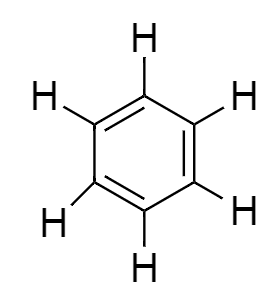
From the above diagram we easily calculate that there are $6$ single bonds formed between all the six-carbon atoms along with $6$single bonds with hydrogen atoms. So, there are a total number of $12$ single bonds in a single benzene.
Now we see that there are $3$ more bonds present in structure between carbon atoms. These are double bonds formed between adjacent carbon atoms of benzene.
$ \Rightarrow $ There are $12$ Single bonds and $3$ double bonds that are present in benzene molecules.
Therefore, option $\left( B \right)$ is the correct option.
Note:
Benzene possesses a very distinctive odour which helps in identification of it. Benzene is unsaturated in nature due to presence of $3$ double bonds but still it does not participate in decolorization reaction with bromine in $CC{l_4}$ and $KMn{O_4}$ alkaline solution.
Complete answer:
As we know, the molecular formula of benzene is ${C_6}{H_6}$. According to the basic concept of orbital theory, all the $6$ carbon atoms of benzene are $s{p^2}$ hybridized. When a carbon atom undergoes overlapping, out of three hybrid orbital of the carbon atom two undergoes axillary overlapping with the adjacent carbon atoms to form the bond. While the remaining last hybrid orbital of carbon undergoes overlapping with the hydrogen atom to form a bond with it.
From the above discussion we finally draw the structure of benzene:
All the carbon atoms of benzene attached to one hydrogen atom to complete its valency to $4$. So the final structure of benzene will be:
From the above diagram we easily calculate that there are $6$ single bonds formed between all the six-carbon atoms along with $6$single bonds with hydrogen atoms. So, there are a total number of $12$ single bonds in a single benzene.
Now we see that there are $3$ more bonds present in structure between carbon atoms. These are double bonds formed between adjacent carbon atoms of benzene.
$ \Rightarrow $ There are $12$ Single bonds and $3$ double bonds that are present in benzene molecules.
Therefore, option $\left( B \right)$ is the correct option.
Note:
Benzene possesses a very distinctive odour which helps in identification of it. Benzene is unsaturated in nature due to presence of $3$ double bonds but still it does not participate in decolorization reaction with bromine in $CC{l_4}$ and $KMn{O_4}$ alkaline solution.
Recently Updated Pages
Master Class 11 English: Engaging Questions & Answers for Success

Master Class 11 Maths: Engaging Questions & Answers for Success
Class 11 Question and Answer - Your Ultimate Solutions Guide
Master Class 11 Biology: Engaging Questions & Answers for Success
Master Class 11 Physics: Engaging Questions & Answers for Success
Master Class 11 Accountancy: Engaging Questions & Answers for Success
Trending doubts
Differentiate between an exothermic and an endothermic class 11 chemistry CBSE
One Metric ton is equal to kg A 10000 B 1000 C 100 class 11 physics CBSE
In what year Guru Nanak Dev ji was born A15 April 1469 class 11 social science CBSE
Difference Between Prokaryotic Cells and Eukaryotic Cells
There are 720 permutations of the digits 1 2 3 4 5 class 11 maths CBSE
Draw a diagram of a plant cell and label at least eight class 11 biology CBSE