




BC is a chord of a circle with center O. If A is a point on the major arc BC as shown in the figure, then $ \angle BAC+\angle OBC=\_\_\_\_\_\_ $ ?
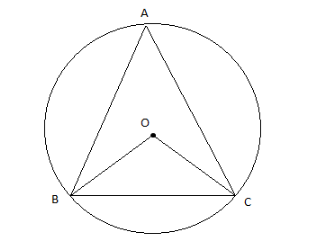
A. $ 45{}^\circ $
B. $ 90{}^\circ $
C. $ 180{}^\circ $
D. $ 165{}^\circ $
Answer
 Verified
578.1k+ views
Hint: The radii of a circle are equal, therefore $ \Delta BOC $ is isosceles and $ \angle OBC=\angle OCB $ .
The angle subtended by two fixed points at the center is double the angle subtended by them at any point on the major arc of the circle.
In other words, $ \angle BOC=2\angle BAC $ .
Assume that $ \angle BAC=x{}^\circ $ , then how much will be the $ \angle OBC $ in terms of $ x $ ?
Complete step-by-step answer:
From the properties of the angles subtended by an arc, we know that $ \angle BOC=2\angle BAC $ .
Let's say that $ \angle BAC=x{}^\circ $ .
Therefore, $ \angle BOC=2x{}^\circ $ .
Now, in the triangle $ \Delta BOC $ , $ OB=OC $ (radius), therefore, $ \angle OBC=\angle OCB=y{}^\circ $ (say).
We know that the sum of the angles of a triangle is $ 180{}^\circ $ .
∴ $ \angle BOC+\angle OBC+\angle OCB=180{}^\circ $
⇒ $ 2x{}^\circ +y{}^\circ +y{}^\circ =180{}^\circ $
⇒ $ 2x{}^\circ +2y{}^\circ =180{}^\circ $
On dividing LHS and RHS by 2; we get
⇒ $ x{}^\circ +y{}^\circ =90{}^\circ $
Also, $ \angle BAC=x{}^\circ $ (assumed) and $ \angle OBC=y{}^\circ $ (assumed).
∴ $ \angle BAC+\angle OBC=90{}^\circ $ .
The correct answer is B. $ 90{}^\circ $ .
So, the correct answer is “Option B”.
Note: Chords of circle which are equal in length, also subtend equal angles at the center.
The angles subtended by a chord in the major and the minor arc add up to $ 180{}^\circ $ .
The angle subtended by the diameter on any point on the circle is always $ 90{}^\circ $ and called as angle in semicircle.
The longest chord of a circle is the diameter of the circle.
The angle subtended by two fixed points at the center is double the angle subtended by them at any point on the major arc of the circle.
In other words, $ \angle BOC=2\angle BAC $ .
Assume that $ \angle BAC=x{}^\circ $ , then how much will be the $ \angle OBC $ in terms of $ x $ ?
Complete step-by-step answer:
From the properties of the angles subtended by an arc, we know that $ \angle BOC=2\angle BAC $ .
Let's say that $ \angle BAC=x{}^\circ $ .
Therefore, $ \angle BOC=2x{}^\circ $ .
Now, in the triangle $ \Delta BOC $ , $ OB=OC $ (radius), therefore, $ \angle OBC=\angle OCB=y{}^\circ $ (say).
We know that the sum of the angles of a triangle is $ 180{}^\circ $ .
∴ $ \angle BOC+\angle OBC+\angle OCB=180{}^\circ $
⇒ $ 2x{}^\circ +y{}^\circ +y{}^\circ =180{}^\circ $
⇒ $ 2x{}^\circ +2y{}^\circ =180{}^\circ $
On dividing LHS and RHS by 2; we get
⇒ $ x{}^\circ +y{}^\circ =90{}^\circ $
Also, $ \angle BAC=x{}^\circ $ (assumed) and $ \angle OBC=y{}^\circ $ (assumed).
∴ $ \angle BAC+\angle OBC=90{}^\circ $ .
The correct answer is B. $ 90{}^\circ $ .
So, the correct answer is “Option B”.
Note: Chords of circle which are equal in length, also subtend equal angles at the center.
The angles subtended by a chord in the major and the minor arc add up to $ 180{}^\circ $ .
The angle subtended by the diameter on any point on the circle is always $ 90{}^\circ $ and called as angle in semicircle.
The longest chord of a circle is the diameter of the circle.
Recently Updated Pages
Master Class 9 Social Science: Engaging Questions & Answers for Success

Master Class 9 Science: Engaging Questions & Answers for Success
Master Class 9 Maths: Engaging Questions & Answers for Success
Master Class 9 General Knowledge: Engaging Questions & Answers for Success
Class 9 Question and Answer - Your Ultimate Solutions Guide
Master Class 8 Social Science: Engaging Questions & Answers for Success
Trending doubts
Who is eligible for RTE class 9 social science CBSE
Explain the importance of pH in everyday life class 9 chemistry CBSE
On an outline map of India show its neighbouring c class 9 social science CBSE
What is the difference between Atleast and Atmost in class 9 maths CBSE
Which of the following is the smallest negative nu-class-9-maths-CBSE
Give two examples of nonsimilar figures-class-9-maths-CBSE