




What is the basic difference between a real image and a virtual image?
A. Real images are the images that can be obtained on a screen whereas a virtual image cannot be obtained on a screen.
B. Virtual images can be obtained on a screen while real images cannot be obtained on a screen
C. Virtual images are formed only in refraction and not in reflection while real images can be formed in both
D. Virtual images are formed only in reflection while real images are also only found in refraction.
Answer
 Verified
620.1k+ views
Hint: Real images are formed by the actual convergence of light rays at a point after refraction from a lens or reflection from a mirror. Virtual images are formed when light rays appear to diverge from a point after reflection from a mirror or refraction from a lens.
Complete Step-by-Step solution:
Real images are images that are formed by the actual convergence of light rays at a point after refraction from a lens or reflection from a mirror. They can be obtained on a screen since the light rays meet physically. Real images can be formed after reflection from a concave mirror under suitable conditions and also after refraction by convex lenses. Thus, they can be formed both by reflection and by refraction under suitable conditions.
Virtual images are images that are formed by the light rays that appear to diverge from a point after refraction from a lens or reflection by a mirror. They cannot be obtained on a screen since the light rays appear to diverge from a point, but in reality the light rays do not meet physically. Virtual images can be formed after reflection by convex mirrors and by concave mirrors (when the object is very near). They can also be formed after refraction by a concave lens. Thus, they can be formed both by reflection and refraction under suitable conditions.
Hence, the correct option is A) Real images are the images that can be obtained on a screen whereas a virtual image cannot be obtained on a screen.
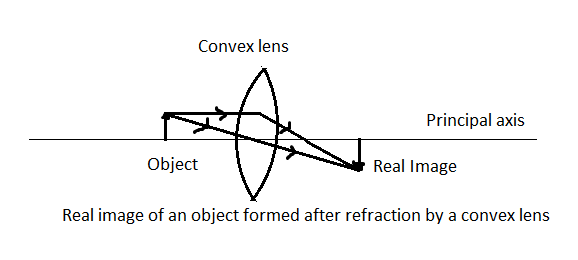
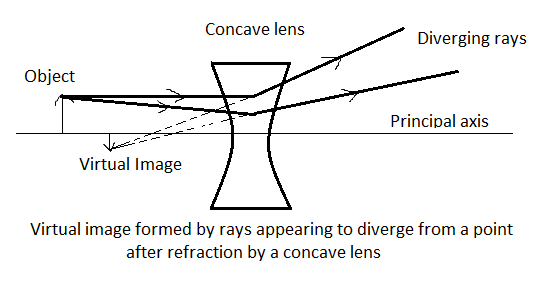
Note: Students might get confused and think that virtual images cannot be formed by reflection but to remember that the example of a plane mirror can be kept in mind. For remembering that they can be formed by refraction also, the example of a magnifying glass will come in handy.
Real images are a bit less intuitive since they cannot be noticed easily in objects of everyday life. However, the best example that real images can be formed by refraction is the lens in our eye which is a convex lens and forms a real image on the retinal screen in our eye.
Thus, by relating the concepts with examples in daily life, especially in topics like optics which are not very easy to imagine, one can get a lot of help in understanding and remembering them.
Complete Step-by-Step solution:
Real images are images that are formed by the actual convergence of light rays at a point after refraction from a lens or reflection from a mirror. They can be obtained on a screen since the light rays meet physically. Real images can be formed after reflection from a concave mirror under suitable conditions and also after refraction by convex lenses. Thus, they can be formed both by reflection and by refraction under suitable conditions.
Virtual images are images that are formed by the light rays that appear to diverge from a point after refraction from a lens or reflection by a mirror. They cannot be obtained on a screen since the light rays appear to diverge from a point, but in reality the light rays do not meet physically. Virtual images can be formed after reflection by convex mirrors and by concave mirrors (when the object is very near). They can also be formed after refraction by a concave lens. Thus, they can be formed both by reflection and refraction under suitable conditions.
Hence, the correct option is A) Real images are the images that can be obtained on a screen whereas a virtual image cannot be obtained on a screen.
Note: Students might get confused and think that virtual images cannot be formed by reflection but to remember that the example of a plane mirror can be kept in mind. For remembering that they can be formed by refraction also, the example of a magnifying glass will come in handy.
Real images are a bit less intuitive since they cannot be noticed easily in objects of everyday life. However, the best example that real images can be formed by refraction is the lens in our eye which is a convex lens and forms a real image on the retinal screen in our eye.
Thus, by relating the concepts with examples in daily life, especially in topics like optics which are not very easy to imagine, one can get a lot of help in understanding and remembering them.
Recently Updated Pages
Master Class 10 Social Science: Engaging Questions & Answers for Success

Master Class 10 Science: Engaging Questions & Answers for Success
Master Class 10 Maths: Engaging Questions & Answers for Success
Master Class 10 General Knowledge: Engaging Questions & Answers for Success
Master Class 10 Computer Science: Engaging Questions & Answers for Success
Class 10 Question and Answer - Your Ultimate Solutions Guide
Trending doubts
What is the full form of PNG A Petrol Natural Gas B class 10 chemistry CBSE
The power of the lens is 2D What is its focal length class 10 physics CBSE
Metals which do not react with dilute acids beginarray20l class 10 chemistry CBSE
The uses of bleaching powder are A It is used bleaching class 10 chemistry CBSE
Write a letter to the principal requesting him to grant class 10 english CBSE
State and prove the Pythagoras theorem-class-10-maths-CBSE