




Base area and volume of solid right circular cylinder are 13.86 sq. cm and 69.3 cu. Cm respectively. Find the height and curved surface area of the cylinder. (Take \[\pi =\dfrac{22}{7}\])
Answer
 Verified
606.9k+ views
Hint: We solve this problem by using the formulas of the solid cylinders.
We have the formula of the base area of the cylinder as
\[B.A=\pi {{r}^{2}}\]
The formula of volume of a cylinder is given as
\[V=\pi {{r}^{2}}h\]
By using the above two formulas we find the height and radius of the given cylinder.
We have the formula of the curved surface area of the cylinder as
\[CSA=2\pi rh\]
Complete step by step answer:
Let us take a rough figure of a cylinder having the height \[h\] and radius \[r\] as follows
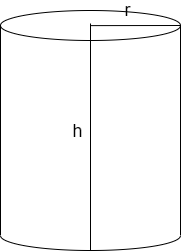
We are given that the base area of a solid cylinder as 13.86 sq. cm
Let us assume that the radius of the cylinder as \[r\]
We know that the formula of the base area of the cylinder as
\[B.A=\pi {{r}^{2}}\]
By using the above formula to given cylinder we get
\[\Rightarrow \pi {{r}^{2}}=13.86\]
We are told to take \[\pi =\dfrac{22}{7}\]
By substituting the value of \[\pi \] in above equation we get
\[\begin{align}
& \Rightarrow \dfrac{22}{7}\times {{r}^{2}}=13.86 \\
& \Rightarrow {{r}^{2}}=13.86\times \dfrac{7}{22} \\
& \Rightarrow r=\sqrt{4.41}=2.1cm \\
\end{align}\]
Here, we can see that the radius of the cylinder is 2.1 cm.
We are given that the volume of the cylinder is 69.3 cu. Cm
We know that the formula of volume of cylinder is given as
\[V=\pi {{r}^{2}}h\]
By using the above formula to given cylinder we get
\[\begin{align}
& \Rightarrow \dfrac{22}{7}\times {{\left( 2.1 \right)}^{2}}\times h=69.3 \\
& \Rightarrow h=\dfrac{69.3\times 7}{4.41\times 22} \\
& \Rightarrow h=5cm \\
\end{align}\]
Here, we can see that the height of the cylinder is 5 cm.
Now, let us find the curved surface area of the given cylinder.
We know that the formula of curved surface area of cylinder as
\[CSA=2\pi rh\]
By using the above formula to given cylinder we get
\[\begin{align}
& \Rightarrow CSA=2\times \dfrac{22}{7}\times 2.1\times 5 \\
& \Rightarrow CSA=66 \\
\end{align}\]
Therefore we can conclude that the height of cylinder is 5 cm and the curved surface area of the cylinder is 66 sq. cm
Note:
We can solve for the height of the cylinder in the shortcut method.
We have the formula for volume of the cylinder as
\[V=\left( \text{Base area} \right)\times \left( \text{height} \right)\]
By using the above formula to given cylinder we get
\[\begin{align}
& \Rightarrow 13.86\times h=69.3 \\
& \Rightarrow h=\dfrac{69.3}{13.86} \\
& \Rightarrow h=5 \\
\end{align}\]
Therefore we can conclude that the height of the cylinder is 5 cm.
We have the formula of the base area of the cylinder as
\[B.A=\pi {{r}^{2}}\]
The formula of volume of a cylinder is given as
\[V=\pi {{r}^{2}}h\]
By using the above two formulas we find the height and radius of the given cylinder.
We have the formula of the curved surface area of the cylinder as
\[CSA=2\pi rh\]
Complete step by step answer:
Let us take a rough figure of a cylinder having the height \[h\] and radius \[r\] as follows
We are given that the base area of a solid cylinder as 13.86 sq. cm
Let us assume that the radius of the cylinder as \[r\]
We know that the formula of the base area of the cylinder as
\[B.A=\pi {{r}^{2}}\]
By using the above formula to given cylinder we get
\[\Rightarrow \pi {{r}^{2}}=13.86\]
We are told to take \[\pi =\dfrac{22}{7}\]
By substituting the value of \[\pi \] in above equation we get
\[\begin{align}
& \Rightarrow \dfrac{22}{7}\times {{r}^{2}}=13.86 \\
& \Rightarrow {{r}^{2}}=13.86\times \dfrac{7}{22} \\
& \Rightarrow r=\sqrt{4.41}=2.1cm \\
\end{align}\]
Here, we can see that the radius of the cylinder is 2.1 cm.
We are given that the volume of the cylinder is 69.3 cu. Cm
We know that the formula of volume of cylinder is given as
\[V=\pi {{r}^{2}}h\]
By using the above formula to given cylinder we get
\[\begin{align}
& \Rightarrow \dfrac{22}{7}\times {{\left( 2.1 \right)}^{2}}\times h=69.3 \\
& \Rightarrow h=\dfrac{69.3\times 7}{4.41\times 22} \\
& \Rightarrow h=5cm \\
\end{align}\]
Here, we can see that the height of the cylinder is 5 cm.
Now, let us find the curved surface area of the given cylinder.
We know that the formula of curved surface area of cylinder as
\[CSA=2\pi rh\]
By using the above formula to given cylinder we get
\[\begin{align}
& \Rightarrow CSA=2\times \dfrac{22}{7}\times 2.1\times 5 \\
& \Rightarrow CSA=66 \\
\end{align}\]
Therefore we can conclude that the height of cylinder is 5 cm and the curved surface area of the cylinder is 66 sq. cm
Note:
We can solve for the height of the cylinder in the shortcut method.
We have the formula for volume of the cylinder as
\[V=\left( \text{Base area} \right)\times \left( \text{height} \right)\]
By using the above formula to given cylinder we get
\[\begin{align}
& \Rightarrow 13.86\times h=69.3 \\
& \Rightarrow h=\dfrac{69.3}{13.86} \\
& \Rightarrow h=5 \\
\end{align}\]
Therefore we can conclude that the height of the cylinder is 5 cm.
Recently Updated Pages
Master Class 11 English: Engaging Questions & Answers for Success

Master Class 11 Social Science: Engaging Questions & Answers for Success
Master Class 11 Maths: Engaging Questions & Answers for Success
Master Class 11 Biology: Engaging Questions & Answers for Success
Master Class 11 Physics: Engaging Questions & Answers for Success
Master Class 11 Chemistry: Engaging Questions & Answers for Success
Trending doubts
Explain the Treaty of Vienna of 1815 class 10 social science CBSE
What is the full form of POSCO class 10 social science CBSE
Define Potential, Developed, Stock and Reserved resources
Why is Venus called Earths sister planet class 10 physics CBSE
10 examples of evaporation in daily life with explanations
Identify the plural form of the word child from the class 10 english CBSE