




Balance the following equation by oxidation number method.
$ {K_2}C{r_2}{O_7} + HCl \to KCl + CrC{l_3} + {H_2}O + C{l_2} $
Answer
 Verified
597k+ views
Hint :The oxidation state or sometimes known as oxidation number, defines the degree of oxidation that an atom possesses in a chemical compound. In other words, oxidation number refers to the charge left on the central atom especially when all the bonding pairs of electrons get broken, with the charge allocated to the most electronegative atom.
Complete Step By Step Answer:
Oxidation number method is generally used to balance the redox reactions. This method works on the principle that the amount of oxidation equals the amount of reduction in the whole chemical reaction. Now using this method, we will balance the given chemical equation stepwise as stated below:
Step 1: To write down the correct molecular formula for each of the reactants and products.
$ {K_2}C{r_2}{O_7} + HCl \to KCl + CrC{l_3} + {H_2}O + C{l_2} $
In the given chemical equation, all molecular formula provided is correct.
Step 2: To identify the elements which change their oxidation number during the execution of reaction. We will write the oxidation numbers of atoms above their chemical symbols on each side of the chemical equation.

It can be thus visualised that $ Cl $ ion is getting oxidized while $ Cr $ ion is getting reduced.
Step 3: To find out the increase or decrease in oxidation number of each atom. Make them equal by multiplying with a suitable number.

We will multiply $ HCl $ and $ C{l_2} $ by 3 and $ {K_2}C{r_2}{O_7} $ and $ C{l_2} $ by 1.
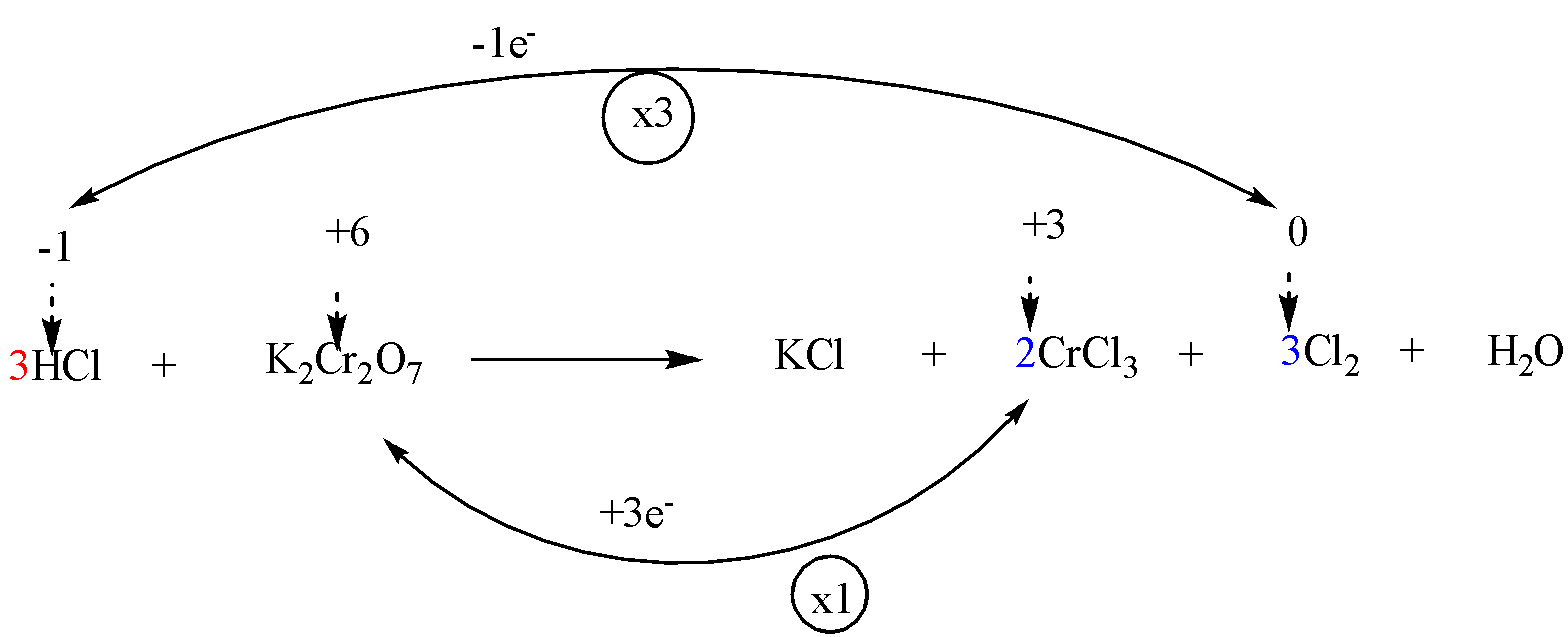
Step 4: To balance the metal ions which don’t change their oxidation number.

Step 5: Add $ {H^ + } $ (in case of acidic solutions) or $ O{H^ - } $ ions (in case of alkaline solutions) to the chemical reaction on appropriate sides such that total ionic charges of the reactants as well as products are same.
The given reaction in question is in acidic solution (i.e. $ HCl $ ). Thus, $ HCl $ must be added on the side of reactants in order to balance 14 $ Cl $ atoms on the side of products. Therefore, the coefficient of $ HCl $ will be 14.

Step 6: Finally balance the number of hydrogen and oxygen atoms in the expression on each side by adding $ {H_2}O $ molecules.

The reaction is now completely balanced.
Note :
A balanced chemical equation simply obeys the law of conservation of mass. Balancing the chemical equations is a significant guiding principle in chemistry. A balanced chemical equation helps you to predict the amount of reactants required and the amount of products formed.
Complete Step By Step Answer:
Oxidation number method is generally used to balance the redox reactions. This method works on the principle that the amount of oxidation equals the amount of reduction in the whole chemical reaction. Now using this method, we will balance the given chemical equation stepwise as stated below:
Step 1: To write down the correct molecular formula for each of the reactants and products.
$ {K_2}C{r_2}{O_7} + HCl \to KCl + CrC{l_3} + {H_2}O + C{l_2} $
In the given chemical equation, all molecular formula provided is correct.
Step 2: To identify the elements which change their oxidation number during the execution of reaction. We will write the oxidation numbers of atoms above their chemical symbols on each side of the chemical equation.
It can be thus visualised that $ Cl $ ion is getting oxidized while $ Cr $ ion is getting reduced.
Step 3: To find out the increase or decrease in oxidation number of each atom. Make them equal by multiplying with a suitable number.
We will multiply $ HCl $ and $ C{l_2} $ by 3 and $ {K_2}C{r_2}{O_7} $ and $ C{l_2} $ by 1.
Step 4: To balance the metal ions which don’t change their oxidation number.
Step 5: Add $ {H^ + } $ (in case of acidic solutions) or $ O{H^ - } $ ions (in case of alkaline solutions) to the chemical reaction on appropriate sides such that total ionic charges of the reactants as well as products are same.
The given reaction in question is in acidic solution (i.e. $ HCl $ ). Thus, $ HCl $ must be added on the side of reactants in order to balance 14 $ Cl $ atoms on the side of products. Therefore, the coefficient of $ HCl $ will be 14.
Step 6: Finally balance the number of hydrogen and oxygen atoms in the expression on each side by adding $ {H_2}O $ molecules.
The reaction is now completely balanced.
Note :
A balanced chemical equation simply obeys the law of conservation of mass. Balancing the chemical equations is a significant guiding principle in chemistry. A balanced chemical equation helps you to predict the amount of reactants required and the amount of products formed.
Recently Updated Pages
Which will be the least stable resonating structure class 11 chemistry CBSE

How many 5 digit telephone numbers can be construc-class-11-maths-CBSE
How do you find the angle of the resultant vector class 11 physics CBSE
Draw labelled diagram of the following i Gram seed class 11 biology CBSE
1 Quintal is equal to a 110 kg b 10 kg c 100kg d 1000 class 11 physics CBSE
What is the need and importance of classification class 11 biology CBSE
Trending doubts
Find the value of the expression given below sin 30circ class 11 maths CBSE
The teeth used for biting and cutting food are called class 11 biology CBSE
Bond order ofO2 O2+ O2 and O22 is in order A O2 langle class 11 chemistry CBSE
Frogs heart when taken out of the body continues to class 11 biology CBSE
Can anyone list 10 advantages and disadvantages of friction
Draw a diagram of a plant cell and label at least eight class 11 biology CBSE