




Bacterium concerned with pertussis is
(a)Bacillus
(b)Diplococcus
(c)Bordetella
(d)Mycobacterium
Answer
 Verified
585.6k+ views
Hint: The bacterium causing pertussis is an aerobic organism. The optimum temperature required for its growth is 35-36 degrees celsius. The organism requires a complex medium for its primary isolation.
Complete answer:
Its colonies on incubation resemble bisected pearls or mercury drops.
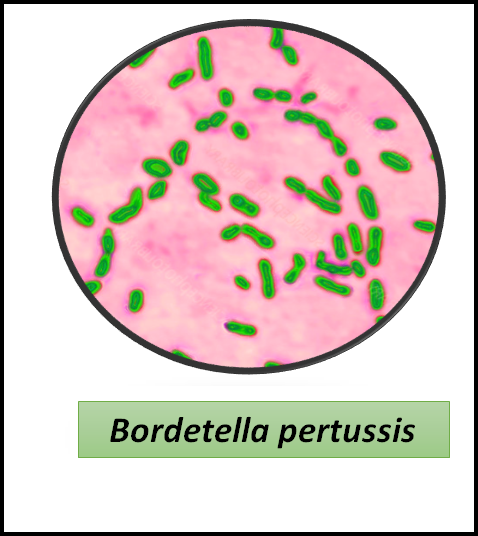
The bacterium concerned with pertussis is Bordetella. B. pertussis is a small ovoid bacterium. Its size varies around 1-1.5 х 0.3 𝜇m. It is a Gram-negative coccobacillus. It is a non-motile and non-sporing bacteria. The bacterium is capsulated but tends to lose the capsule on repeated subcultures.
Now let's learn briefly about pertussis.
B. pertussis infection is predominantly a childhood disease. It is commonly called ‘whooping cough.’ 95% of the cases of whooping cough are due to B. pertussis. The remaining 5% may be caused by B. parapertussis, and in only 0.1 % of cases, B. bronchiseptica is responsible. In human beings, the source of infection is the patient in the early stage. The incubation period is about one-two weeks. The mode of transmission is by droplets.
Additional Information: Cocci are spherically shaped bacterium. Diplococcus means two slightly elongated cocci arranged in pairs. Bacterium pneumococcus is an example of diplococci.
So, the correct answer is, ‘Bordetella.’
Note: -B. Pertussis is a biochemically inactive bacterium. It usually produces catalase enzymes during its metabolism.
-Diplococci like pneumococci are normal commensals of the upper respiratory tract. They are important pathogens of pneumonia in children.
-A member of the genus Bacillus called Bacillus cereus is the most important pathogen behind food poisoning.
Complete answer:
Its colonies on incubation resemble bisected pearls or mercury drops.
The bacterium concerned with pertussis is Bordetella. B. pertussis is a small ovoid bacterium. Its size varies around 1-1.5 х 0.3 𝜇m. It is a Gram-negative coccobacillus. It is a non-motile and non-sporing bacteria. The bacterium is capsulated but tends to lose the capsule on repeated subcultures.
Now let's learn briefly about pertussis.
B. pertussis infection is predominantly a childhood disease. It is commonly called ‘whooping cough.’ 95% of the cases of whooping cough are due to B. pertussis. The remaining 5% may be caused by B. parapertussis, and in only 0.1 % of cases, B. bronchiseptica is responsible. In human beings, the source of infection is the patient in the early stage. The incubation period is about one-two weeks. The mode of transmission is by droplets.
Additional Information: Cocci are spherically shaped bacterium. Diplococcus means two slightly elongated cocci arranged in pairs. Bacterium pneumococcus is an example of diplococci.
So, the correct answer is, ‘Bordetella.’
Note: -B. Pertussis is a biochemically inactive bacterium. It usually produces catalase enzymes during its metabolism.
-Diplococci like pneumococci are normal commensals of the upper respiratory tract. They are important pathogens of pneumonia in children.
-A member of the genus Bacillus called Bacillus cereus is the most important pathogen behind food poisoning.
Recently Updated Pages
Master Class 11 Computer Science: Engaging Questions & Answers for Success

Master Class 11 Business Studies: Engaging Questions & Answers for Success
Master Class 11 Economics: Engaging Questions & Answers for Success
Master Class 11 English: Engaging Questions & Answers for Success
Master Class 11 Maths: Engaging Questions & Answers for Success
Master Class 11 Biology: Engaging Questions & Answers for Success
Trending doubts
One Metric ton is equal to kg A 10000 B 1000 C 100 class 11 physics CBSE
There are 720 permutations of the digits 1 2 3 4 5 class 11 maths CBSE
Discuss the various forms of bacteria class 11 biology CBSE
Draw a diagram of a plant cell and label at least eight class 11 biology CBSE
State the laws of reflection of light
Explain zero factorial class 11 maths CBSE