




How bacteria, fungi and lower plants survive in unfavorable conditions? Explain.
Answer
 Verified
610.2k+ views
Hint: The microorganisms like bacteria, fungi etc. can remain alive in the extreme climatic conditions. This is possible by the formation of the spores. The algae produce the thick-walled spores which store food material in them called the aconites or the resting pore. The spores of the fungi are called chlamydospores which are penetrating in nature.
Complete answer:
The organisms like bacteria, fungi, virus and the lower plants can even survive in the unfavorable conditions like high heat, or cold, in the absence of oxygen and also in the absence of the host or the food. This is possible because these organisms possess spores. The endospores are the non reproductive cells of the organisms like bacteria. These spores are covered by means of thick and the hard layer that protects it from the unfavorable condition. They help the bacteria and the other organisms to remain dormant in the extreme climatic conditions.
These organisms during the unfavorable condition uses or consumes less energy than in the normal conditions and so the metabolic rate is also lowered. This helps in conserving the energy for survival. After when the favorable condition returns, these spores begin to germinate and starts its normal metabolism
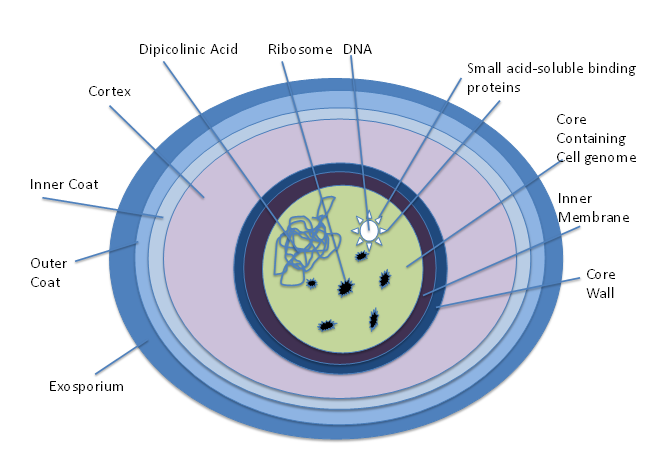
Note: The spores formed by the bacteria are called endospores. These endospores are the most known living organisms which are more resistant in nature. They survive, even for the period of two days in the hot boiling water.
Complete answer:
The organisms like bacteria, fungi, virus and the lower plants can even survive in the unfavorable conditions like high heat, or cold, in the absence of oxygen and also in the absence of the host or the food. This is possible because these organisms possess spores. The endospores are the non reproductive cells of the organisms like bacteria. These spores are covered by means of thick and the hard layer that protects it from the unfavorable condition. They help the bacteria and the other organisms to remain dormant in the extreme climatic conditions.
These organisms during the unfavorable condition uses or consumes less energy than in the normal conditions and so the metabolic rate is also lowered. This helps in conserving the energy for survival. After when the favorable condition returns, these spores begin to germinate and starts its normal metabolism
Note: The spores formed by the bacteria are called endospores. These endospores are the most known living organisms which are more resistant in nature. They survive, even for the period of two days in the hot boiling water.
Recently Updated Pages
Master Class 12 Business Studies: Engaging Questions & Answers for Success

Master Class 12 Chemistry: Engaging Questions & Answers for Success
Master Class 12 Biology: Engaging Questions & Answers for Success
Class 12 Question and Answer - Your Ultimate Solutions Guide
Master Class 11 English: Engaging Questions & Answers for Success
Master Class 11 Social Science: Engaging Questions & Answers for Success
Trending doubts
Which are the Top 10 Largest Countries of the World?
Draw a labelled sketch of the human eye class 12 physics CBSE
Differentiate between homogeneous and heterogeneous class 12 chemistry CBSE
Differentiate between Pyramid of energy and pyramid class 12 biology CBSE
Why is the cell called the structural and functional class 12 biology CBSE
Draw the diagram of the pyramid of energy Explain In class 12 biology CBSE