




Atomic number of iron is 26. It exhibits $F{e^{ + 2}}$, $F{e^{ + 3}}$ oxidation state. Write the subshell electronic configuration.
Subshell electronic configuration
Fe
$F{e^{ + 2}}$
$F{e^{ + 3}}$
Answer
 Verified
644.1k+ views
Hint:. To answer this question we should know about electronic configuration and rules to write the electronic configuration. Iron is a d-block element. It is very important to understand variable oxidation state.
Complete step by step answer:
Electronic configuration can be defined as the distribution of electrons in various shells, subshells and in the orbitals of an atom.
The rules to write electronic configuration:
- The number of electrons in a shell: According to Bohr-bury scheme, the maximum number of electrons a shell can hold is equal to $2{n^2}$, where n is the number of shells.
If n=1 , the maximum number of electrons this shell can hold is $2{(1)^2}$ that is two electrons.
-The number of electrons in sub- shell: The maximum number of electrons the subshell can hold is given by azimuthal quantum number which is equal to $2(2l + 1)$, where l is 0,1,2,3 for s, p, d, f sub-shell respectively.
If l = 2,
= $2 (2l + 1)$
= 2 [ 2(2) + 1]
= 2 (5)
= 10
d subshell can hold 10 electrons only
-Aufbau principle: According to Aufbau principle only the subshells are arranged in a sequence with respect to the energy level.
Aufbau principle states that “In the ground state of the atoms, the orbitals are filled in order of their increasing energies”. This principle is based on Hund’s rule of maximum multiplicity and Pauli Exclusion Principle.
According to Aufbau principle, the order in which the energies of the orbitals increases:
1s, 2s, 2p, 3s, 3p, 4s, 3d, 4p, 5s, 4d ,5p, 4f, 5d……………..
Let’s write the electronic configuration:
We know the atomic number of iron is 26. The s shell can accommodate 2 electrons, p shell can accommodate 6 electrons, d shell can accommodate 10 electrons and f can accommodate 14 electrons.
Now, follow the above rules and write electronic configuration.
Firstly write the order in which the energies of the orbitals increase as given by Aufbau principle. Then keep on filling the electrons a particular shell can accommodate.
The electronic configuration of Fe = $1{s^2},2{s^2},2{p^6},3{s^2},3{p^6},4{s^2},3{d^6}$
Fe =
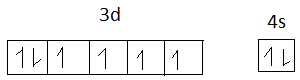
If two electrons are removed from the outermost shell then, it changes from Fe to $F{e^{ + 2}}$
The electronic configuration of $F{e^{ + 2}}$ = $1{s^2},2{s^2},2{p^6},3{s^2},3{p^6},4{s^0},3{d^6}$
$F{e^{ + 2}}$ =
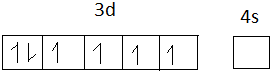
If three electrons are removed from the outermost shell, it changes from Fe to $F{e^{ + 3}}$
The electronic configuration of $F{e^{ + 3}}$ = $1{s^2},2{s^2},2{p^6},3{s^2},3{p^6},4{s^0},3{d^5}$
$F{e^{ + 3}}$ =
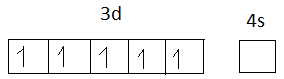
Note: The orbital diagram drawn above helps you understand the difference and remember. It’s important to understand the difference between shell and subshell. s,p,d,f are shells and 1s, 2s, 3s,….,2p, 3p, 4p…,3d, 4d, 5d…, 4f, 5f… are subshells.
Complete step by step answer:
Electronic configuration can be defined as the distribution of electrons in various shells, subshells and in the orbitals of an atom.
The rules to write electronic configuration:
- The number of electrons in a shell: According to Bohr-bury scheme, the maximum number of electrons a shell can hold is equal to $2{n^2}$, where n is the number of shells.
If n=1 , the maximum number of electrons this shell can hold is $2{(1)^2}$ that is two electrons.
-The number of electrons in sub- shell: The maximum number of electrons the subshell can hold is given by azimuthal quantum number which is equal to $2(2l + 1)$, where l is 0,1,2,3 for s, p, d, f sub-shell respectively.
If l = 2,
= $2 (2l + 1)$
= 2 [ 2(2) + 1]
= 2 (5)
= 10
d subshell can hold 10 electrons only
-Aufbau principle: According to Aufbau principle only the subshells are arranged in a sequence with respect to the energy level.
Aufbau principle states that “In the ground state of the atoms, the orbitals are filled in order of their increasing energies”. This principle is based on Hund’s rule of maximum multiplicity and Pauli Exclusion Principle.
According to Aufbau principle, the order in which the energies of the orbitals increases:
1s, 2s, 2p, 3s, 3p, 4s, 3d, 4p, 5s, 4d ,5p, 4f, 5d……………..
Let’s write the electronic configuration:
We know the atomic number of iron is 26. The s shell can accommodate 2 electrons, p shell can accommodate 6 electrons, d shell can accommodate 10 electrons and f can accommodate 14 electrons.
Now, follow the above rules and write electronic configuration.
Firstly write the order in which the energies of the orbitals increase as given by Aufbau principle. Then keep on filling the electrons a particular shell can accommodate.
The electronic configuration of Fe = $1{s^2},2{s^2},2{p^6},3{s^2},3{p^6},4{s^2},3{d^6}$
Fe =
If two electrons are removed from the outermost shell then, it changes from Fe to $F{e^{ + 2}}$
The electronic configuration of $F{e^{ + 2}}$ = $1{s^2},2{s^2},2{p^6},3{s^2},3{p^6},4{s^0},3{d^6}$
$F{e^{ + 2}}$ =
If three electrons are removed from the outermost shell, it changes from Fe to $F{e^{ + 3}}$
The electronic configuration of $F{e^{ + 3}}$ = $1{s^2},2{s^2},2{p^6},3{s^2},3{p^6},4{s^0},3{d^5}$
$F{e^{ + 3}}$ =
Note: The orbital diagram drawn above helps you understand the difference and remember. It’s important to understand the difference between shell and subshell. s,p,d,f are shells and 1s, 2s, 3s,….,2p, 3p, 4p…,3d, 4d, 5d…, 4f, 5f… are subshells.
Recently Updated Pages
If x a + bt + ct2 where x is in meters and t is in class 11 physics CBSE

A car covers the first half distance between two places class 11 physics CBSE
The resultant of two vectors overrightarrow P and overrightarrow class 11 physics CBSE
Find the value of cos 135 class 11 maths CBSE
A mass M is held in place by an applied force F and class 11 physics CBSE
A solution of glucose in water is labelled as 10 dfracwv class 11 chemistry CBSE
Trending doubts
Find the value of the expression given below sin 30circ class 11 maths CBSE
One Metric ton is equal to kg A 10000 B 1000 C 100 class 11 physics CBSE
Draw a diagram of nephron and explain its structur class 11 biology CBSE
10 examples of friction in our daily life
Proton was discovered by A Thomson B Rutherford C Chadwick class 11 chemistry CBSE
Bond order ofO2 O2+ O2 and O22 is in order A O2 langle class 11 chemistry CBSE