




At yield point, Hooke’s law doesn’t hold good
A) True
B) False
Answer
 Verified
577.8k+ views
Hint: Hooke’s Law: Hooke’s law states that the strain of the material is proportional to the applied stress within the elastic limit of that material.
Formula used: $F = - k.x$
F = force
x = extension
k = spring constant
Step by step solution:
The yield point is the point on a stress strain curve that indicates the limit of the elastic behavior and the beginning of the plastic behavior. Yielding means the start of breaking of fibers.
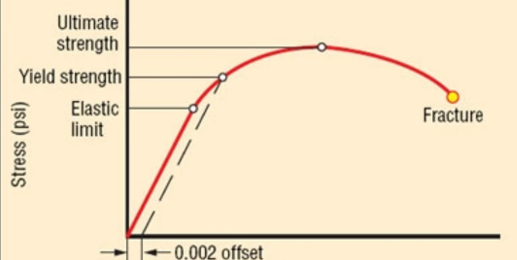
Thus, Hooke’s law doesn’t hold good in this region, as stress is not proportional to strain in this region.
Additional information:Hooke's equation holds (to some extent) in many other situations where an elastic body is deformed, such as wind blowing on a tall building, and a musician plucking a string of a guitar. An elastic body or material for which this equation can be assumed is said to be linear-elastic or Hookean. Hooke's law is only a first-order linear approximation to the real response of springs and other elastic bodies to applied forces. It must eventually fail once the forces exceed some limit, since no material can be compressed beyond a certain minimum size, or stretched beyond a maximum size, without some permanent deformation or change of state. Many materials will noticeably deviate from Hooke's law well before those elastic limits are reached.
Note:While solving these types of questions one should have a clear understanding of the stress strain diagram and all the terms involved in it. Sometimes we get confused with terms like elastic and plastic. Both are different terms and we should have a clear understanding of these terms then only we can give a correct answer.
Formula used: $F = - k.x$
F = force
x = extension
k = spring constant
Step by step solution:
The yield point is the point on a stress strain curve that indicates the limit of the elastic behavior and the beginning of the plastic behavior. Yielding means the start of breaking of fibers.
Thus, Hooke’s law doesn’t hold good in this region, as stress is not proportional to strain in this region.
Additional information:Hooke's equation holds (to some extent) in many other situations where an elastic body is deformed, such as wind blowing on a tall building, and a musician plucking a string of a guitar. An elastic body or material for which this equation can be assumed is said to be linear-elastic or Hookean. Hooke's law is only a first-order linear approximation to the real response of springs and other elastic bodies to applied forces. It must eventually fail once the forces exceed some limit, since no material can be compressed beyond a certain minimum size, or stretched beyond a maximum size, without some permanent deformation or change of state. Many materials will noticeably deviate from Hooke's law well before those elastic limits are reached.
Note:While solving these types of questions one should have a clear understanding of the stress strain diagram and all the terms involved in it. Sometimes we get confused with terms like elastic and plastic. Both are different terms and we should have a clear understanding of these terms then only we can give a correct answer.
Recently Updated Pages
Master Class 11 Computer Science: Engaging Questions & Answers for Success

Master Class 11 Business Studies: Engaging Questions & Answers for Success
Master Class 11 Economics: Engaging Questions & Answers for Success
Master Class 11 English: Engaging Questions & Answers for Success
Master Class 11 Maths: Engaging Questions & Answers for Success
Master Class 11 Biology: Engaging Questions & Answers for Success
Trending doubts
One Metric ton is equal to kg A 10000 B 1000 C 100 class 11 physics CBSE
There are 720 permutations of the digits 1 2 3 4 5 class 11 maths CBSE
Discuss the various forms of bacteria class 11 biology CBSE
Draw a diagram of a plant cell and label at least eight class 11 biology CBSE
State the laws of reflection of light
Explain zero factorial class 11 maths CBSE