




At which phase of the moon do solar eclipses occur?
A. Full
B. New
C. First quarter
D. Third quarter
Answer
 Verified
618.3k+ views
Hint: A solar eclipse happens when the moon comes between the Earth and The Sun.
It is not observed from the entire Earth.
Complete step by step answer:
Description about the phase of moon:
The phases of the moon are the different ways the moon looks from earth for about a month. As the moon orbits around the earth, the part of the moon that faces the sun will be lit up. The different shapes of the lit portion of the moon that can be seen from the earth are known as phases of the moon.
The new moon is the phase when we can only see an outer ring of light around the moon and can’t actually see the moon. This happens because the light that falls on the moon does not come to earth but scatters away from the earth. And this happens because, at this particular time, the moon is blocking the way of sun rays that were coming to earth. That is, the moon is between the earth and the sun. That means, a new moon is the phase when a solar eclipse occurs.
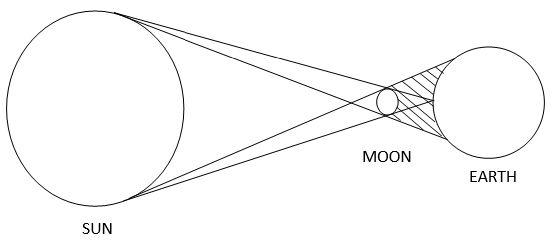
So, the correct answer is “Option B”.
Note:
In some parts of the earth, where the impact of an eclipse is the most, we can observe complete darkness in broad daylight for some time.
The phases of the moon starting with the new moon are:
1. New moon
2. Waxing crescent
3. First quarter
4. Waxing gibbous
5. Full
6. Waning gibbous
7. Third quarter
8. Waning crescent
9. Dark moon.
It is not observed from the entire Earth.
Complete step by step answer:
Description about the phase of moon:
The phases of the moon are the different ways the moon looks from earth for about a month. As the moon orbits around the earth, the part of the moon that faces the sun will be lit up. The different shapes of the lit portion of the moon that can be seen from the earth are known as phases of the moon.
The new moon is the phase when we can only see an outer ring of light around the moon and can’t actually see the moon. This happens because the light that falls on the moon does not come to earth but scatters away from the earth. And this happens because, at this particular time, the moon is blocking the way of sun rays that were coming to earth. That is, the moon is between the earth and the sun. That means, a new moon is the phase when a solar eclipse occurs.
So, the correct answer is “Option B”.
Note:
In some parts of the earth, where the impact of an eclipse is the most, we can observe complete darkness in broad daylight for some time.
The phases of the moon starting with the new moon are:
1. New moon
2. Waxing crescent
3. First quarter
4. Waxing gibbous
5. Full
6. Waning gibbous
7. Third quarter
8. Waning crescent
9. Dark moon.
Recently Updated Pages
Master Class 11 English: Engaging Questions & Answers for Success

Master Class 11 Social Science: Engaging Questions & Answers for Success
Master Class 11 Maths: Engaging Questions & Answers for Success
Master Class 11 Biology: Engaging Questions & Answers for Success
Master Class 11 Physics: Engaging Questions & Answers for Success
Master Class 11 Chemistry: Engaging Questions & Answers for Success
Trending doubts
One Metric ton is equal to kg A 10000 B 1000 C 100 class 11 physics CBSE
Difference Between Prokaryotic Cells and Eukaryotic Cells
Find the value of the expression given below sin 30circ class 11 maths CBSE
Difference between physical and chemical change class 11 chemistry CBSE
Two of the body parts which do not appear in MRI are class 11 biology CBSE
Draw a diagram of a plant cell and label at least eight class 11 biology CBSE