




At what angle ($\theta $) with the horizontal should a body be projected so that its horizontal range equals the maximum height it attains?
A. $\theta = {\tan ^{ - 1}}(\sqrt 2 )$
B. $\theta = {\tan ^{ - 1}}(2\sqrt 2 )$
C. $\theta = {\tan ^{ - 1}}(2\sqrt 3 )$
D. $\theta = {\tan ^{ - 1}}(4)$
Answer
 Verified
632.4k+ views
Hint – You can start the solution by describing the general formula for calculating range and maximum height attained by the projectile i.e. $R = \dfrac{{{u^2}\sin 2\theta }}{g}$ and \[{h_{\max }} = \dfrac{{{u^2}{{\sin }^2}\theta }}{{2g}}\] respectively. Then compare these two equations to find the angle that the projectile makes with the horizontal.
Complete step-by-step answer:
Before finding the horizontal range (the horizontal distance that the projectile covers) of the projectile, let’s describe the general formulas for calculating the horizontal range and maximum height (the maximum vertical displacement that the projectile undergoes).
The diagram for the situation given in the problem is
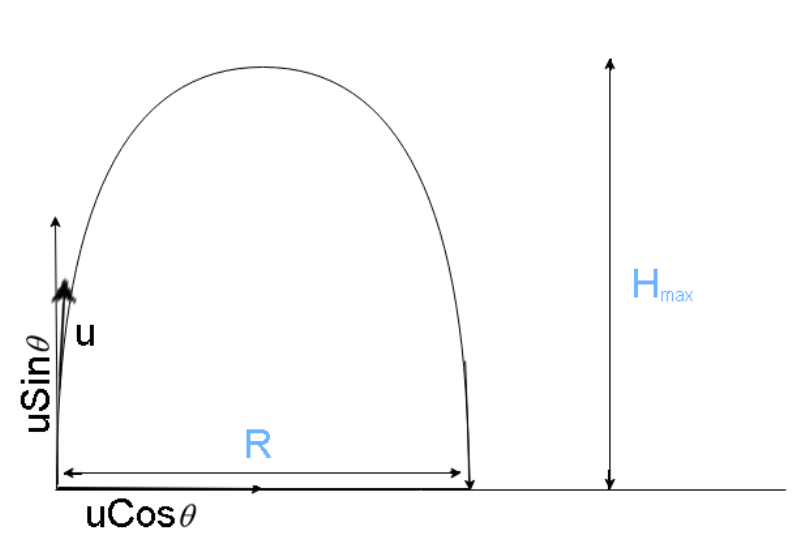
The projectile has some initial velocity (both horizontal and vertical). The horizontal velocity is not affected because there is no force affecting it, but the vertical velocity constantly decreases due to the force of gravity against it, vertical velocity is maximum at the bottom and zero at the top.
We know that
$R = \dfrac{{{u^2}\sin 2\theta }}{g}$ (Equation 1)
And \[{h_{\max }} = \dfrac{{{u^2}{{\sin }^2}\theta }}{{2g}}\](Equation 2)
Here
\[R = \]Horizontal range,
\[u = \]Initial speed,
\[\theta = \]Angle that the projectile makes with the horizontal and
\[g = \]Acceleration due to gravity.
It is given in the question that the maximum height is equal to the horizontal range (\[R = {h_{\max }}\]), so by using equation 1 and 2
$ \Rightarrow \dfrac{{{u^2}\sin 2\theta }}{g} = \dfrac{{{u^2}{{\sin }^2}\theta }}{{2g}}$
$ \Rightarrow \sin 2\theta = \dfrac{{{{\sin }^2}\theta }}{2}$
$ \Rightarrow 2\sin \theta \cos \theta = \dfrac{{{{\sin }^2}\theta }}{2}$$(\because \sin 2\theta = 2\sin \theta \cos \theta )$
$ \Rightarrow \tan \theta = 4$
$\theta = {\tan ^{ - 1}}(4)$
Hence, option D is the correct choice.
Note – This problem is a classic example of projectiles, remember to always consider what the horizontal range and maximum height should be and the angle it makes with the horizontal. Like in this problem, it is clearly stated that the projectile is thrown in such a way that lets it attain horizontal range equal to the maximum height. But these conditions differ from problem to problem.
Complete step-by-step answer:
Before finding the horizontal range (the horizontal distance that the projectile covers) of the projectile, let’s describe the general formulas for calculating the horizontal range and maximum height (the maximum vertical displacement that the projectile undergoes).
The diagram for the situation given in the problem is
The projectile has some initial velocity (both horizontal and vertical). The horizontal velocity is not affected because there is no force affecting it, but the vertical velocity constantly decreases due to the force of gravity against it, vertical velocity is maximum at the bottom and zero at the top.
We know that
$R = \dfrac{{{u^2}\sin 2\theta }}{g}$ (Equation 1)
And \[{h_{\max }} = \dfrac{{{u^2}{{\sin }^2}\theta }}{{2g}}\](Equation 2)
Here
\[R = \]Horizontal range,
\[u = \]Initial speed,
\[\theta = \]Angle that the projectile makes with the horizontal and
\[g = \]Acceleration due to gravity.
It is given in the question that the maximum height is equal to the horizontal range (\[R = {h_{\max }}\]), so by using equation 1 and 2
$ \Rightarrow \dfrac{{{u^2}\sin 2\theta }}{g} = \dfrac{{{u^2}{{\sin }^2}\theta }}{{2g}}$
$ \Rightarrow \sin 2\theta = \dfrac{{{{\sin }^2}\theta }}{2}$
$ \Rightarrow 2\sin \theta \cos \theta = \dfrac{{{{\sin }^2}\theta }}{2}$$(\because \sin 2\theta = 2\sin \theta \cos \theta )$
$ \Rightarrow \tan \theta = 4$
$\theta = {\tan ^{ - 1}}(4)$
Hence, option D is the correct choice.
Note – This problem is a classic example of projectiles, remember to always consider what the horizontal range and maximum height should be and the angle it makes with the horizontal. Like in this problem, it is clearly stated that the projectile is thrown in such a way that lets it attain horizontal range equal to the maximum height. But these conditions differ from problem to problem.
Recently Updated Pages
Master Class 12 Economics: Engaging Questions & Answers for Success

Master Class 12 English: Engaging Questions & Answers for Success
Master Class 12 Social Science: Engaging Questions & Answers for Success
Master Class 12 Maths: Engaging Questions & Answers for Success
Master Class 12 Physics: Engaging Questions & Answers for Success
Master Class 9 General Knowledge: Engaging Questions & Answers for Success
Trending doubts
One Metric ton is equal to kg A 10000 B 1000 C 100 class 11 physics CBSE
Difference Between Prokaryotic Cells and Eukaryotic Cells
Find the value of the expression given below sin 30circ class 11 maths CBSE
Two of the body parts which do not appear in MRI are class 11 biology CBSE
Draw a diagram of nephron and explain its structur class 11 biology CBSE
10 examples of friction in our daily life