




At what angle should the two force vectors $2F$ and $\sqrt 2 F$ act so that the resultant vector is $\sqrt {10} F$ ?
Answer
 Verified
496.8k+ views
Hint: The resultant is the vector sum of two or more vectors. This can be found out using vector addition methods like the triangle law, parallelogram law and the polygon law.
When two forces act making an angle $\theta $ with each other, then their resultant is given as $R = \sqrt {F_1^2 + F_2^2 + 2{F_1}{F_2}\cos \theta } $ .
Complete step by step solution:
The diagrammatic representation is as follows
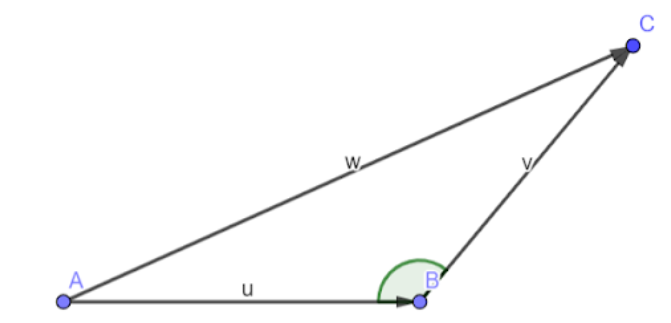
Here u and v are given vectors and w is the resultant vector. The formula can be derived following the triangle law of vector addition.
In this question, we are given the magnitude of two vectors. We shall also assume the angle between them to be $\theta $ . Given the value of the resultant of the two vectors, we can plug in these into the formula of the resultant of the two vectors to get the value of $\theta $ since it will be the only variable in the equation.
Complete step by step answer: Given two vectors $2F$ and $\sqrt 2 F$. Their resultant is given as $\sqrt {10} F$
Let the angle made by the two vectors be $\theta $.
Substituting the values in the formula $R = \sqrt {F_1^2 + F_2^2 + 2{F_1}{F_2}\cos \theta } $ we get,
$\sqrt {10} F = \sqrt {{{(2F)}^2} + {{(\sqrt 2 F)}^2} + 2 \times \sqrt 2 F \times 2F\cos \theta } $
Here $R = \sqrt {10} F\,,\,{F_1} = 2F\,,\,{F_2} = \sqrt 2 F$
Further solving the equation,
$\sqrt {10} F = \sqrt {4{F^2} + 2{F^2} + 4\sqrt 2 {F^2}\cos \theta } $
$ \Rightarrow \sqrt {10} F = \sqrt {6{F^2} + 4\sqrt 2 {F^2}\cos \theta } $
Squaring both sides,
$10{F^2} = 6{F^2} + 4\sqrt 2 {F^2}\cos \theta $
Now solving,
$4{F^2} = 4\sqrt 2 {F^2}\cos \theta $
$ \Rightarrow 1 = \sqrt 2 \cos \theta $
$ \Rightarrow \cos \theta = \dfrac{1}{{\sqrt 2 }}$
$\theta = {\cos ^{ - 1}}\dfrac{1}{{\sqrt 2 }}$
So, the final answer is $\theta = {\cos ^{ - 1}}\dfrac{1}{{\sqrt 2 }}$.
Note:
The arrowheads on the vectors signify their direction. It is imperative to note the direction of vectors while calculating the resultant. The direction could be different as given in the triangle law and so the angle between the vectors would change accordingly. If the direction of one of the vectors is opposite then the angle between the vectors becomes $\pi - \theta $ .
When two forces act making an angle $\theta $ with each other, then their resultant is given as $R = \sqrt {F_1^2 + F_2^2 + 2{F_1}{F_2}\cos \theta } $ .
Complete step by step solution:
The diagrammatic representation is as follows
Here u and v are given vectors and w is the resultant vector. The formula can be derived following the triangle law of vector addition.
In this question, we are given the magnitude of two vectors. We shall also assume the angle between them to be $\theta $ . Given the value of the resultant of the two vectors, we can plug in these into the formula of the resultant of the two vectors to get the value of $\theta $ since it will be the only variable in the equation.
Complete step by step answer: Given two vectors $2F$ and $\sqrt 2 F$. Their resultant is given as $\sqrt {10} F$
Let the angle made by the two vectors be $\theta $.
Substituting the values in the formula $R = \sqrt {F_1^2 + F_2^2 + 2{F_1}{F_2}\cos \theta } $ we get,
$\sqrt {10} F = \sqrt {{{(2F)}^2} + {{(\sqrt 2 F)}^2} + 2 \times \sqrt 2 F \times 2F\cos \theta } $
Here $R = \sqrt {10} F\,,\,{F_1} = 2F\,,\,{F_2} = \sqrt 2 F$
Further solving the equation,
$\sqrt {10} F = \sqrt {4{F^2} + 2{F^2} + 4\sqrt 2 {F^2}\cos \theta } $
$ \Rightarrow \sqrt {10} F = \sqrt {6{F^2} + 4\sqrt 2 {F^2}\cos \theta } $
Squaring both sides,
$10{F^2} = 6{F^2} + 4\sqrt 2 {F^2}\cos \theta $
Now solving,
$4{F^2} = 4\sqrt 2 {F^2}\cos \theta $
$ \Rightarrow 1 = \sqrt 2 \cos \theta $
$ \Rightarrow \cos \theta = \dfrac{1}{{\sqrt 2 }}$
$\theta = {\cos ^{ - 1}}\dfrac{1}{{\sqrt 2 }}$
So, the final answer is $\theta = {\cos ^{ - 1}}\dfrac{1}{{\sqrt 2 }}$.
Note:
The arrowheads on the vectors signify their direction. It is imperative to note the direction of vectors while calculating the resultant. The direction could be different as given in the triangle law and so the angle between the vectors would change accordingly. If the direction of one of the vectors is opposite then the angle between the vectors becomes $\pi - \theta $ .
Recently Updated Pages
Master Class 11 Computer Science: Engaging Questions & Answers for Success

Master Class 11 Business Studies: Engaging Questions & Answers for Success
Master Class 11 Economics: Engaging Questions & Answers for Success
Master Class 11 English: Engaging Questions & Answers for Success
Master Class 11 Maths: Engaging Questions & Answers for Success
Master Class 11 Biology: Engaging Questions & Answers for Success
Trending doubts
One Metric ton is equal to kg A 10000 B 1000 C 100 class 11 physics CBSE
There are 720 permutations of the digits 1 2 3 4 5 class 11 maths CBSE
Discuss the various forms of bacteria class 11 biology CBSE
Draw a diagram of a plant cell and label at least eight class 11 biology CBSE
State the laws of reflection of light
Explain zero factorial class 11 maths CBSE