




At what angle should a projectile with initial velocity $'v'$ be thrown, so that it achieves its maximum range?
Answer
 Verified
534k+ views
Hint:Let us get some ideas about projectiles. Any object thrown by the application of force is referred to as a projectile.An object launched into space and permitted to move freely under the influence of gravity and air resistance is also referred to as a spacecraft. Although projectiles can be any object in motion across space (for example, a thrown baseball, kicked football, fired bullet, thrown arrow, or stone released from a catapult), they are most typically used in warfare and sports. Projectile trajectories are analysed using mathematical equations of motion.
Complete step-by-step solution:
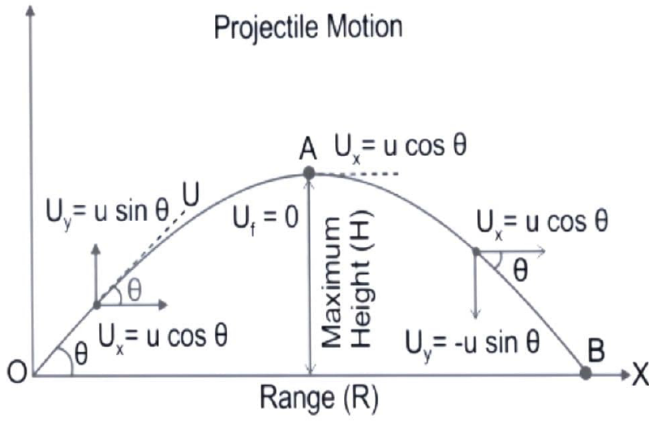
Total time of flight $ = \dfrac{{2\,u\,\sin \theta }}{g}$
Range of projectile $ = \dfrac{{{u^2}\,\sin 2\theta }}{g}$
Maximum Height $ = \dfrac{{{u^2}\,{{\sin }^2}\theta }}{{2g}}$
Where, u = projected speed
$\theta = $angle at which an object is thrown from the ground.
$g = $acceleration due to gravity $ = \,9.8\,m/{s^2}$
Maximum Range: During projectile motion, it is the object's largest distance travelled.
The maximum horizontal range is attained when the projection angle is \[{45^ \circ }\] degrees.
Angle for maximum Vertical range $ = {90^ \circ }$
For maximizing the vertical range, $\sin \theta $must be maximum
which is $\sin \theta = 1$
$\theta = {90^ \circ }$
Note:The propelling force is the most important force applied to the ‘projectile' in projectile motion; in this case, the propelling forces are the muscles that act upon the ball to make it move; the stronger the force applied, the more propelling force, which means the projectile (the ball) will travel farther; and the stronger the force applied, the more the projectile (the ball) will move further due to the pushing force.
Complete step-by-step solution:
Total time of flight $ = \dfrac{{2\,u\,\sin \theta }}{g}$
Range of projectile $ = \dfrac{{{u^2}\,\sin 2\theta }}{g}$
Maximum Height $ = \dfrac{{{u^2}\,{{\sin }^2}\theta }}{{2g}}$
Where, u = projected speed
$\theta = $angle at which an object is thrown from the ground.
$g = $acceleration due to gravity $ = \,9.8\,m/{s^2}$
Maximum Range: During projectile motion, it is the object's largest distance travelled.
The maximum horizontal range is attained when the projection angle is \[{45^ \circ }\] degrees.
Angle for maximum Vertical range $ = {90^ \circ }$
For maximizing the vertical range, $\sin \theta $must be maximum
which is $\sin \theta = 1$
$\theta = {90^ \circ }$
Note:The propelling force is the most important force applied to the ‘projectile' in projectile motion; in this case, the propelling forces are the muscles that act upon the ball to make it move; the stronger the force applied, the more propelling force, which means the projectile (the ball) will travel farther; and the stronger the force applied, the more the projectile (the ball) will move further due to the pushing force.
Recently Updated Pages
Master Class 11 English: Engaging Questions & Answers for Success

Master Class 11 Maths: Engaging Questions & Answers for Success
Class 11 Question and Answer - Your Ultimate Solutions Guide
Master Class 11 Biology: Engaging Questions & Answers for Success
Master Class 11 Physics: Engaging Questions & Answers for Success
Master Class 11 Accountancy: Engaging Questions & Answers for Success
Trending doubts
Differentiate between an exothermic and an endothermic class 11 chemistry CBSE
One Metric ton is equal to kg A 10000 B 1000 C 100 class 11 physics CBSE
Difference Between Prokaryotic Cells and Eukaryotic Cells
There are 720 permutations of the digits 1 2 3 4 5 class 11 maths CBSE
Draw a diagram of a plant cell and label at least eight class 11 biology CBSE
1 Quintal is equal to a 110 kg b 10 kg c 100kg d 1000 class 11 physics CBSE