




At the time of expiration, diaphragm becomes
a) Oblique
b) Normal
c) Flattened
d) Dome shaped
Answer
 Verified
644.4k+ views
Hint:Expiration is giving out carbon dioxide. It is a part of breathing. This follows Boyle’s Law. (Pressure is inversely proportional to Volume). During expiration, volume of the lung cavity decreases and thus due to high pressure, air is out.
Complete answer:
Respiration includes Breathing and exchange of gases. Breathing is inspiration and expiration. Breathing can be normal or forceful. Structures required for normal breathing are External intercostal muscles and diaphragm while for forceful breathing internal intercostal muscles and abdominal muscles are needed.
Intercostal muscles are muscles present in between the ribs. These can be External or Internal
Diagrammatic representation of these two types
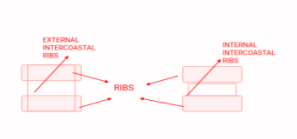
As seen in the diagram, the external intercostal muscles are attached to the upper border of upper rib and lower border of lower rib.Internal intercostal is completely in between the ribs.The external intercostal muscles are attached to the sternum as well.
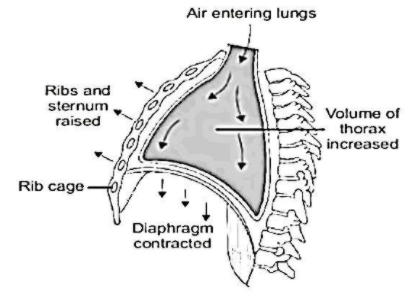
During normal breathing, contraction and relaxation of the external intercostal muscles bring about movement of ribs and sternum. The muscles contract and the ribs and sternum are pulled out. This increases the volume of the lung cavity and as a result the pressure decreases, Thus the movement of air is from high to low i.e. from the atmosphere to the inside. The dome shaped diaphragm is also pulled in such a way that the volume of the lung cavity increases. Thus the diaphragm becomes flat during inspiration
During expiration, the muscles relax. The ribs and sternum return to their original position. The diaphragm also relaxes and thus it becomes dome shaped. This causes the volume of the thoracic cavity to decrease. This increases the pressure inside the lung cavity. Thus the air gushes out.
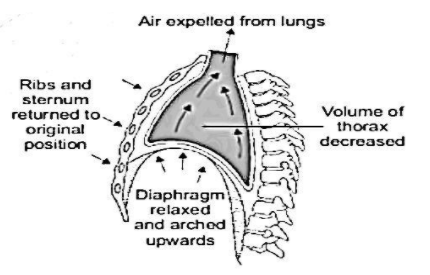
Thus the question is about expiration , hence diaphragm becomes dome shaped. Hence the answer is d.
Note:
Three factors play a major role during breathing.
>Boyle’s law
>Unique movement of external intercostal muscles
>Pressure gradient (movement of pressure from high to low pressure areas is due to differences in pressure)
Complete answer:
Respiration includes Breathing and exchange of gases. Breathing is inspiration and expiration. Breathing can be normal or forceful. Structures required for normal breathing are External intercostal muscles and diaphragm while for forceful breathing internal intercostal muscles and abdominal muscles are needed.
Intercostal muscles are muscles present in between the ribs. These can be External or Internal
Diagrammatic representation of these two types
As seen in the diagram, the external intercostal muscles are attached to the upper border of upper rib and lower border of lower rib.Internal intercostal is completely in between the ribs.The external intercostal muscles are attached to the sternum as well.
During normal breathing, contraction and relaxation of the external intercostal muscles bring about movement of ribs and sternum. The muscles contract and the ribs and sternum are pulled out. This increases the volume of the lung cavity and as a result the pressure decreases, Thus the movement of air is from high to low i.e. from the atmosphere to the inside. The dome shaped diaphragm is also pulled in such a way that the volume of the lung cavity increases. Thus the diaphragm becomes flat during inspiration
During expiration, the muscles relax. The ribs and sternum return to their original position. The diaphragm also relaxes and thus it becomes dome shaped. This causes the volume of the thoracic cavity to decrease. This increases the pressure inside the lung cavity. Thus the air gushes out.
Thus the question is about expiration , hence diaphragm becomes dome shaped. Hence the answer is d.
Note:
Three factors play a major role during breathing.
>Boyle’s law
>Unique movement of external intercostal muscles
>Pressure gradient (movement of pressure from high to low pressure areas is due to differences in pressure)
Recently Updated Pages
Master Class 11 English: Engaging Questions & Answers for Success

Master Class 11 Physics: Engaging Questions & Answers for Success
Master Class 11 Computer Science: Engaging Questions & Answers for Success
Master Class 11 Chemistry: Engaging Questions & Answers for Success
Master Class 11 Social Science: Engaging Questions & Answers for Success
Master Class 11 Accountancy: Engaging Questions & Answers for Success
Trending doubts
Difference Between Prokaryotic Cells and Eukaryotic Cells
Two of the body parts which do not appear in MRI are class 11 biology CBSE
One Metric ton is equal to kg A 10000 B 1000 C 100 class 11 physics CBSE
10 examples of friction in our daily life
Draw a diagram of nephron and explain its structur class 11 biology CBSE
Draw a diagram of a plant cell and label at least eight class 11 biology CBSE