




At the foot of a mountain, the elevation of its summit is \[{{45}^{\circ }}\]. After ascending 1000 m towards the mountain up, a slope of \[{{30}^{\circ }}\] inclination, the elevation is found to be \[{{60}^{\circ }}\]. Find the height of the mountain.
Answer
 Verified
616.2k+ views
Hint: Draw a figure as per the question. Consider O as the foot of the mountain, thus ascending means climbing upwards in a slope of \[{{30}^{\circ }}\]. Thus from the triangles, solve them using basic geometry and find the height.
Complete step-by-step answer:
Let AB be the height of the mountain from the ground. Let O be the foot of the mountain.
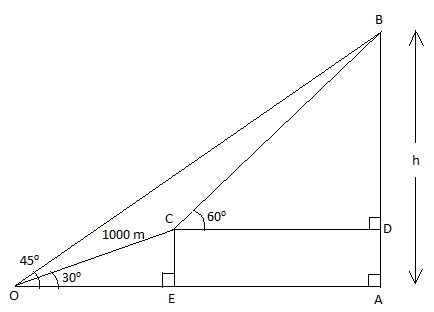
After climbing 1000 m upwards in a slope of \[{{30}^{\circ }}\], the elevation becomes \[{{60}^{\circ }}\].
The elevation from the foot of the mountain is \[{{45}^{\circ }}\].
From the figure, let us first consider the \[\Delta OCE.\]
\[\sin {{30}^{\circ }}=\dfrac{Opposite\text{ }side}{Adjacent\text{ }side}=\dfrac{CE}{OC}.\]
From the trigonometric table, we know that \[\sin {{30}^{\circ }}=\dfrac{1}{2}\].
We have been given OC = 1000. Let us find CE.
\[\therefore \sin {{30}^{\circ }}=\dfrac{CE}{OC}\]
\[\Rightarrow \dfrac{1}{2}=\dfrac{CE}{1000}\] [Cross multiply and find CE]
\[CE=\dfrac{1000}{2}=500m\]
From the figure we can say that CE = AD as they are parallel.
\[\therefore CE=AD=500m\]
Now, \[\cos {{30}^{\circ }}=\dfrac{Adjacent\text{ }side}{Hypotenuse}=\dfrac{OE}{OC}\]
From the trigonometric table, we know that \[\cos {{30}^{\circ }}=\dfrac{\sqrt{3}}{2}\].
\[\therefore \dfrac{\sqrt{3}}{2}=\dfrac{OE}{1000}\] [Cross multiply and find OE]
\[\therefore OE=\dfrac{1000\sqrt{3}}{2}=500\sqrt{3}m\].
Now let us consider \[\Delta AOB\].
\[\tan {{45}^{\circ }}=\dfrac{Opposite\text{ }side}{Adjacent\text{ }side}=\dfrac{AB}{OA}.\]
From the trigonometric table, we know that \[\tan {{45}^{\circ }}=1\].
\[\begin{align}
& \therefore 1=\dfrac{AB}{OA} \\
& \Rightarrow AB=OA=h \\
\end{align}\]
From the figure, we can say that CD = EA.
We know that OA = OE + AE
\[\begin{align}
& \therefore AE=OA-OE=h=500\sqrt{3} \\
& \therefore AB=OA=h,OE=500\sqrt{3} \\
& \therefore CD=AE=h-500\sqrt{3} \\
\end{align}\]
From the figure,
\[\begin{align}
& AB=BD+AD \\
& BD=AB-AD \\
\end{align}\] \[\therefore AD=500m\]
\[BD=\left( h-500 \right)m\]
Now let us consider \[\Delta BCD\].
\[\tan {{60}^{\circ }}=\dfrac{Opposite\text{ }side}{Adjacent\text{ }side}=\dfrac{BD}{CD}\] \[\left[ From\text{ }trigonometric\text{ }table,tan{{60}^{\circ }}=\sqrt{3} \right]\]
\[\sqrt{3}=\dfrac{h-500}{h-500\sqrt{3}}\]
Cross multiply and simplify it.
\[\begin{align}
& \sqrt{3}\left( h-500\sqrt{3} \right)=h-500 \\
& h\sqrt{3}-\left( 500\times 3 \right)=h-500 \\
& h\sqrt{3}-1500=h-500 \\
& \Rightarrow h\sqrt{3}-h=1500-500 \\
& \therefore n\left( \sqrt{3}-1 \right)=1000 \\
& \therefore h=\dfrac{1000}{\sqrt{3}-1} \\
\end{align}\]
Let us rationalize the above value by multiplying and dividing it with \[\left( \sqrt{3}+1 \right)\].
\[\therefore h=\dfrac{1000\left( \sqrt{3}+1 \right)}{\left( \sqrt{3}-1 \right)\left( \sqrt{3}+1 \right)}\] \[\because \left( a+b \right)\left( a-b \right)={{a}^{2}}-{{b}^{2}}\]
\[\begin{align}
& =\dfrac{1000\left( \sqrt{3}+1 \right)}{3-1}=\dfrac{1000\left( \sqrt{3}+1 \right)}{2} \\
& \therefore h=500\left( \sqrt{3}+1 \right)m \\
\end{align}\]
Thus we got the height of the mountain as \[500\left( \sqrt{3}+1 \right)m\].
Note: We have used basic trigonometric identities, thus you should remember the trigonometric table to solve the same. After finding the value of x, i.e. height of the mountain, don’t forget to rationalize it.
Complete step-by-step answer:
Let AB be the height of the mountain from the ground. Let O be the foot of the mountain.
After climbing 1000 m upwards in a slope of \[{{30}^{\circ }}\], the elevation becomes \[{{60}^{\circ }}\].
The elevation from the foot of the mountain is \[{{45}^{\circ }}\].
From the figure, let us first consider the \[\Delta OCE.\]
\[\sin {{30}^{\circ }}=\dfrac{Opposite\text{ }side}{Adjacent\text{ }side}=\dfrac{CE}{OC}.\]
From the trigonometric table, we know that \[\sin {{30}^{\circ }}=\dfrac{1}{2}\].
We have been given OC = 1000. Let us find CE.
\[\therefore \sin {{30}^{\circ }}=\dfrac{CE}{OC}\]
\[\Rightarrow \dfrac{1}{2}=\dfrac{CE}{1000}\] [Cross multiply and find CE]
\[CE=\dfrac{1000}{2}=500m\]
From the figure we can say that CE = AD as they are parallel.
\[\therefore CE=AD=500m\]
Now, \[\cos {{30}^{\circ }}=\dfrac{Adjacent\text{ }side}{Hypotenuse}=\dfrac{OE}{OC}\]
From the trigonometric table, we know that \[\cos {{30}^{\circ }}=\dfrac{\sqrt{3}}{2}\].
\[\therefore \dfrac{\sqrt{3}}{2}=\dfrac{OE}{1000}\] [Cross multiply and find OE]
\[\therefore OE=\dfrac{1000\sqrt{3}}{2}=500\sqrt{3}m\].
Now let us consider \[\Delta AOB\].
\[\tan {{45}^{\circ }}=\dfrac{Opposite\text{ }side}{Adjacent\text{ }side}=\dfrac{AB}{OA}.\]
From the trigonometric table, we know that \[\tan {{45}^{\circ }}=1\].
\[\begin{align}
& \therefore 1=\dfrac{AB}{OA} \\
& \Rightarrow AB=OA=h \\
\end{align}\]
From the figure, we can say that CD = EA.
We know that OA = OE + AE
\[\begin{align}
& \therefore AE=OA-OE=h=500\sqrt{3} \\
& \therefore AB=OA=h,OE=500\sqrt{3} \\
& \therefore CD=AE=h-500\sqrt{3} \\
\end{align}\]
From the figure,
\[\begin{align}
& AB=BD+AD \\
& BD=AB-AD \\
\end{align}\] \[\therefore AD=500m\]
\[BD=\left( h-500 \right)m\]
Now let us consider \[\Delta BCD\].
\[\tan {{60}^{\circ }}=\dfrac{Opposite\text{ }side}{Adjacent\text{ }side}=\dfrac{BD}{CD}\] \[\left[ From\text{ }trigonometric\text{ }table,tan{{60}^{\circ }}=\sqrt{3} \right]\]
\[\sqrt{3}=\dfrac{h-500}{h-500\sqrt{3}}\]
Cross multiply and simplify it.
\[\begin{align}
& \sqrt{3}\left( h-500\sqrt{3} \right)=h-500 \\
& h\sqrt{3}-\left( 500\times 3 \right)=h-500 \\
& h\sqrt{3}-1500=h-500 \\
& \Rightarrow h\sqrt{3}-h=1500-500 \\
& \therefore n\left( \sqrt{3}-1 \right)=1000 \\
& \therefore h=\dfrac{1000}{\sqrt{3}-1} \\
\end{align}\]
Let us rationalize the above value by multiplying and dividing it with \[\left( \sqrt{3}+1 \right)\].
\[\therefore h=\dfrac{1000\left( \sqrt{3}+1 \right)}{\left( \sqrt{3}-1 \right)\left( \sqrt{3}+1 \right)}\] \[\because \left( a+b \right)\left( a-b \right)={{a}^{2}}-{{b}^{2}}\]
\[\begin{align}
& =\dfrac{1000\left( \sqrt{3}+1 \right)}{3-1}=\dfrac{1000\left( \sqrt{3}+1 \right)}{2} \\
& \therefore h=500\left( \sqrt{3}+1 \right)m \\
\end{align}\]
Thus we got the height of the mountain as \[500\left( \sqrt{3}+1 \right)m\].
Note: We have used basic trigonometric identities, thus you should remember the trigonometric table to solve the same. After finding the value of x, i.e. height of the mountain, don’t forget to rationalize it.
Recently Updated Pages
Master Class 10 Computer Science: Engaging Questions & Answers for Success

Master Class 10 General Knowledge: Engaging Questions & Answers for Success
Master Class 10 English: Engaging Questions & Answers for Success
Master Class 10 Social Science: Engaging Questions & Answers for Success
Master Class 10 Maths: Engaging Questions & Answers for Success
Master Class 10 Science: Engaging Questions & Answers for Success
Trending doubts
What is the median of the first 10 natural numbers class 10 maths CBSE
Which women's tennis player has 24 Grand Slam singles titles?
Who is the Brand Ambassador of Incredible India?
Why is there a time difference of about 5 hours between class 10 social science CBSE
Write a letter to the principal requesting him to grant class 10 english CBSE
A moving boat is observed from the top of a 150 m high class 10 maths CBSE